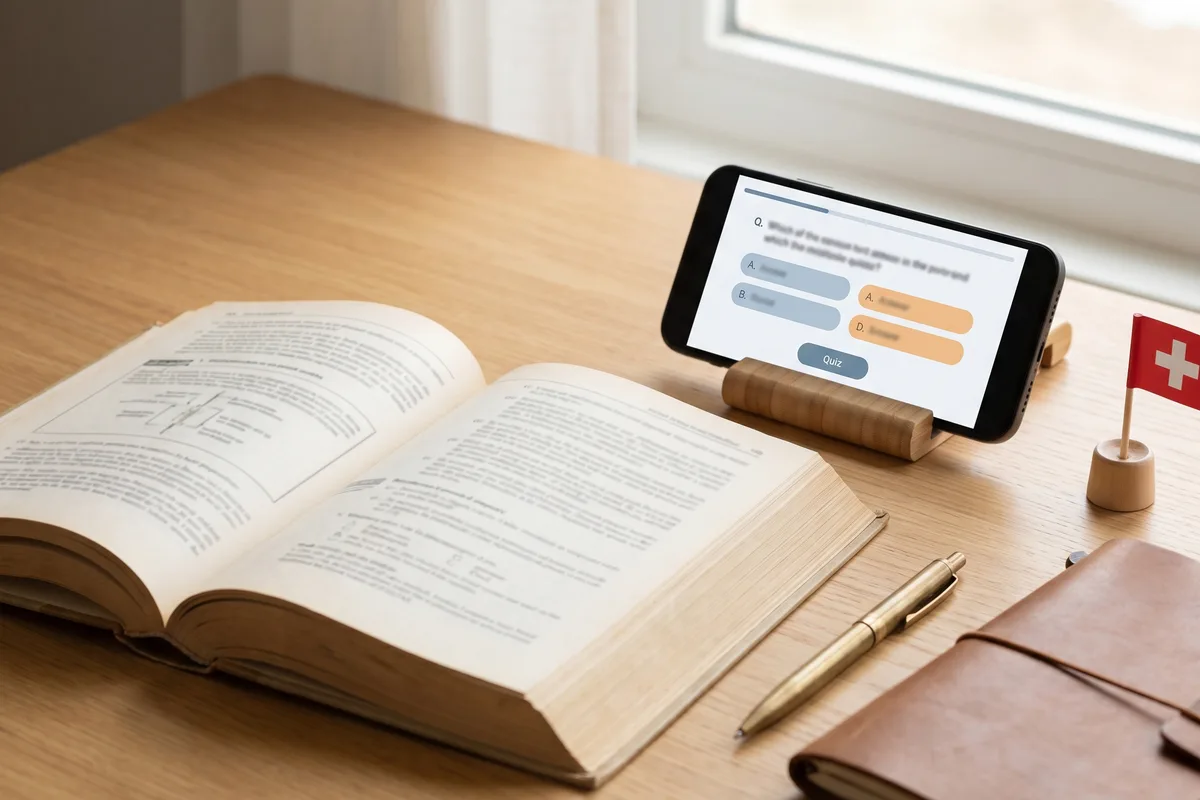
Book or App – the Wrong Question?
"Should I buy a book or an app for the Swiss citizenship test?" is one of the most common questions candidates ask – and it is slightly the wrong question. A book and an app are not really competitors. They are tools built for two different jobs, and the smart move is to understand which job each one does best before you decide.
Think about how you actually learn for an exam. There are two distinct phases. First you have to understand the material: how Swiss direct democracy works, why 1848 matters, how your canton is governed, what the rights and duties of a citizen are. This is reading and comprehension work – you sit down, follow a logical order, and build a mental map of the subject. Second, you have to drill that knowledge until you can recall it under pressure: answering exam-style questions over and over, spotting your weak topics, and simulating the real test with a timer.
A book – specifically a structured handbook – is the better tool for the first job. It gives you a complete, ordered reference you can read offline and front to back, so you genuinely understand the why behind each answer. An app is the better tool for the second job. It turns the material into hundreds of questions you can drill anywhere, tracks your progress, and tells you when you are ready.
So the honest answer to "book or app" is usually: both, in that order – understand with the book, drill with the app. But budgets and time are real, so the rest of this guide explains exactly what each one is best at, how to combine them, and – if you truly can only pick one – which to choose. If you want the wider landscape of every study option first, read our study-material comparison.
What the Book Is Better For
A good handbook does something an app cannot: it lets you sit down, switch off notifications, and actually understand the country you are about to become a citizen of. For deep, structured learning, paper or a clean PDF still wins.
Here is where the book is the stronger tool:
- Understanding the why, not just the answer – a written chapter can take three pages to explain how a popular initiative becomes a referendum, why Switzerland has seven Federal Councillors, or how your canton joined the Confederation. You finish understanding the topic, not just memorizing which letter is correct. That deeper understanding is exactly what protects you when the exam asks a question in wording you have never seen.
- A structured, complete reference you read front to back – our handbook, "Das vollständige Handbuch", is 300+ pages organized as a full civics curriculum: 15 chapters and 44 lessons covering politics, direct democracy, history, geography, languages, rights and duties, the economy and the social and education systems, plus a glossary. There is a clear order, so you are never wondering what to study next.
- Distraction-free, offline, anywhere – no signal, no battery anxiety, no app pulling you toward other notifications. You can read on a train through a tunnel, in a waiting room, or in the garden. As a PDF and EPUB it reads cleanly on a phone, tablet or e-reader – and it is genuinely print-friendly if you prefer paper and a highlighter.
- A reference you own forever – one purchase, no subscription, no DRM, and lifetime free updates when content changes. It is yours to keep and re-read long after exam day.
- All 26 cantons in one place – you are not hunting for a separate brochure for your location; the cantonal material sits in the same reference as the federal content.
The handbook covers all of this for CHF 19.90 as a one-time purchase. If you want the full breakdown of what is inside, our handbook page lays it out chapter by chapter.
What the App Is Better For
Once you understand the material, you have to make it stick – and that is where the app pulls ahead. Reading a chapter teaches you a topic; answering 50 questions on it is what turns that knowledge into fast, reliable recall on exam day. The app is built for active recall, and active recall is what passes tests.
Here is where the app is the stronger tool:
- Drilling, anywhere, in small bursts – the app holds 1'700+ exam-style questions across all 26 cantons and 227 lessons. You can answer ten on the tram, five in a queue, twenty over a coffee. Those minutes add up far faster than waiting for a free evening with the book.
- Spaced-repetition flashcards – the app schedules facts you keep getting wrong to come back at exactly the right moment, so names, dates and cantonal details actually move into long-term memory instead of slipping away.
- Mock exams with a timer – a 20-question, 60-minute mock mirrors the real test format, so you practise pacing and walk in calm rather than surprised by the clock.
- Analytics with pass-prediction – instead of guessing whether you are ready, the app estimates your readiness, shows your accuracy trend, and maps your weak topics so every session targets what actually needs work.
- Four languages with a side-by-side mode – German, English, French and Italian, with a bilingual view that shows two languages at once: ideal if you are learning the German terminology while leaning on your own language.
The app is a separate product from the book, priced at CHF 29.90 as a one-time lifetime purchase, and there is a free tier so you can try it first – the first 2 chapters and 50 questions, no payment needed. That free tier is the easiest way to feel the difference between reading about a topic and being tested on it. If you want to see the app plans in detail:
Avoid Costly Retakes
View pricingThe Best Combination: How to Use Both Together
If you can use both, you get the best of each – and the workflow is simple. The principle is one line: read to understand, then drill to remember. Here is how that looks in practice, topic by topic.
- Read the chapter in the book first. Take one topic at a time – say, direct democracy. Read the handbook chapter in a quiet, offline session until the why clicks: how an initiative differs from a referendum, why the timelines exist, who votes on what. Do not rush to questions yet; the goal of this step is genuine understanding.
- Immediately drill that same topic in the app. While it is fresh, answer the app's questions on direct democracy. This is where understanding turns into recall, and where you discover the small gaps the reading glossed over. The explanations on each question reinforce what the book just taught you.
- Let spaced repetition mop up the leftovers. Star the facts you missed and let the flashcards bring them back over the following days. You read once, then the app makes sure it sticks without you having to re-read everything.
- Move topic by topic, then switch to whole-exam mode. Repeat read-then-drill through the curriculum. In the final two weeks, shift the app into full mock-exam mode with the timer to rehearse the real thing, and use the book only to look up anything the mocks reveal you are still shaky on.
This is exactly the rhythm our 8-week study plan is built around: the book as the backbone that gives each week its reading, the app as the daily drill that proves you have learned it. The two are not redundant – the book stops you from blindly memorizing answers, and the app stops your reading from staying passive. Together they cover both halves of how an exam is actually passed.
If You Can Only Pick One
Combining both is ideal, but plenty of people just want one purchase. Here is the honest guidance, without dressing it up.
Choose the book if you want one complete, offline reference and you want to truly understand the material – not just pattern-match answers. This fits you if you are starting more or less from scratch, if you learn best by reading in a logical order, if you like owning a permanent reference you can re-read and print, or if you simply prefer studying away from a screen and its notifications. The handbook also already contains 525 explained practice questions across all 26 cantons, so even on its own it is not only reading – you can read a chapter and then test yourself on it. For most candidates, and especially beginners, the book is the better single choice because understanding is the foundation everything else is built on.
Choose the app if your main need is drilling and tracking. This fits you if you already broadly understand Swiss civics and mostly need volume – hundreds of reps, spaced repetition and timed mocks to convert what you know into confident recall – or if you mainly study in short bursts on your phone and want analytics telling you when you are ready. The app is the stronger practice engine, so if practice is the gap you are filling, it is the right pick.
The deciding question is simple: do you mostly need to understand the material, or mostly need to drill it? Understanding is the foundation, and a book is unbeatable for building it – so if you are unsure, start with the book. You can always add the app later when you move from learning into pure practice.
Everything in one book
See the handbookConclusion: What to Buy First
Book or app is not a battle with a single winner – they are two halves of a good preparation. The book is for understanding the material deeply and offline; the app is for drilling it, tracking your progress and simulating the exam. Used together, they cover everything: the book stops you memorizing blindly, the app stops your reading from staying passive.
If you are doing both, the order matters: buy the book first. Understanding is the foundation, and it is far more effective to drill questions in the app once you actually grasp the why than to grind through questions on material you have not yet learned. Read the handbook to build the map, then let the app burn it into memory. That sequence – book first, app second – is what our 8-week study plan follows, and it is the most reliable path to passing on the first attempt.
If you can only buy one, the book is the safer single choice for most candidates: it is a complete, offline, lifetime reference that already includes 525 explained practice questions across all 26 cantons, for CHF 19.90 with no subscription. It builds the understanding everything else depends on – and you can always add the app later when you shift into pure practice mode.
For the bigger picture on how to structure the weeks ahead, our preparation guide ties it all together. But the first step is the simplest one: get the reference you will build everything else around.
Everything in one book
See the handbook