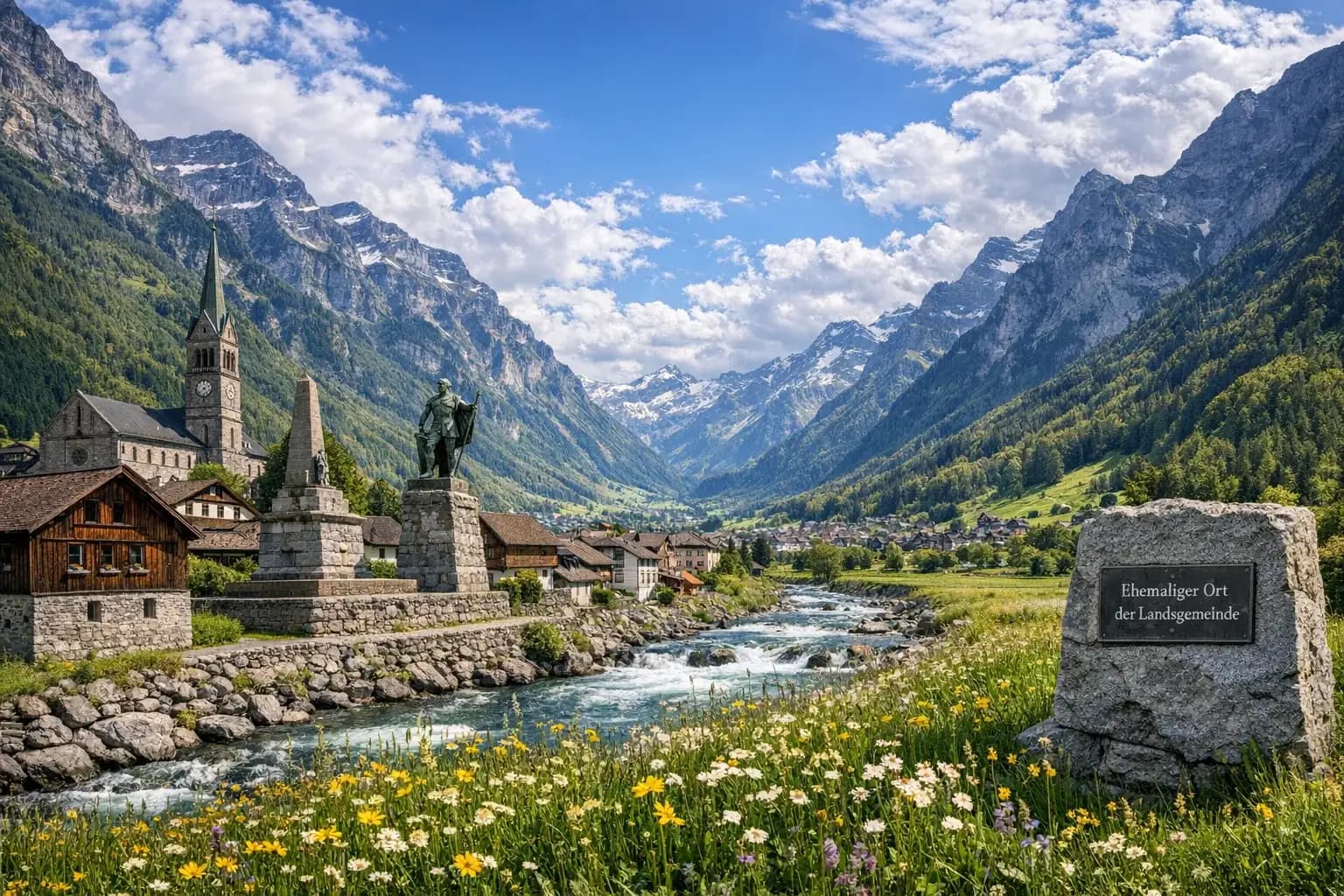
Two Hurdles: the KBS Exam, Then the Commune's Interview
Glarus is one of the cantons where the test comes before the application. The cantonal citizenship act of 2016 lets the authorities demand proof of a passed integration or naturalisation course, and the ordinance makes that proof a required attachment: a certificate, no more than four years old, of having passed the exam of the cantonal preparation course. Glarus Nord puts it plainly on its page: the exam is mandatory before filing, and so is the information evening that precedes it. Both are run by the Kaufmännische Berufsfachschule Glarus (KBS) on the canton's behalf, and the exam is oral.
The second hurdle comes after the canton's preliminary examination. Your commune's naturalisation authority may hold a naturalisation interview before deciding, and in practice all three communes do. The ordinance ties the interview to the course: the authority must tell you beforehand how it will run and what it covers, and must follow either the content of the preparation course or a standardised question catalogue.
The cantonal part of both hurdles is what our Glarus questions rehearse; the communal part you build yourself from your commune's website.
Ten, Five and Three Years, and the Rules of the 2016 Act
The residence rules are the federal ten years in Switzerland, three of them in the last five, with the years between ages 8 and 18 counting double and six years of actual presence, plus the cantonal five years in Glarus, of which the last three must be uninterrupted in the commune where you apply. A C permit is required at filing. One Glarus particularity concerns moving: within Switzerland you may only move once communal citizenship has been assured to you, and a move abroad ends the procedure in every case.
Language is German at B1 in reading, speaking and listening and A2 in writing, in standard German. Native speakers, people with five years of compulsory school in German and holders of an upper-secondary or tertiary qualification in German need no certificate; everyone else does, and the authority may order a recognised language test if it has justified doubts. Glarus Nord calls the language proof the first step for a practical reason: you have to be able to follow the course and the exam.
The ordinance is specific about money and conduct. For the five years before the application and until the procedure ends, the debt register may show no loss certificates and no enforcement by public bodies or for unpaid health-insurance premiums; taxes must be paid and judgments respected. No social assistance, and no unemployment benefits for self-inflicted unemployment, in the three years before filing and during the procedure, unless repaid in full. And no criminal-record entry or pending proceedings, which the canton checks again just before it applies to the Confederation.
The KBS Exam: Dates, Fees and What It Covers
Everything runs through the Kaufmännische Berufsfachschule at Zaunplatz 36 in Glarus. Step one is the mandatory information evening, CHF 30, held in January, March or September; the next one listed is Tuesday 23 March 2027 from 6.30 to 8.30 p.m. Without it you can book neither the course nor the exam. Step two is your choice. The preparation course costs CHF 250 plus CHF 25 for materials, runs on six Tuesday evenings from 20 April to 25 May 2027, covers school, work and insurance, health, rights and duties, the political system and the canton, and ends with the oral exam on 1 or 2 June 2027. If you prefer to study on your own, you register for the exam alone: CHF 100, twice a year in March and October, next on Thursday 21 October 2027, with a limited number of places allocated as payments arrive.
The exam itself tests history, geography, culture, civics, political rights and duties and social insurance, each for Switzerland, for Canton Glarus and for your commune of residence. Pass it and you receive a certificate valid for four years, the document your commune needs before it can take up your application. Fail it and the school's pages say nothing about waiting periods, only that the next dates are in March and October.
For reading, the canton's own leaflet recommends two titles: the HEKS series "ECHO – Informationen zur Schweiz" and "Die Schweiz verstehen" from hep publishers, which also comes as a free app.
Test Your Knowledge
Try 5 free questionsThree Communes, Three Practices, One Fee Ceiling
Since 2011 the canton has only three communes, and each organises the communal stage in its own way. In Glarus the Einbürgerungsrat, a seven-member body separate from the Gemeinderat, decides on communal citizenship on the basis of files prepared by the administration; the fee is a flat CHF 2,100 per adult and CHF 4,200 per married couple, payable before filing, half of which is forfeited if you withdraw before the interview and all of which is lost on a negative decision. In Glarus Nord the Einbürgerungskommission, made up of the commune president, a councillor and three party representatives, conducts the interviews and grants or refuses citizenship; the fee is CHF 1,500 to 2,100 per person according to effort, with a CHF 500 deposit when the application arrives. In Glarus Süd a 30-minute preliminary talk at the Departement Gesellschaft und Sicherheit in Schwanden opens the file, the Einbürgerungskommission later holds an interview of about an hour on German, basic political and social knowledge, integration and working life, and the Gemeinderat admits you; the fee is CHF 2,100 per person, paid before filing.
The ceiling for all three is set by the cantonal ordinance at CHF 2,100 per person. The canton's own fee is at most CHF 1,000 per application, raised by half to CHF 1,500 when a file causes exceptionally high effort, typically many family members. The Confederation charges CHF 100 per adult, CHF 150 for a married couple and CHF 50 for a minor applying alone. Included minor children are free at every level. Add the KBS: CHF 30 for the information evening and either CHF 100 for the exam or CHF 275 for course and materials.
Avoid Costly Retakes
View pricingPreparing: Landsgemeinde, Landrat and Näfels
The cantonal layer of the exam and the interview is where preparation pays off, and the constitution supplies the hard facts. The ordinary Landsgemeinde meets on the first Sunday of May in Glarus; all Swiss residents from age 16 may vote in cantonal and communal matters, one of only two such rules in Switzerland; the Landsgemeinde elects the Landammann and the Landesstatthalter as well as the court presidents and judges, while the Landrat, the cantonal parliament of 60 members, and the Regierungsrat of five full-time members are elected at the ballot box. Since 1 January 2011 the canton consists of three unified communes, Glarus Nord, Glarus and Glarus Süd, each combining the former Ortsgemeinde, Schulgemeinde and Tagwen.
History and geography follow in our 35 Glarus questions: the accession to the Confederation in 1352, the same year as Zug; the Battle of Näfels in 1388 and the annual Näfelser Fahrt; Zwingli's years as priest in Glarus; the great fire of 1861 fanned by the Föhn and the grid-plan rebuilding of the town; the Tödi as the highest peak; the Klöntalersee; the Glarus thrust in the UNESCO World Heritage Tectonic Arena Sardona; Schabziger, the green herb cheese; and the textile-printing past.
The communal layer is yours to assemble: the name of your Gemeindepräsident, how your commune's assembly or parliament works, the neighbouring villages, the local associations and festivals. Rehearse everything aloud, because both the KBS exam and the commune's interview are spoken, not written.
Practice Anywhere
Download iOS AppAfter the Interview: Canton, SEM and Regierungsrat
The order of authorities in Glarus is fixed by the act. You file with your commune, which forwards the complete file to the Zivilstands- und Bürgerrechtsdienst at Postgasse 29 for the preliminary examination; the service gathers information from authorities and third parties, demands missing papers under threat of default and draws up the enquiry report, or issues a negative decision if an obstacle cannot be removed within about a year. The result goes back to the commune, which interviews you and decides, notifying the decision together with the fee ruling; a refusal can be appealed to the Regierungsrat within 30 days.
Then the canton takes over again. It checks the criminal record and pending proceedings once more, sends the file with the cantonal assurance to the State Secretariat for Migration, and once the federal authorisation arrives the Regierungsrat grants cantonal citizenship, subject to new facts. The act is explicit that communal and Swiss citizenship are acquired only at that moment, and that the cantonal fee must be deposited with the state treasury beforehand.
Glarus Süd puts the whole journey at about one and a half to two years and adds a warning worth taking seriously: during that time there must be no incidents or penalties. Report every change of address, civil status, employment or finances at once, because the ordinance makes that a duty and the enquiry report is updated until the end.