Two interviews instead of a test: the criminal police and the commune
Nidwalden is one of the cantons without a written naturalisation test. What is examined here is set out in article 7 of the cantonal citizenship act as in force since 1 January 2026: you must be "familiar with Swiss, cantonal and communal living conditions, customs and traditions", respect public security and order, and be able to express yourself in everyday German, spoken and written. How this is checked is described in the canton's leaflet on the enquiry and naturalisation interview as a two-stage procedure.
The first stage belongs to the Nidwalden criminal police. On behalf of the civil registry and citizenship office it clarifies whether you meet the naturalisation requirements, invites you to an interview and records the result in the enquiry report under article 17 of the federal citizenship ordinance. The focus is on public security and order, respect for the Federal Constitution and participation in economic life.
The second stage is the naturalisation interview of your commune of residence. Under section 6 of the cantonal citizenship ordinance it checks whether you are familiar with Swiss living conditions "in social, cultural, political and civic terms" and have basic knowledge of geography and history, relying on the interview, your CV, information from current or former employers and further references, for instance from teachers. The canton publishes no question catalogue. The cantonal part of what the communes want to hear is what our Nidwalden questions practise.
Requirements: ten years in Switzerland, five in canton and commune, German B2
Formally, Nidwalden requires a C settlement permit when you file and ten years of residence in Switzerland, of which, under article 6 of the cantonal act, the five years immediately before the application must be spent without interruption in the canton and in the same commune. The years between your 8th and 18th birthdays count double for Switzerland and the canton but not for the commune, and you must have actually been present for at least six years. Time on a B or C permit counts in full, temporary admission F counts half, short-stay L and asylum N permits do not count at all.
Materially the bar is higher than in federal law. Section 3 of the ordinance demands German at B2 in speaking, comprehension and reading and B1 in writing, proven with the certificate of a language institution recognised by the Justice and Security Directorate, at your own expense. You are exempt if German is your mother tongue, if you attended at least six years of compulsory school, completed an apprenticeship or a degree in German, or if you are a child included in your parents' application. Without a proof, or with an insufficient one, the office does not consider the application.
The office also refuses to consider applications when the VOSTRA criminal register shows adult-law entries in the ten years before filing, juvenile-law entries in the five years before, or pending criminal proceedings. In addition you declare that you have not committed anything abroad that would lead to an entry in Switzerland. Section 5 of the ordinance adds the five-year rules: no economic social assistance and no asylum welfare, no benefits for self-inflicted unemployment, no bankruptcy, no loss certificates and no settled debt-enforcement proceedings by public bodies or health insurers in the five years before filing and during the procedure, no open enforcement, no taxes due. If you move away before the material examination is complete, canton and commune lose jurisdiction and you file again at the new address; if you lose the C permit, the application is written off at your cost.
The commune's interview: who hears you and how to prepare
Who hears you is decided by your commune. Since 1 January 2026 the act leaves the assurance of communal citizenship to the Gemeinderat, which may delegate it in the communal regulations to a naturalisation commission it elects, with at least five members, one of whom must sit on the Gemeinderat. In Stans the naturalisation commission at Stansstaderstrasse 18 clarifies for the Gemeinderat whether the legal requirements are met. Until the revision, voters sometimes still decided themselves: in Hergiswil the naturalisation applications were item 3 on the agenda of the spring communal assembly of 21 May 2024. Ask your communal chancellery who is responsible today and how the interview runs.
For the content, the cantonal leaflet gives you a reading list rather than a question catalogue: the federal brochure "Der Bund kurz erklärt" and the "CH info" app, the Canton of Lucerne's questionnaire "Kenntnisse der Schweiz – 100 Fragen und Antworten" with model answers, the canton's portrait on nw.ch, the City of Zurich's information brochure on the naturalisation interview, and ch.ch. At the same time it warns that these sources do not necessarily cover "the canton- and commune-specific particularities of politics, society and culture, geography and history" and that you must inform yourself about them on your own, for instance with the "Kleine Staatskunde" booklet handed out to you. Expect your CV and your workplace to come up, because the ordinance names both explicitly as a basis of the examination.
Test Your Knowledge
Try 5 free questionsFees: the cantonal tariff for commune and canton, plus the Confederation
Unlike in many cantons, in Nidwalden each commune does not set its own fee. Tariff 1.1.1 of the ordinance to the act on official costs, as of 1 January 2025, gives ranges for both levels for the naturalisation of foreign nationals. Adult applying alone: CHF 1,400 to 1,600 for the commune and CHF 1,000 to 1,500 for the canton. Minor applying alone: CHF 1,060 to 1,260 and CHF 800 to 1,300. Married couple: CHF 2,100 to 2,300 and CHF 1,300 to 1,800. Minor naturalised together with a parent: CHF 340 to 540 and CHF 200 to 400. For an adult applying alone that makes CHF 2,400 to 3,100 for commune and canton together.
On top comes the federal fee under article 25 of the citizenship ordinance: CHF 100 per adult, CHF 150 for spouses filing jointly, CHF 50 for a minor filing alone. If the procedure ends early, for instance through a negative decision of the commune or the Confederation or through withdrawal, the tariff sets an appropriately reduced fee in the amount of the work done so far. Under article 35 of the act, canton and communes may demand an advance on costs. Not included in the tariff is the language certificate, which you provide at your own expense under article 9. Against the fee itself the cost appeal under the fee legislation remains open even when the decision is positive. As of 6 September 2026.
Avoid Costly Retakes
View pricingCantonal knowledge for the interview: Landsgemeinde, Landrat, eleven communes
The communes ask about Nidwalden, and there is no official catalogue for it. Our 50 Nidwalden questions cover what the cantonal constitution, the canton's portrait and its history offer. Politics: Nidwalden abolished its Landsgemeinde in 1996; since the constitutional revision of 1 December 1996 voters exercise their voting and electoral rights at the ballot box in the political communes. Under article 57 the Landrat, the cantonal parliament, has sixty members; under article 62a the Regierungsrat, the government, has seven. Under article 49 Stans is the capital and the seat of the cantonal authorities. In the Council of States Nidwalden has one seat under article 150 of the Federal Constitution, like Obwalden, the two Basel and the two Appenzell.
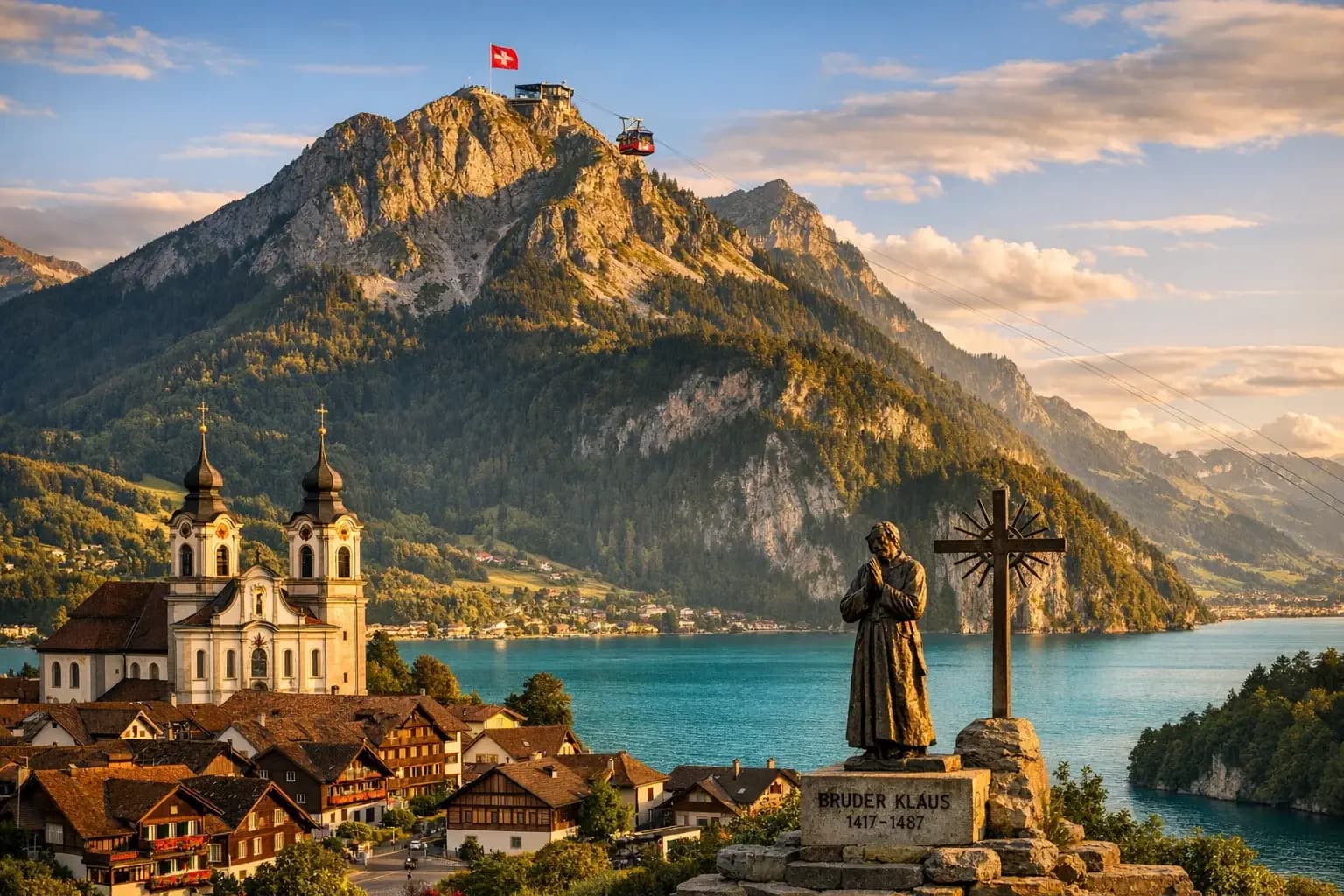
Geography: eleven communes on 276 square kilometres with around 45,200 inhabitants, from the foot of the Pilatus in Hergiswil up to the Jochpass on the Titlis on Wolfenschiessen ground, plus Lake Lucerne, the Stanserhorn with its Cabrio cable car and the Bürgenstock. Economy: the Pilatus aircraft works in Stans. History: Unterwalden as a founding member of 1291, the separation from Obwalden in the Act of Mediation of 1803, Morgarten 1315 and Sempach 1386 with Winkelried, the Sonderbund of 1847.
For the federal part of the interview take the lessons on Swiss politics, history and geography and, as the leaflet recommends, "Der Bund kurz erklärt". Practise out loud: both interviews in Nidwalden are spoken, and under article 9 the naturalisation authority may demand a language proof even from an exempt applicant whose German turns out not to meet the requirements.
Practice Anywhere
Download iOS AppAfter the interview: assurances, SEM, Regierungsrat and the appeal
The procedure in the leaflet of 1 January 2026 has six stations. You file the official form "Gesuch um ordentliche Einbürgerung" with the enclosures under section 1 of the ordinance at the civil registry and citizenship office, Marktgasse 3 in Stans; the documents are available at the counter or by phone on 041 618 44 82, and the office compiles the list of enclosures for your situation. The office examines the application formally and materially and involves the cantonal police, the public prosecutor, the juvenile prosecutor and the migration office. Your commune of residence holds the naturalisation interview and assures or refuses communal citizenship; decisions go to the office within 20 days. The Justice and Security Directorate assures cantonal citizenship. The State Secretariat for Migration grants the federal naturalisation authorisation. The Regierungsrat grants cantonal citizenship, and once its decision becomes final you acquire communal, cantonal and Swiss citizenship in one go; under article 10 they cannot be acquired separately.
The commune's assurance is valid for two years and can be extended by one year by the Gemeinderat in justified cases. The canton gives no figure for the duration; its page and the commune of Stans write that, depending on the case, "a procedure lasting several years" is to be expected. During the procedure you report to the office without delay any change of civil status, family status, name or address, as well as debt enforcement, social assistance or criminal proceedings; criminal proceedings suspend your procedure until they are finally closed, and every included person must meet the requirements for their age until the end, otherwise they are removed and the others continue alone. Children born during the procedure are included.
Under article 33 an appeal is admissible only against negative decisions, under the administrative procedure act; a naturalisation obtained with false statements can be declared void by the Regierungsrat. Switzerland lets you keep your previous nationality; whether your country of origin does too is something the leaflet advises you to clarify beforehand with its embassy.