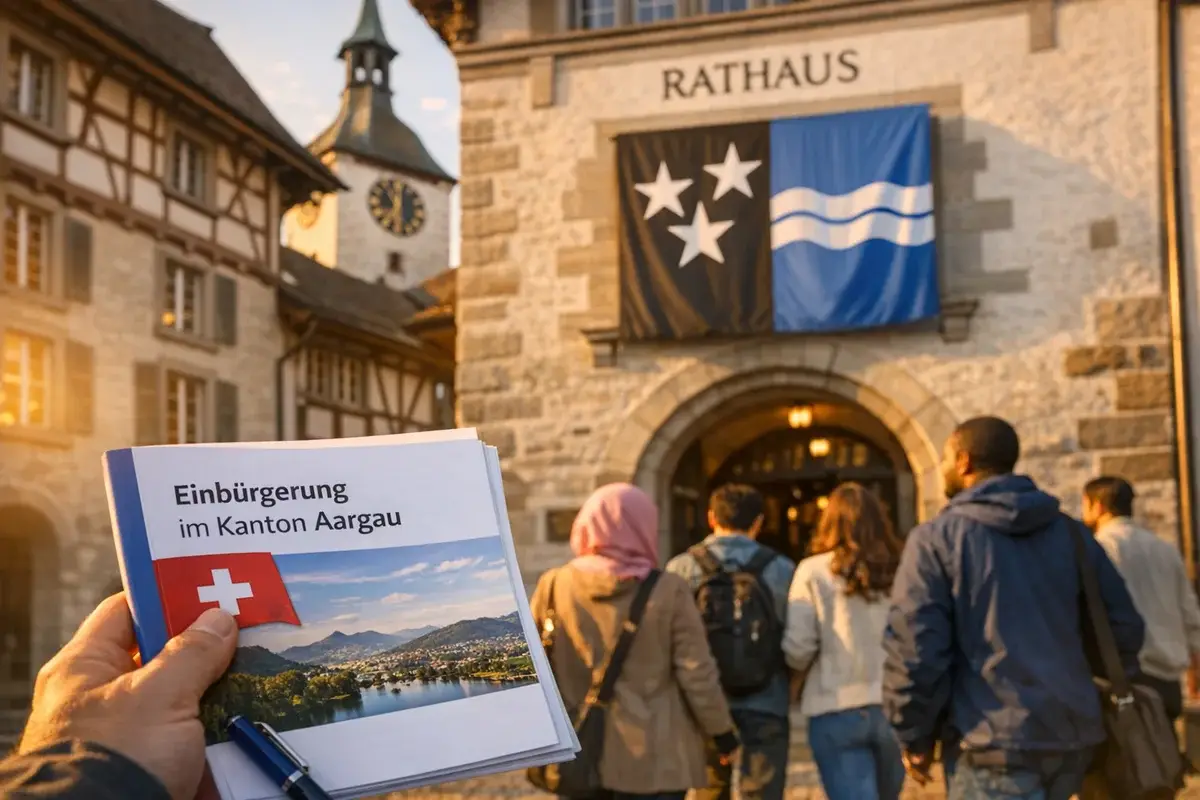
The Civic Test in the Canton of Aargau
To become Swiss in the Canton of Aargau you first pass the cantonal civic test, the staatsbürgerlicher Test. It is the entry ticket: without the certificate of a passed test the commune does not accept your application. The test is the same across the canton, your commune runs it on a computer, and it asks about Switzerland and Aargau: democracy and federalism, the welfare state, the rule of law, history and civil society.
Aargau is strict about who takes it. Everyone who is 16 or older when the application is filed must pass it, and schooling in Switzerland does not exempt you; the handbook for communes rules out exemptions except for an impairment. Children under 16 take no test and are questioned in the naturalisation interview in a way suited to their age.
Who Can Apply?
The federal frame applies: a settlement permit C and 10 years of residence in Switzerland, 3 of them in the 5 years before the application. The years between 8 and 18 count double, with at least 6 actual years; B and C permits count fully, F half, L and N not at all.
Aargau adds five years in the canton and at least three uninterrupted years in the commune before filing. German is required at B1 spoken and A2 written; native speakers, anyone who attended compulsory school in German for at least five years and anyone with an upper secondary or tertiary qualification in German need no certificate, everyone else takes a test with a recognised provider.
Two more rules from the handbook: no social assistance in the ten years before the application or during the procedure, with the exceptions federal law allows for disability, illness, working poverty or care duties, and no debt enforcement by public bodies, social insurances or health insurers in the last three years.
What the Test Looks Like
The civic test in Aargau is a written test on a computer with 45 multiple-choice questions, four answers each, exactly one correct. You have 40 minutes, which cannot be extended, and you pass with 34 correct answers, three quarters. Since 2022 the software draws the 45 questions at random from about 330, always with 11 on democracy and federalism, 5 on the welfare state, 10 on the rule of law, 13 on history and 6 on civil society.
The questions cover the federation and the canton; anything about your own commune belongs to the interview. The test is in German. You take it at your commune, in an office of the administration or in a school computer room, under supervision. Communes may not run tests of their own or hand the test to private institutions, so there are no external test centres.
After passing, the commune prints a certificate with your result, signed by the supervisor. It is your attachment to the application and may not be older than six months when you file.
Registration and Costs
You register for the test with your commune, which tells you the dates at the initial consultation; many communes publish them online. Each sitting costs CHF 50, and you may repeat a failed test as often as you like, but only two months after the last sitting. Book the test early enough that you can file within six months of passing.
Avoid Costly Retakes
View pricingThe naturalisation fees come on top. The commune charges CHF 1,500 for a single applicant and CHF 750 for an included child from the age of ten, the canton CHF 750 and CHF 375, the federal government CHF 100 for a single applicant, CHF 150 for a married couple and CHF 50 for a minor applying alone. Children under ten pay nothing to the commune and the canton. For extraordinary effort the fee may be doubled, and both commune and canton may ask for an advance. Add the civil status document and the register extracts.
For its own part the canton says about twelve months; how long the commune takes depends on the commune, so ask at the initial consultation.
Preparation Tips
The canton publishes an official practice test at einbuergerungstest-aargau.ch, built from the same question pool; take it several times, because every run is a different selection. People with little computer experience can ask the communal administration to walk them through the test interface before the real sitting.
Start with the federal topics that carry most questions: the rule of law and the political system, direct democracy, the welfare state and Swiss history. Then Aargau: the Grosser Rat with 140 members, the Regierungsrat with five, the 1803 founding of the canton, the Habsburg and the Wasserschloss where the Aare, Reuss and Limmat meet. Our seven Aargau lessons with practice questions cover exactly these topics.
Test Your Knowledge
Try 5 free questionsAfter the Test
With the certificate, the civil status document and the other attachments you file the application with your commune; the attachments may not be older than three months. The commune may ask for an advance on costs, checks the file and publishes the application in its official gazette. The communal council then examines integration in depth, including social assistance, debt enforcement and the criminal record, and holds a naturalisation interview with you: a conversation about your life in the commune, its authorities, festivals and neighbours, not a quiz.
Depending on the commune, the communal assembly, the Einwohnerrat or the communal council decides on the promise of communal citizenship. The file then goes to the canton's Department of Economy and Interior, which obtains the federal permit from the State Secretariat for Migration (SEM). The naturalisation committee of the Grosser Rat grants cantonal citizenship finally, unless the parliament decides itself; this cantonal part normally takes about twelve months.
Failed the test? You may repeat it as often as necessary, two months apart, at CHF 50 a sitting. Ask your commune for the next dates.