What Does Naturalization Cost?
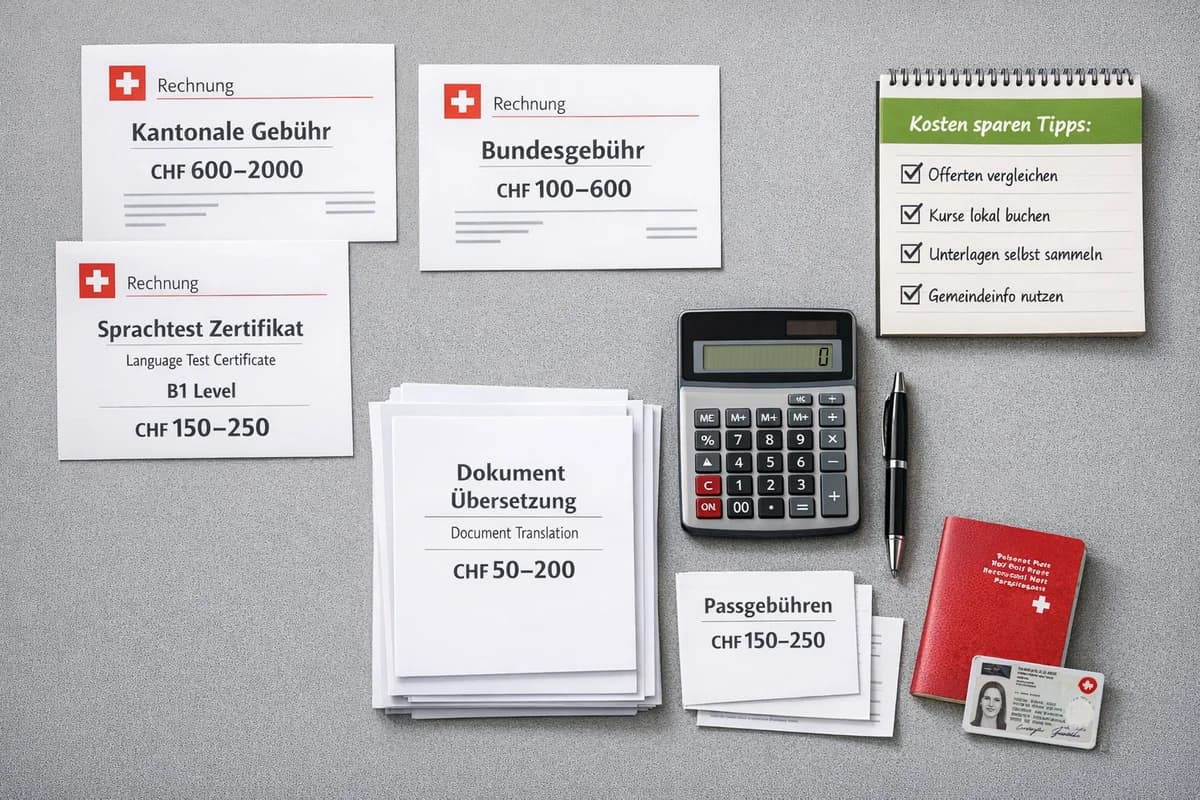
There's no single price tag for Swiss citizenship. The total cost depends on three levels of government — federal, cantonal, and municipal — and each one charges its own fee. On top of that, you'll likely spend money on language certificates, document translations, and possibly a citizenship test.
For a single adult, the total typically lands somewhere between CHF 1,000 and CHF 5,000. The range is huge because municipal fees vary wildly from one commune to the next. A couple applying together will pay more, but not double — some fees are per household, not per person.
The good news: all the fees are published and predictable. There are no hidden costs. You can calculate your total before you even start the application. You can also practice for the test online and learn about general requirements.
Act now: Some cantons are actively reducing fees (like Basel-Stadt eliminating them from mid-2026). Start your application soon to benefit from current favorable conditions or upcoming fee reductions.
Federal Fees
The federal level is the cheapest part. The State Secretariat for Migration (SEM) charges a flat fee that's the same everywhere in Switzerland.
For a single person: CHF 100. For a married couple applying together: CHF 150. For minors included in a parent's application: CHF 50 each. These fees haven't changed in years and are set by federal ordinance.
You pay this once your application reaches the federal level — usually toward the end of the process. It's a small fraction of the total cost, but it's good to know it's coming.
Cantonal Fees
Each canton sets its own naturalization fee. This is where the costs start to diverge.
Some examples: Zurich charges CHF 500 (CHF 250 for applicants under 25). Bern charges CHF 1,150 per adult. Aargau charges CHF 750. Geneva charges CHF 1,250 for adults over 25 (CHF 850 for under 25). Basel-Stadt abolishes its cantonal fee entirely from 1 July 2026: applicants under 25 then pay only the CHF 100 federal fee, while over-25s pay just the reduced municipal fee (about CHF 900 all-in in the city of Basel, down from CHF 1,750).
Most cantons publish their fee schedules online or will tell you on request. The cantonal fee is typically a flat amount per adult applicant, with reduced rates for young people and sometimes for families.
Fees are changing in several cantons right now. Always check with your cantonal Bürgerrechtsamt (citizenship office) for the current numbers before applying.
Municipal Fees – The Big Wildcard
The municipal fee is where the total cost can swing by thousands of francs. Every commune sets its own price, and the range is enormous.
Some municipalities charge as little as CHF 100. Others go above CHF 1,500. In most of the larger cities, expect CHF 400–800. Smaller communes can be cheaper or much more expensive — there's no pattern.
A few concrete examples: Zurich city charges around CHF 500 (recently reduced — it was CHF 1,200 before 2024). Stadt Bern charges CHF 400 per person. In Aargau, municipal fees are among the highest at CHF 1,500 per adult. In canton Vaud, municipalities are generally more moderate at CHF 100–400.
Before you apply, call your Gemeindeverwaltung (municipal administration) and ask for the exact fee. Some municipalities also charge additional fees for the interview or the Einbürgerungsgespräch. Better to know upfront.
Other Costs to Budget For
Beyond the official fees, there are several smaller costs that add up.
Language certificate: You need to prove your language skills (typically B1 speaking/listening, A2 reading/writing for German-speaking cantons). A fide-recognized test costs CHF 250–400 depending on the provider. If you already have a recognized certificate, you won't need a new one.
Citizenship test (GKT): In cantons that require it, like Zurich, the test itself may be free or cost around CHF 150–200 at an external provider. Not all cantons have a standardized test — some assess knowledge in the interview instead.
Avoid Costly Retakes
View pricingDocument procurement and translations: Birth certificates, criminal records, and other documents from your home country may need official translations. Budget CHF 50–150 per document. If you need an apostille, add more.
Passport photos and administrative extras: Minor but they exist. CHF 20–50 total.
All in, these additional costs usually run CHF 300–800 on top of the three government fees.
The Process Step by Step
Here's how the naturalization process works from start to finish — and when the fees come due.
First, you submit your application at the municipal level (Gemeindeamt). You'll need your documents, language certificate, and the municipal application fee. The municipality reviews your file, may invite you for an interview (Einbürgerungsgespräch), and checks your integration. In some cantons, you'll take a citizenship test at this stage.
Once the municipality approves, the file goes to the canton. The cantonal Bürgerrechtsamt reviews everything again and charges the cantonal fee. This step can take several months.
Finally, the file goes to the federal State Secretariat for Migration (SEM) for the last check. You pay the federal fee here. SEM confirms you meet all the requirements under federal law.
When all three levels have approved, you receive the Einbürgerungsurkunde (naturalization certificate) and an invitation to the citizenship ceremony. The whole process takes 1.5 to 3 years depending on the canton and municipality.
One practical tip: most fees are due when each level starts processing your file. So the costs are spread over time, not all at once. That said, budget for the total upfront so there are no surprises.