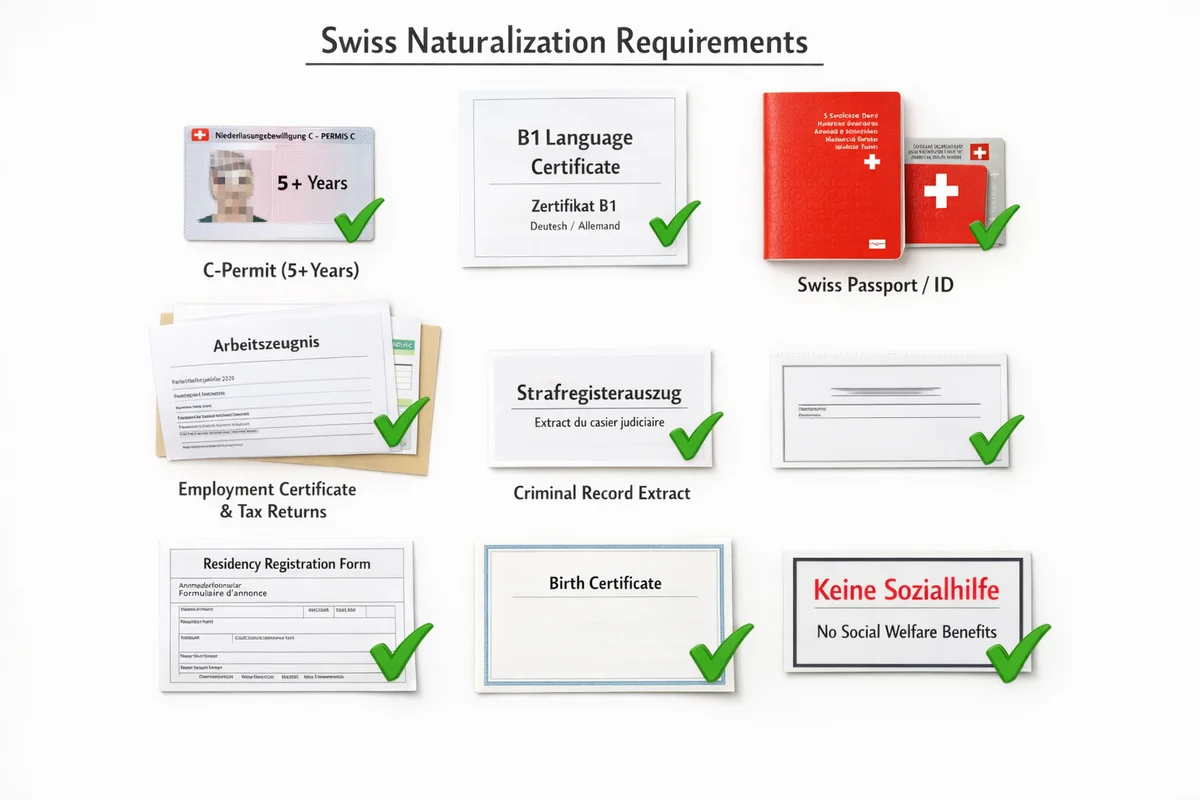
How Swiss Naturalization Works
Swiss citizenship isn't something you get automatically after living here long enough. You have to apply for it, and you have to meet a set of requirements defined at three levels: federal, cantonal, and municipal.
The legal basis is the Swiss Citizenship Act (Bürgerrechtsgesetz, BüG), which was fully revised in 2018. The federal law sets the minimum requirements. Cantons and municipalities can — and do — add their own conditions on top. That's why the process looks different depending on where you live.
There are two main paths. Ordinary naturalization is the standard route for most foreigners. You apply at your municipality, and the application passes through all three levels (municipality, canton, federation). Simplified naturalization is a shorter process available to spouses of Swiss citizens, third-generation foreigners, and some other specific cases — it bypasses the municipal and cantonal levels and goes directly through the federal government.
This article covers ordinary naturalization, since that's the path most people take. The requirements fall into four categories: residency, language, integration, and civic knowledge.
Important: The naturalization process takes 1.5-3 years on average. Every month of delay matters. Start preparing your documents today to avoid unnecessary setbacks.
Residency Requirements
The federal law requires 10 years of legal residence in Switzerland. At least 3 of those 10 years must fall within the 5 years immediately before you submit your application. So you can't count on years from decades ago alone — recent continuous presence matters.
There's one important exception: years spent in Switzerland between the ages of 8 and 18 count double. So a person who lived in Switzerland from age 10 to 18 would have 8 actual years but 16 counted years. This rule makes the path significantly shorter for people who grew up here.
On top of the federal 10-year rule, your canton and municipality have their own residency requirements. Most cantons require 2 to 5 years of residence in the same canton, and many municipalities require 2 or more years in the specific commune. These vary, so check with your local authorities.
Which residence permits count? C permits (permanent residence) and B permits (annual residence) count fully toward the 10 years. F permits (temporary admission) count at half — so 2 years on an F permit equals 1 year of counted residence. N permits (asylum seekers) and L permits (short-stay) do not count at all.
Important: you must hold a C permit (permanent residence) at the time of application. This changed with the 2018 law — a B permit is no longer sufficient to file the application, even though B permit years count toward the 10-year total.
Language Requirements
You need to prove that you speak the official language of the place where you live. The federal minimum is level B1 for speaking and listening, and A2 for reading and writing, based on the Common European Framework of Reference (CEFR).
Some cantons set the bar higher. Cantons like Schwyz, Nidwalden, Thurgau, and Zug require B2 for speaking and listening and B1 for reading and writing. Others may follow — Solothurn raised its oral requirement to B2 in 2026. St. Gallen, Basel-Landschaft and Appenzell Ausserrhoden take a different route: they require B1 for reading and writing as well as speaking, above the federal A2 written minimum. Always check what your specific canton requires, as the federal minimum is just the floor.
Accepted proof includes certificates from fide-recognized test providers (like the fide test, telc, Goethe, DELF/DALF, or CELI). Recognized certificates are generally valid for life, though authorities may request a new one if your certificate is very old and they have doubts about your current level.
There are exemptions. If you completed at least 5 years of compulsory schooling in Switzerland (with 3 at secondary level), or hold a Swiss upper-secondary diploma (Matura, EFZ/CFC, or equivalent), you don't need a separate language certificate. Some cantons also exempt people who completed higher education in the relevant language.
If you're not sure whether your existing qualifications count, ask your Gemeindeamt before paying for a new test. They can tell you exactly what they accept.
Integration Criteria
Language and residency are the quantifiable requirements. Integration is the qualitative side — and it's where applications sometimes run into trouble.
The federal law requires that you respect the public order and security of Switzerland. In practice, this means no serious criminal convictions and no outstanding criminal proceedings. Minor traffic offenses won't automatically disqualify you, but anything beyond that can be a problem. Pending cases usually need to be resolved before you can proceed.
You need to participate in economic life or be in education. This means having a job, running a business, or being enrolled in a training program. Being unemployed doesn't automatically disqualify you, but dependence on social assistance (Sozialhilfe) is a problem. The federal baseline is 3 years without social assistance before your application — or you must have repaid it in full. But cantons vary widely: most follow the 3-year rule, some require 5 years (like Zug), and a few require up to 10 years (like Aargau and Bern). Note that unemployment insurance (ALV) is not the same as social assistance and does not count against you.
Outstanding debts matter too. Unpaid taxes, health insurance premiums, or other debts to public agencies can block your application. The municipality will check your debt register (Betreibungsregisterauszug). Having a few old, paid-off debts isn't necessarily a dealbreaker, but active debt enforcement proceedings are.
Finally, you need to show familiarity with Swiss living conditions, customs, and traditions. This is assessed partly through the citizenship test (where applicable) and partly through the naturalization interview. It's not about becoming perfectly Swiss — it's about demonstrating that you're part of the community and understand how things work here.
Citizenship Test and Interview
Most cantons require some form of civic knowledge assessment. The format depends on where you live.
In cantons like Zurich, Bern, and Aargau, there's a formal written test — the Grundkenntnistest (GKT). It's a multiple-choice exam covering Swiss politics, history, geography, the social system, and cantonal specifics. The number of questions, time limit, and pass mark vary by canton. You typically receive a study brochure and practice test in advance.
Other cantons don't have a separate written test. Instead, they assess your civic knowledge during the naturalization interview (Einbürgerungsgespräch). The interview is conducted by municipal officials and covers your personal situation, your knowledge of Switzerland and local life, and your integration into the community.
Even in cantons with a written test, there's usually still an interview. The interview is less about textbook knowledge and more about how you live your life here — your social connections, your involvement in the community, your understanding of local customs. It's a conversation, not an exam.
Exemptions from the test exist in most cantons. If you went through Swiss schooling (typically 5 years of compulsory school with 3 at secondary level), you're usually exempt from the written test. The interview may still be required.
If you fail the test, you can retake it. The waiting period and retake conditions vary by canton — ask your municipality.
How to Start the Process
Your first step is your Gemeindeamt (municipal administration) or Einwohnerdienste. They handle the entire application at the municipal level and can tell you the exact requirements for your specific commune — including local residency requirements, fees, and the test format.
Before you go, gather the key documents. You'll typically need: valid passport, residence permit, birth certificate, marriage certificate (if applicable), criminal record extract from your home country, debt register extract (Betreibungsregisterauszug), language certificate, and proof of employment or education. Some municipalities have a checklist on their website.
Documents from abroad usually need to be officially translated and may require an apostille or legalization. Budget extra time and money for this — it can take weeks.
Once you submit the application, the municipality reviews your file, schedules the test (if applicable), and conducts the interview. After municipal approval, the file goes to the cantonal Bürgerrechtsamt, then to the federal State Secretariat for Migration (SEM). Each level charges its own fee. You can find detailed information about naturalization costs on our pricing page.
The entire process typically takes 1.5 to 3 years from application to the citizenship ceremony, depending on the canton and municipality. Some places are faster, some slower. The fees vary widely too — from around CHF 1,000 to CHF 5,000 total for a single adult, depending on where you live.
One practical tip: start gathering documents and checking requirements well before you're eligible. Some documents take time to obtain, and knowing exactly what you need avoids delays once you apply. To prepare for the Einbürgerungstest, you can practice with real questions online.