What Gets Asked on the Test?
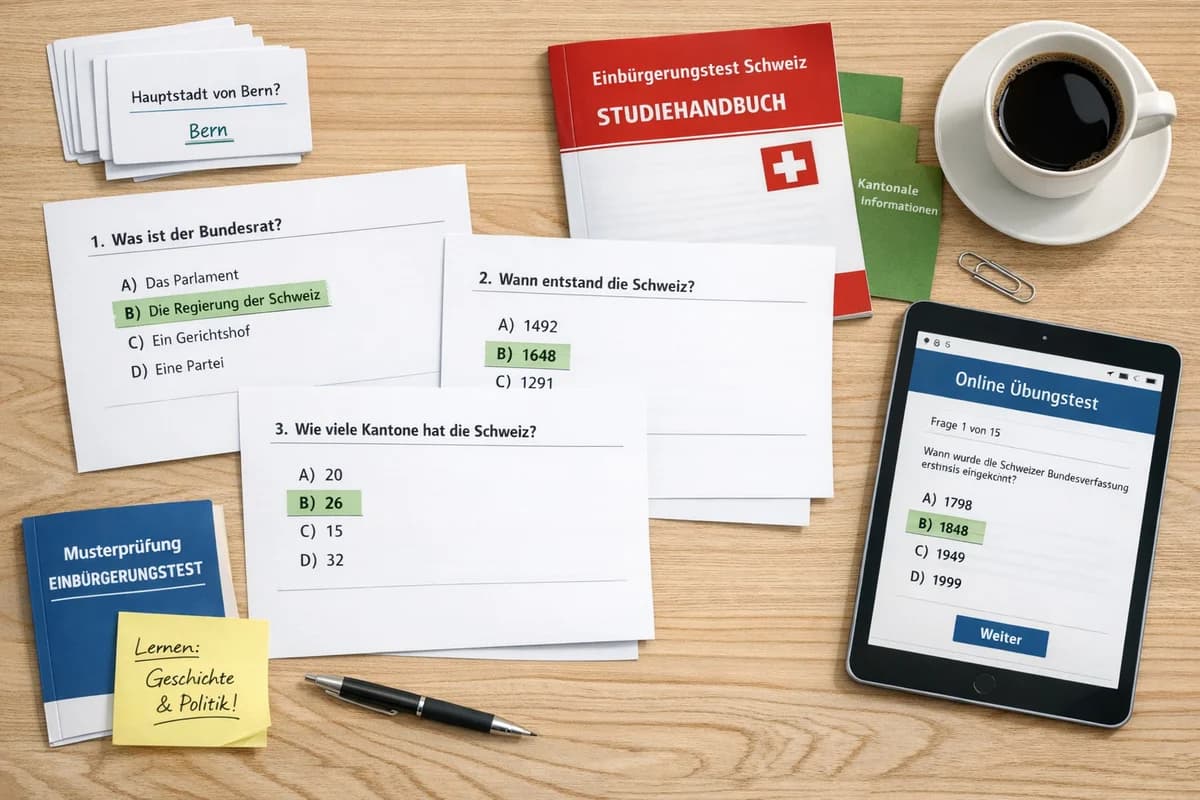
The Swiss citizenship test — called Grundkenntnistest (GKT) in German-speaking cantons — is a written multiple-choice exam. It covers the basics you need to know about Switzerland: how the political system works, key facts about geography and history, and practical knowledge about everyday life.
The format varies by canton. Most tests have 45 to 50 multiple-choice questions with a time limit between 40 and 90 minutes. The pass mark is typically around 60%, though some cantons set it higher. The test is taken on a computer or tablet, and the language is always the official language of your canton — German, French, or Italian.
Not every canton uses a formal written test. Some assess your civic knowledge during the naturalization interview instead. Check with your municipality to find out what applies to you.
Here's the important part: the test isn't just about Switzerland as a whole. A significant chunk of questions are specific to your canton and municipality. Someone testing in Zurich will get different questions than someone in Bern or Lucerne. That's why generic study guides only get you halfway — you need to know your local context too.
The topics break down into a few main categories. Let's go through each one.
Politics and Direct Democracy
This is the biggest topic on the test, and the one most people need to study hardest. Swiss politics is unique, and the test expects you to understand the basics.
The Federal Council (Bundesrat) is the executive branch — 7 members who collectively run the country. There's no single head of state in the traditional sense. The president rotates yearly among the 7 members. You should know the current members and their party affiliations.
Parliament has two chambers: the National Council (Nationalrat, 200 seats, proportional representation) and the Council of States (Ständerat, 46 seats, two per canton). Together they form the Federal Assembly. Know the difference between the two chambers and how they work together.
Direct democracy is central to Switzerland and comes up in almost every test. Citizens can launch a popular initiative (Volksinitiative) to propose a constitutional change — you need 100,000 signatures within 18 months. A referendum (Referendum) lets citizens challenge a law passed by parliament — 50,000 signatures within 100 days triggers a public vote. Mandatory referendums happen automatically for constitutional changes.
Separation of powers: legislative (parliament), executive (Federal Council), judicial (Federal Supreme Court in Lausanne). Federalism means power is shared between the Confederation, 26 cantons, and roughly 2,100 municipalities. Each level has its own responsibilities.
Expect questions like: How many members does the Federal Council have? What's the difference between an initiative and a referendum? How many signatures do you need for a popular initiative?
Geography and History
Geography and history together make up the second-largest block of questions. The good news: much of it is straightforward factual knowledge.
Switzerland has 26 cantons and four national languages: German (spoken by about 62%), French (23%), Italian (8%), and Romansh (less than 1%). The country borders Germany, France, Italy, Austria, and Liechtenstein. Key geographic features include the Alps, the Jura mountains, and the Mittelland (the plateau between them). Major rivers: the Rhine, the Rhône, the Aare. Highest peak: the Dufourspitze (4,634m), not the Matterhorn.
For history, focus on the key dates. 1291 is the founding of the Old Swiss Confederacy — the Federal Charter between Uri, Schwyz, and Unterwalden. 1848 marks the creation of the modern federal state with the first constitution. 1971 is when women gained the right to vote at the federal level. 1815: Congress of Vienna recognized Swiss neutrality.
Switzerland's neutrality is a common test topic. The country hasn't fought in a foreign war since 1515 (Battle of Marignano). It's not a member of the EU but joined the UN in 2002. The Red Cross was founded in Geneva in 1863 by Henry Dunant — the Swiss flag (white cross on red) inspired the Red Cross emblem (inverted colors).
Typical questions: How many cantons does Switzerland have? What year was the federal state founded? Which countries border Switzerland? What are the four national languages?
Daily Life and Social Systems
This section tests whether you understand how everyday life in Switzerland actually works. It covers insurance, schools, taxes, and the labor market.
Health insurance (KVG/LAMal) is mandatory for everyone living in Switzerland. You choose your own insurer, but basic coverage is the same everywhere. Supplementary insurance is optional. Premiums vary by canton and insurer. There's a deductible (Franchise) you can adjust — higher deductible means lower monthly premiums.
The social insurance system includes AHV/AVS (old-age and survivors' insurance — the first pillar), BVG/LPP (occupational pension — the second pillar), and private savings (third pillar). IV/AI covers disability insurance. ALV/AC is unemployment insurance. You should understand the three-pillar system at a high level.
The school system: compulsory education lasts 11 years (including 2 years of kindergarten in most cantons). After that, students go to either a Gymnasium (academic track leading to university) or a Berufslehre (vocational apprenticeship — this is the path most Swiss students take). The dual education system combining work and school is a distinctly Swiss feature.
Taxes are levied at three levels: federal, cantonal, and municipal. Everyone files a tax return. Tax rates vary significantly between cantons and even municipalities.
Expect questions about: What insurance is mandatory? What are the three pillars? How long is compulsory school? What is a Berufslehre?
Your Canton and Municipality
This is what makes each citizenship test unique. A large portion of the questions are about your specific canton and municipality — and this is where many people get tripped up because they focused only on national-level material.
You'll need to know the structure of your cantonal government. In German-speaking cantons, the executive is usually called the Regierungsrat (5 or 7 members depending on the canton), and the parliament is the Kantonsrat or Grosser Rat. Know how many members each body has in your canton, and ideally the current head of government.
Municipal structures matter too. How is your municipality governed? What's the local executive called? In many places it's the Gemeinderat or Stadtrat. Some municipalities have a Gemeindeversammlung (town assembly) where citizens vote directly on local matters — others have a municipal parliament instead.
Public holidays are a classic test question. Switzerland has very few national holidays (August 1st is the only one guaranteed everywhere). Most holidays are cantonal. You need to know which holidays your canton observes — this includes religious holidays that vary between Catholic and Protestant cantons.
Religious demographics come up too. Historically, some cantons are predominantly Catholic (Lucerne, Fribourg, Valais, Ticino), others Protestant (Zurich, Bern, Vaud). Today the picture is more mixed, but the historical distinction still shapes cantonal culture and holidays.
The learning brochure your canton provides before the test covers all of this local content. Study it carefully — it's the single most valuable resource for this part of the exam.
How to Prepare
Give yourself 2 to 3 months of study time. The test isn't difficult if you prepare, but it covers a lot of ground and the cantonal material takes time to absorb.
Your most important resource is the official learning brochure that your canton sends with the test invitation. It contains exactly the material the test is based on. Read it cover to cover, then go through it again focusing on the parts you're weakest on. Some cantons also provide a practice test — take it under timed conditions to see where you stand.
For the national topics, focus on three areas first: the Federal Council (current members, how it works, the rotation of the presidency), direct democracy (initiative vs. referendum, signature requirements, how votes work), and the three-pillar system. These come up on almost every test.
For cantonal and municipal topics, look up your cantonal government website. Find the names of current Regierungsrat members, the structure of the cantonal parliament, and local holidays. If your municipality has a website with a section on politics or administration, read that too.
Online practice tests can help, but be careful — many are too generic and don't cover cantonal specifics. Use them as a supplement, not a replacement for the official materials. You can practice with real questions that cover all 26 cantons.
One last tip: don't just memorize facts. Understand the logic behind the system. If you understand why Switzerland has direct democracy, you'll remember the details about initiatives and referendums much more easily. The same goes for federalism — once you grasp that power is deliberately split across three levels, the specific structures at each level make more sense.
Critical: Popular test centers fill up quickly. Secure your spot and start preparing now to avoid another year of waiting.
Test Your Knowledge
Try 5 free questions