50 questions from a catalogue of 350: how the Grundkenntnistest works
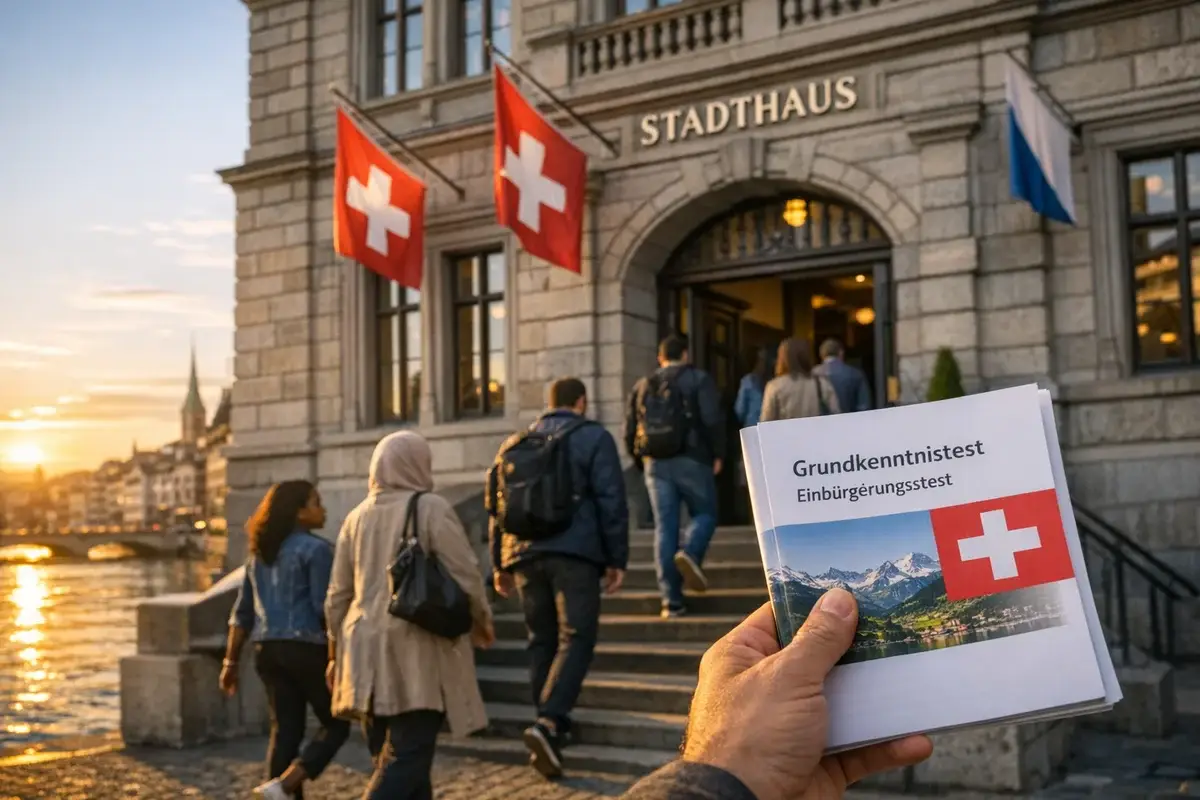
Since 1 July 2023 the Canton of Zürich has had a new citizenship act, and with it a single cantonal basic knowledge test, the Grundkenntnistest or GKT. The canton's 2025 survey of its communes found that they now all use it. The rules are in the cantonal citizenship ordinance and in the Gemeindeamt's handbook on naturalisation, and they are precise: 50 questions are drawn at random from a public catalogue of 350, 35 on the Confederation, 10 on the Canton of Zürich and 5 on the communes, and you pass with 30 correct answers, which is 60 percent.
You take the test digitally, on a computer or tablet, on site at your commune or at an educational institution the commune has appointed. Every question has four answers and exactly one is right; open questions are not allowed. The test does not measure your German, but it must be solvable with German at level A2, so the questions are deliberately plainly worded.
The public catalogue is organised in five topics: democracy and federalism, the welfare state and civil society, history, geography, and culture and everyday life, each at the federal, cantonal and communal level. The canton publishes the whole catalogue as a 78-page PDF together with a learning brochure, free of charge. Our Zürich questions follow the same five topics and add the explanations the catalogue leaves out.
Who is exempt, when you take it, and what happens if you fail
You do not take the test if you attended compulsory school in Switzerland for at least five years, three of them at lower-secondary level, if you completed an upper-secondary education in Switzerland, if you are currently attending compulsory school or upper-secondary education in Switzerland, or if you are under 12. Everyone else takes it, including applicants who have lived in the canton for decades.
Your commune decides when: before you file the application or during the procedure. Failing is not a ground for rejection. The test may be repeated, the ordinance does not allow a waiting period, and if the test is taken during the procedure the commune must allow at least one repeat, in individual cases a second. A failed test does not stop you from filing either.
In the City of Zürich the test takes place at the Stadthaus and is free; the learning brochure comes with the invitation. In other communes the cost depends on the commune and its test provider, so ask when you register. One more thing the city makes clear: the GKT belongs to ordinary naturalisation. In the simplified federal procedure, for example for the spouse of a Swiss citizen, the city checks basic knowledge in the naturalisation interview instead.
Test Your Knowledge
Try 5 free questionsThe other requirements: two years in the commune, a C permit, German A2 and B1
The test is one of several conditions the Gemeindeamt checks before your file goes to the commune. You need ten years in Switzerland, three of them in the five years before the application, with the years between your eighth and eighteenth birthdays counting double; a valid C permit; and two years in the same commune when you file. Applicants under 25 need only two years in the Canton of Zürich, not in one commune. The canton also checks whether you honoured your payment obligations in the last five years and respected the criminal law.
German is required at A2 in writing and B1 in speaking. The canton accepts certificates from telc, the Goethe-Institut, ÖSD and fide, and the communes run the cantonal German test for naturalisation, the KDE, through accredited providers. No certificate is needed if German is your mother tongue, if you went to school in German for at least five years, or if you completed an upper-secondary or tertiary education in German.
At the commune the file is read for more than paper: participation in social and economic life, contacts with Swiss people and respect for the values of the Federal Constitution. According to the canton's 2025 survey just over half of the communes hold a personal interview and 41 percent ask for a letter of motivation.
Fees: CHF 500 for the canton, 200 to 2,400 for the commune, 100 for the Confederation
The cantonal fee is CHF 500; applicants under 25 pay half and applicants under 20 nothing, and a rejected application costs CHF 200. The federal fee is CHF 100 per person, CHF 150 for a married couple and CHF 50 for a minor. An advance on costs is due with the online application.
The communal fee is where the range opens. Each commune sets its own, and the canton's 2025 survey found that from age 25 it usually lies between CHF 400 and 600, with a spread from CHF 200 to 2,400. The City of Zürich charges CHF 1,200 per person under its fee ordinance, with children on the application free. The test itself costs nothing in the city; elsewhere the commune or its provider may charge for it. Add the language certificate, if you need one, and the civil-status extract.
Avoid Costly Retakes
View pricingThe ten cantonal questions: 1351, the Limmat, seven Regierungsräte, Sechseläuten
Ten of the fifty questions concern the Canton of Zürich and five your commune, and they follow the same five topics as the federal part. History starts with 1351, the year Zürich joined the Confederation as its fifth member. Geography means the lake, the Limmat that flows out of it through the old town, and the Sihl that joins it in the city centre. Politics means the institutions: the Regierungsrat with its seven members, elected by the people for four years and working as a collegial body, the Kantonsrat, the districts and the communes. Culture means the customs the catalogue asks about, such as Sechseläuten, the spring festival of the guilds on the third Monday in April with its procession and the burning of the Böögg.
Learn the cantonal part the way the test asks it: short questions with four answers, one of them right. Our 35 Zürich questions are written in that form, and the catalogue's own questions are the best rehearsal for the wording. Prepare the communal five with your commune's website: what it calls its executive and its legislative body, its districts or neighbourhoods, and what it does itself and what the canton does for it.
The five steps and about two years
The procedure runs canton, commune, canton, Confederation, canton. You file online through the canton's naturalisation portal, with the advance on costs; if you are not yet in the civil register, the civil registry office records your civil status first. The Gemeindeamt runs the preliminary check: complete documents, C permit, federal and cantonal residence periods, payment obligations of the last five years, criminal law. If something is missing you can complete or withdraw the application; if all is in order it goes to your commune.
The commune checks the German certificate, the basic knowledge, your participation in social and economic life, your contacts with Swiss people and your respect for the constitutional values, and the body named in its regulations grants communal citizenship. The Gemeindeamt then examines the file again and grants cantonal citizenship, the State Secretariat for Migration issues the federal naturalisation permit, and once all fees are paid the Gemeindeamt issues the naturalisation decision, with which you hold communal, cantonal and Swiss citizenship. A negative communal decision can be appealed to the Bezirksrat within 30 days.
The canton estimates about two years in total. In 2025 about a quarter of the communes reported more than six months for their own part, so the communal phase is the one to plan around. Everything in this guide comes from the cantonal act and ordinance, the Gemeindeamt's handbook, the canton's survey of December 2025 and the pages of the canton and the city, all linked on the Zürich canton page and checked on 4 September 2026.
Practice Anywhere
Download iOS App