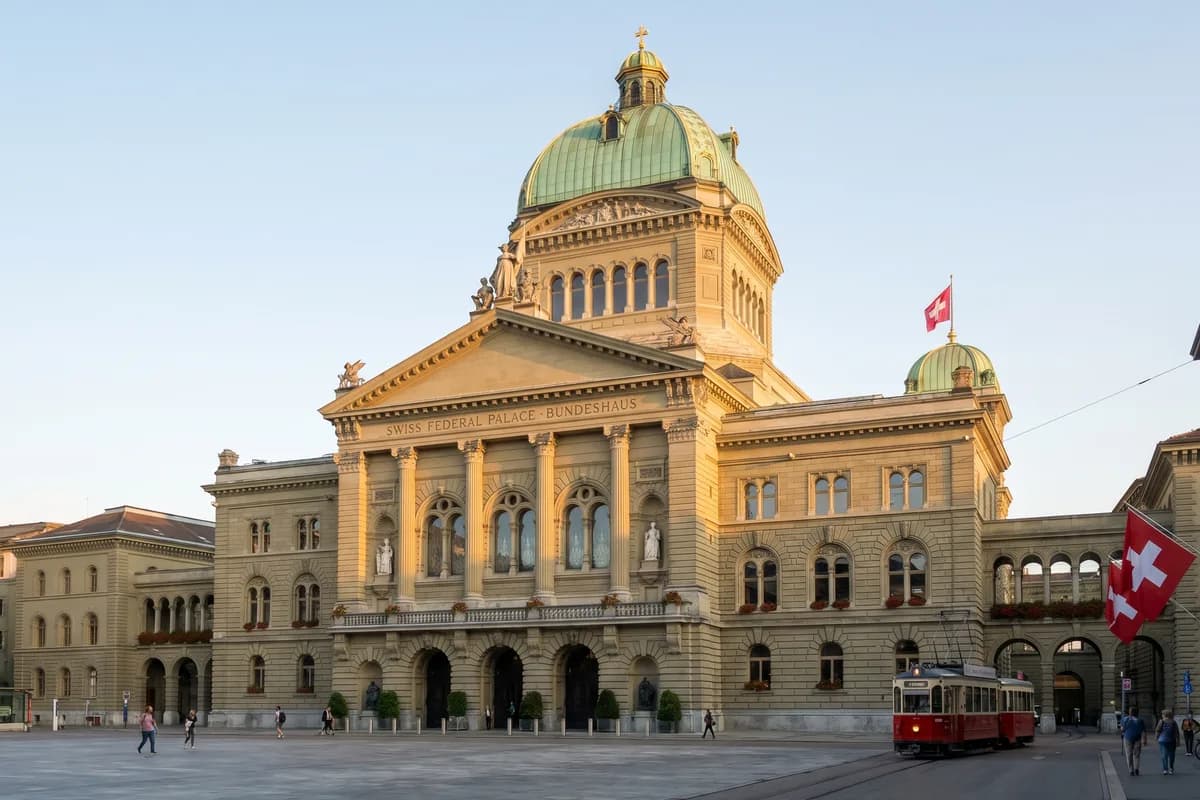
Federalism: Federal Level, Cantons and Communes
To understand how Switzerland is governed, start with one word: federalism. Switzerland has been a federal state since 1848, and power is not concentrated in a single capital. Instead, it is shared vertically across three levels – and knowing these three levels is the foundation of the whole political system.
The first level is the federal level (Bund). It is responsible for matters that concern the whole country: foreign policy, the army, the national currency, customs, the railways and federal law. The federal state is based in Bern, which serves as the seat of government.
The second level is the 26 cantons (Kantone). Each canton is like a small state with its own constitution, its own parliament, its own government and its own courts. Cantons are responsible for areas such as schools, the police, health and culture. This is why rules can differ from one canton to the next – and why the naturalization test always has a cantonal part about your specific canton.
The third level is the roughly 2'100 communes (Gemeinden). The commune is the level closest to you: it handles local matters like the civil register, local roads, water, waste and often the first stage of the naturalization procedure. Many decisions in Switzerland are actually taken here, at the most local level.
Federalism therefore means that power is deliberately divided between the federal level, the cantons and the communes – never held by one body alone. A useful principle to remember is subsidiarity: a task should be handled at the lowest level that can do it well, and only moved up to the canton or the federal level when necessary. If you want the official overview of how the country is organized, the federal portal ch.ch is a reliable starting point, and our complete handbook explains each level with practice questions.
Separation of Powers: The Three Branches of the State
Federalism splits power vertically across three levels. The second key idea splits it horizontally: the separation of powers. At every level – federal, cantonal and communal – the state is divided into three branches, so that no single body can both make the laws, carry them out and judge them. This balance is one of the most important things to understand for the test.
The legislative branch makes the laws. At the federal level this is the Federal Assembly (Bundesversammlung), the parliament with its two chambers, which we look at in detail in the next section.
The executive branch governs the country and carries out the laws. At the federal level this is the Federal Council (Bundesrat), the seven-member government. It prepares legislation, runs the federal administration and represents Switzerland abroad.
The judiciary branch interprets the law and settles disputes. The highest court of the country is the Federal Supreme Court (Bundesgericht), based mainly in Lausanne. It ensures that federal law is applied correctly and has the final say in legal disputes.
The whole point of separating these three branches is to prevent the concentration of power. The parliament makes the rules, the government applies them, and the courts check that everyone – including the state itself – follows them. In a memorable phrase: the legislative writes the rules of the game, the executive plays the game, and the judiciary acts as the referee. Keeping these three roles clearly apart, at all three levels, is exactly what keeps the Swiss system balanced.
Parliament: National Council and Council of States
The Swiss parliament is called the Federal Assembly (Bundesversammlung), and it is the legislative branch at the federal level. A detail that surprises many newcomers – and a popular test question – is that it has two chambers of equal standing. Together they have 246 members.
The first chamber is the National Council (Nationalrat) with 200 seats. It represents the people: the seats are distributed among the cantons according to population, so a populous canton like Zürich sends many representatives, while a small canton sends only one. When you vote in a federal election, this is the chamber you are filling.
The second chamber is the Council of States (Ständerat) with 46 seats. It represents the cantons, not the population. The rule is simple and worth memorizing: each full canton has 2 seats, and the six former half-cantons have 1 seat each. That gives 20 full cantons times 2, plus 6 half-cantons times 1, which equals exactly 46. This way, small cantons carry real weight despite their smaller populations.
The two chambers are equal in power, and this is the key to how laws are made. A new federal law must be approved by both chambers in the same wording. The National Council and the Council of States debate a bill separately; if their versions differ, the text goes back and forth between them until they agree. This two-chamber system (bicameralism) balances the will of the people with the interests of the cantons – a direct expression of Swiss federalism inside parliament itself. When the two chambers meet together as the United Federal Assembly, they perform special tasks such as electing the members of the Federal Council and the Bundespräsident/in.
The Federal Council and Direct Democracy
Two features make the Swiss system genuinely unusual, and both come up again and again in the test: the collegial government and direct democracy.
The government is the Federal Council (Bundesrat), and it has exactly 7 members. Switzerland has no single president who holds power. Instead, the seven councillors govern as a team and take their decisions jointly – this is called the collegial principle. Each one heads a department, but on the big questions they decide together and then defend the common decision as one. One of the seven serves as Bundespräsident/in (Federal President) for a single year, rotating among the members. The president is only "first among equals": he or she chairs the meetings and represents Switzerland on ceremonial occasions, but has no more power than the other six. By long-standing custom the major parties share these seats according to an informal formula (the "Zauberformel"), which is why Switzerland is governed by consensus rather than by a single winning party. We explain the government in depth in Federal Council explained.
The second special feature is direct democracy, which gives citizens far more say than in most countries. Two instruments matter most. With a popular initiative, citizens who collect 100'000 valid signatures within 18 months can propose a change to the federal constitution and force a national vote on it. With a referendum, citizens can challenge a law that parliament has already passed: if 50'000 signatures are gathered within 100 days, the law must be put to the people. So in Switzerland, the people are not only voters at election time – they are a permanent part of lawmaking. We cover this in detail in direct democracy explained.
Together, collegial government and direct democracy explain why Switzerland is built on consensus and concordance: power is shared, decisions are taken jointly, and the last word often belongs to the people. For a compact, official summary of all of this, the Federal Chancellery booklet is the classic reference, and we summarize it in The Confederation in brief, explained.
Why This Is Central to the Naturalization Test
Everything above is not just background knowledge – it is the heart of the civics part of the Swiss naturalization test. Whatever your canton and whatever the exact format, you will almost certainly be asked about the political system. The examiners want to see that you understand the country you are becoming a citizen of, and that means understanding how it is governed.
In practice, the most common questions are exactly the facts in this article. How many members does the Federal Council have? (Seven.) How many chambers does parliament have, and how many seats do they have? (Two: the National Council with 200 and the Council of States with 46.) What are the three levels of the state? (Federal level, cantons, communes.) What are the three branches of power? (Legislative, executive, judiciary.) What is a popular initiative, and what is a referendum? These recur again and again because they define how Switzerland actually works. You can see typical examples in our politics and civics questions.
The challenge is not that the material is hard – it is that it is interconnected, and loose facts are easy to mix up under exam pressure. Many candidates confuse the two chambers, or muddle the signature thresholds for an initiative and a referendum. The fix is to learn the system as one connected picture (the way this article presents it) and then to drill it with realistic questions until the numbers and roles are automatic.
That is exactly what our complete handbook is built for. It teaches the whole political system as a structured chapter – federalism, separation of powers, parliament, the Federal Council and direct democracy – and then lets you test yourself with practice questions in the real exam format, each with a full explanation. It also covers all 26 cantons, so you are ready for the cantonal part too. Read the chapter, answer the questions, and the civics part of the test stops being something to fear.
Everything in one book
See the handbookConclusion
The Swiss political system looks complicated from the outside, but it rests on a few clear ideas that fit together. Power is divided in two directions at once. Vertically, through federalism: the federal level, the 26 cantons and the roughly 2'100 communes each have their own tasks. Horizontally, through the separation of powers: the legislative makes the laws, the executive carries them out, and the judiciary judges.
At the federal level, parliament is the Federal Assembly with two equal chambers – the National Council (200 seats, the people) and the Council of States (46 seats, the cantons), 246 members in total. The government is the Federal Council with 7 members who govern as a collegial team, led each year by a rotating Federal President who is only first among equals. And through direct democracy – the popular initiative and the referendum – citizens themselves can change the constitution and challenge laws. The result is a country built on consensus and concordance, with no single all-powerful leader.
If you can explain those points in your own words, you have understood the core of how Switzerland is governed – and you have covered the most important part of the civics in the naturalization test. The best next step is to lock the facts in with structured study and realistic practice questions, which is exactly what our handbook gives you, alongside all 26 cantons.
Everything in one book
See the handbook