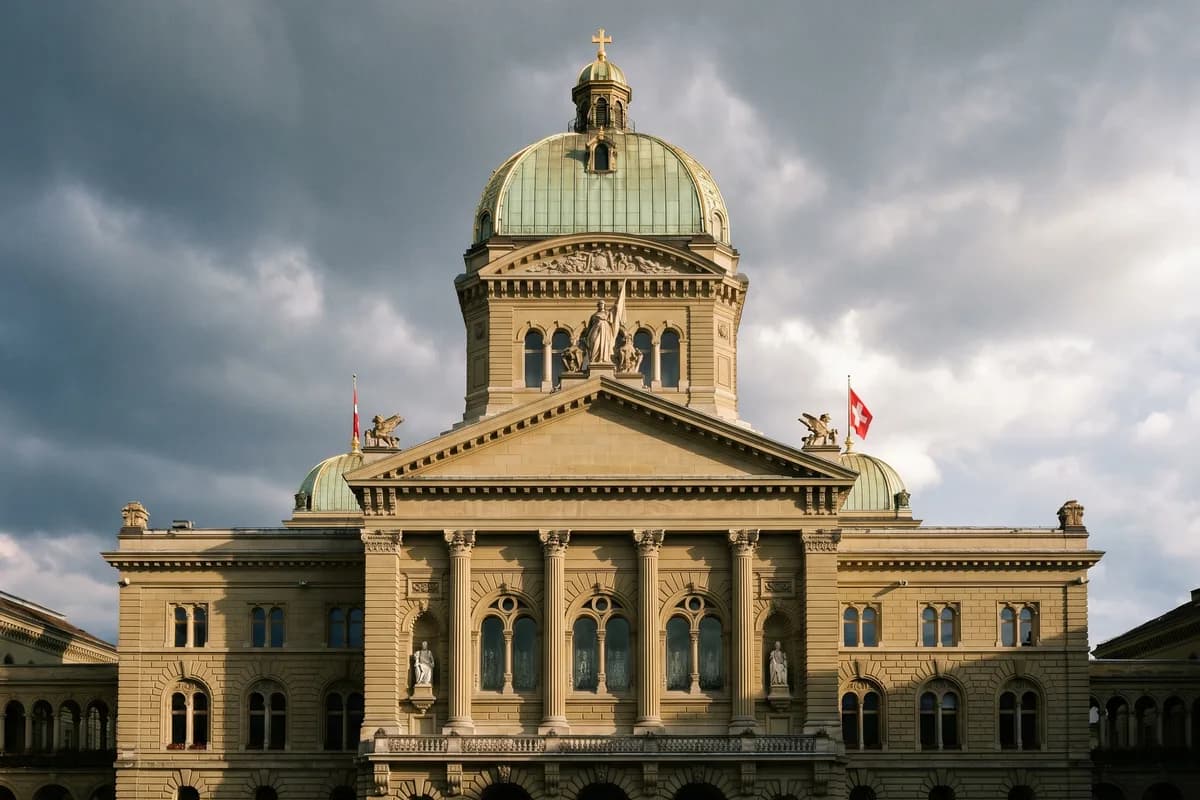
What Is the Federal Council?
The Federal Council (Bundesrat) is the government of Switzerland – the country's highest executive authority. Unlike most countries, Switzerland has no single prime minister and no president with real power. Instead, it is governed by a team of seven equal members who lead the country together.
This team is called the Gesamtbundesrat (the Federal Council as a whole). The seven members make their most important decisions jointly as a body, not individually. Each member heads one of the seven federal departments – think of them as ministries – but no single member stands above the others.
The big idea to remember for the test: in Switzerland, executive power is shared, not concentrated in one person. This is one of the reasons the system stays stable even when politics get heated. You can verify the official structure on the Federal Council's pages at admin.ch.
The Seven Departments
Each Federal Councillor leads one department. There are exactly seven, and the test often asks what each one does. Here they are with their official abbreviations:
- EDA – Federal Department of Foreign Affairs: diplomacy, embassies, Switzerland's relations with other countries and the EU.
- EDI – Federal Department of Home Affairs: social insurance (AHV/IV), health, culture, gender equality, statistics.
- EJPD – Federal Department of Justice and Police: laws, migration and the SEM, citizenship, federal police.
- VBS – Federal Department of Defence, Civil Protection and Sport: the army, civil protection, and national sport.
- EFD – Federal Department of Finance: the federal budget, taxes, customs, and federal personnel.
- WBF – Federal Department of Economic Affairs, Education and Research: the economy, jobs, vocational training, universities and research.
- UVEK – Federal Department of the Environment, Transport, Energy and Communications: roads and railways, energy, environment, post and telecoms.
A simple memory trick: the seven departments cover foreign affairs, home affairs, justice, defence, finance, economy/education, and environment/transport. If you can map each abbreviation to its area, you'll handle most department questions on the test.
Collegiality, Concordance and the Magic Formula
Three principles explain how the seven actually work together. They come up again and again in the test.
The collegial principle (Kollegialitätsprinzip): Decisions are made by the council as a whole, and all seven members stand behind them in public – even if they personally voted against the decision in the room. There is no chairperson who can overrule the others. Each member has one vote, and the majority decides.
Concordance (Konkordanz): Switzerland deliberately includes the main political parties in the government at the same time, instead of having one party rule and the others sit in opposition. The goal is broad consensus and stable politics. This is why several parties with different views share the seven seats.
The magic formula (Zauberformel): Since 1959, the seven seats have been distributed among the strongest parties by a fixed key. The classic ratio was 2 : 2 : 2 : 1 (historically two FDP, two CVP, two SP and one SVP). Important for the test: the idea of the Zauberformel is a roughly proportional distribution among the largest parties – but the exact party composition changes over time as election results and parties shift. So learn the principle (proportional power-sharing since 1959), and check the current breakdown on admin.ch.
The Federal President and the Federal Chancellery
A common test trap: the Swiss President is not a powerful head of state. The official title is President of the Confederation (Bundespräsident:in), and the role rotates among the seven Federal Councillors – a new one each year.
The President is primus inter pares – "first among equals." They chair the Federal Council's meetings and represent Switzerland on ceremonial occasions, but they have no extra power and cannot overrule the other six. They still keep running their own department at the same time. The presidency is essentially a one-year honorary chairmanship that rotates by seniority, so the answer to "who has more power, the President or the other members?" is: nobody – all seven are equal.
Working alongside the Federal Council is the Federal Chancellery (Bundeskanzlei), led by the Federal Chancellor (Bundeskanzler:in). The Chancellor is the staff chief of the government – often called its "eighth member," but without a vote and without a department. The Chancellery prepares the council's meetings, supports its work and handles communication. For the names and current presidency, the official source is admin.ch.
How the Council Is Elected
The Federal Council is not elected directly by the people. The seven members are chosen by the United Federal Assembly (Vereinigte Bundesversammlung) – that is, both chambers of parliament sitting together: the National Council (Nationalrat) and the Council of States (Ständerat).
Each member is elected individually for a term of four years. Elections happen after each parliamentary election, and in practice sitting members who run again are almost always re-elected. When a member steps down between elections, parliament elects a replacement for the rest of the term.
A few extra facts the test likes:
- A member who wants to leave usually announces their resignation, and a by-election (Ersatzwahl) fills the seat.
- Federal Councillors are full members of the executive and may not sit in parliament at the same time – they give up their parliamentary seat.
- There is an informal expectation that the different language regions of Switzerland are fairly represented in the council.
So the chain to remember is: the people elect parliament, and parliament elects the Federal Council for four years.
The Council in 2026 – and How to Learn It
Status 2026: The Federal Council still has its seven members across the seven departments described above, elected by the United Federal Assembly, with the presidency rotating yearly. The names of the individual councillors and who currently holds the presidency change over time – a member can resign and be replaced at any sitting. For that reason, always confirm the current line-up and the President of the year against the official source: the Federal Council and Federal Chancellery pages on admin.ch, or the civics overview on ch.ch. Don't memorise an out-of-date list from an old brochure.
What will not change and is therefore worth memorising: seven members, a collegial government, seven departments (EDA, EDI, EJPD, VBS, EFD, WBF, UVEK), the Zauberformel principle since 1959, election by parliament for four years, and a rotating one-year presidency whose holder is only primus inter pares.
For the citizenship test, the smart move is to learn the structure first (it stays stable) and then check the current names right before your exam. The best way to make these facts stick is active recall, not re-reading. Drill the departments and principles with flashcards, then test yourself under exam conditions with a mock exam. You can also see the full politics and civics curriculum and start free.
Test Your Knowledge
Try 5 free questions