The Language Problem in Swiss Citizenship Prep
If you're preparing for Swiss citizenship and German isn't your first language, you've probably already hit the wall: almost every study material out there is in German. Cantonal brochures, sample question sheets, community forums, the thick civics booklets – they're written for native speakers, often in dense administrative German that's hard to follow even at an intermediate level. French and Italian speakers in the Romandie and Ticino have more local-language material, but English speakers are left with very little.
This is a real problem, because the Swiss naturalization test covers a lot of ground: federal politics, history from 1291 to today, geography, the three-pillar social system, direct democracy, plus everything specific to your canton. Trying to absorb all of that in a language you're still learning means you spend half your energy decoding the words instead of actually understanding the concepts. Many candidates give up on structured study entirely and just hope they'll pass.
The good news: it doesn't have to be this way. There is solid material in English, French and Italian – you just have to know where to look, and you have to understand one important distinction first. Understanding the content in a language you read fluently, and proving your language skills for the official procedure, are two separate things. This guide walks you through both: what exists in your language, and how to use it the smart way.
Which Language Is Your Test Actually In?
This is the part nobody tells you clearly, so let's be honest about it: the actual naturalization test and the interview are held in the official language of your canton – German, French or Italian. There is no English version of the real exam. If you live in Zürich, Bern or Lucerne, the test and the conversation with the authorities are in German. In Geneva, Vaud or Neuchâtel they're in French. In Ticino, in Italian.
That means English study material is incredibly useful for one specific thing: understanding the content. It is not a substitute for the local language, and you cannot naturalize purely in English. You still have to demonstrate the cantonal language at a defined level – typically B1 spoken and A2 written for ordinary naturalization, though some cantons ask for more. So the realistic plan for a non-German speaker is two-track: use English (or French/Italian) material to grasp what the topics mean, while you separately build and certify the official language of your canton.
The language requirement is its own subject with its own rules, accepted certificates and exemptions, so read our dedicated guide on the language requirements for naturalization and our walkthrough of the fide test, which is the everyday-language exam most cantons accept. Get clarity on those early, because the language certificate often takes the longest to organize. Once you know which language your test is in and which certificate you need, the study materials below slot neatly into your plan.
Free Official Material in Multiple Languages
Before you spend a franc, grab the free federal material – and the best part is that one key resource exists in several languages. The Federal Chancellery publishes a booklet called "The Swiss Confederation – a brief guide" (in German, "Der Bund kurz erklärt"). It explains the federal government, Parliament, the Federal Council, the courts, the cantons and direct democracy in plain language, with the year's key facts. Crucially, it is available in German, French, Italian, Romansh and English, so you can read the federal basics in a language you actually understand. Download it free from bk.admin.ch.
This booklet is genuinely useful for the federal part of the test, which is the same for everyone regardless of canton. Reading the English or French edition first gives you the mental model – what the National Council is, how an initiative works, why Switzerland has seven federal councillors – and then the German terminology stops feeling like a wall of foreign words.
What the free federal material does not cover well is the cantonal part. There is no single tidy multilingual booklet for "everything you need to know about Canton Aargau," and the cantonal questions are exactly where many candidates lose points. Cantonal civics is usually documented only in the canton's own official language, scattered across government pages. That gap – comprehensive, explained, canton-by-canton content in a language non-German speakers can read – is precisely what the study guides in the next section are built to fill.
Study Guides and Tools in English, French and Italian
Once you move beyond the free federal booklet, you need material that is comprehensive, explained and covers your specific canton – in a language you read fluently. Two multilingual tools are built exactly for that.
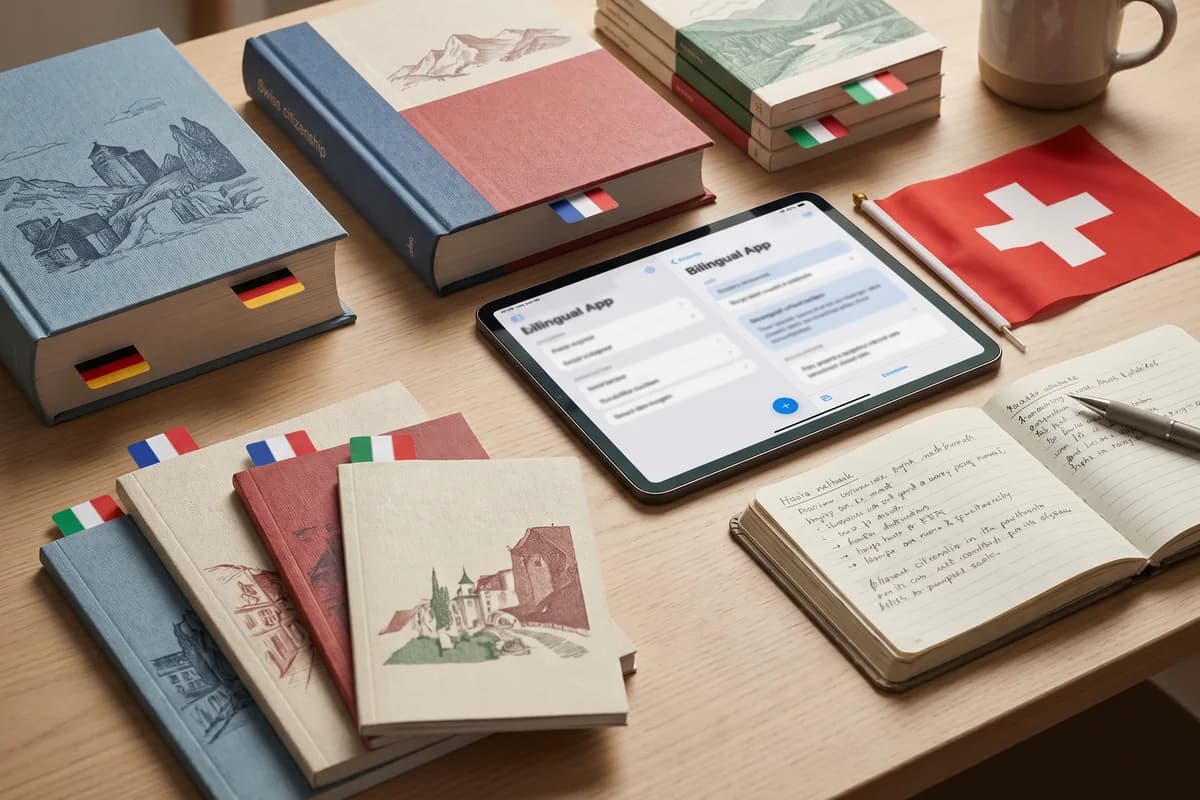
The first is our study app. Every question, every lesson and the whole interface are available in German, English, French and Italian, with full coverage of all 26 cantons. The feature that matters most for non-German speakers is the bilingual side-by-side mode: it shows two languages at once, so you can read a question in English while seeing the original German next to it. That way you understand the content and quietly absorb the German terminology you'll meet in the real test – federal and cantonal vocabulary you can't pick up from an English-only resource. For a full breakdown of the question bank, study modes and analytics, see our guide to the Swiss citizenship test app.
The second is our handbook, "Das vollständige Handbuch" – a 300-plus-page study guide with 525 fully explained questions across all 26 cantons and the complete civics curriculum, available as PDF and EPUB. It's offered in German, English, French and Italian. The English edition is the closest thing to a proper, explained English-language study guide for the Swiss citizenship test, and it's built to be read end to end, not just skimmed for answers. You can find it on our handbook page. Together, the app and the handbook give non-German speakers something that simply hasn't existed before: structured, explained, multilingual prep for every canton.
How Our Handbook Helps Non-German Speakers
If you read best from a book rather than a screen, the handbook is built for you. "Das vollständige Handbuch" is a one-time purchase at CHF 19.90 – no subscription – and you get both the PDF and the EPUB, so you can read it on a laptop, tablet, e-reader or phone, and annotate it however you like. Over 300 pages cover the full civics curriculum and all 26 cantons, with 525 questions that are each fully explained, not just answered.
That 'fully explained' part is the whole point for a non-German speaker. A bare answer key tells you the right option; it doesn't tell you why. The handbook walks through the reasoning behind every answer, so you learn the underlying facts about Swiss politics, history, federalism and your canton in a language you read fluently. You build genuine understanding instead of memorizing letters, which is exactly what you need when the examiner rephrases a question or asks a follow-up in the interview.
The smart way to use it: read the handbook in English (or German) to understand the material thoroughly, then drill the same topics in the local language so the official terms become second nature. The book gives you the concepts and the structure; your local-language practice turns them into exam-ready, interview-ready knowledge. The English, French and Italian editions are all available and cover everything you need to understand the test. Grab the handbook and start with the federal chapters, then move into your canton.
Everything in one book
See the handbookA Smart Study Approach When the Test Is in a New Language
Here's how to put it all together when the exam is in a language you're still learning. The goal is to separate understanding from language so each one doesn't slow down the other, then bring them back together near the end.
Start with understanding. Read the free federal booklet and the handbook in English (or whichever language you read best) until the concepts are solid – what direct democracy means, how the cantons relate to the Confederation, the basics of your canton's history and government. Don't worry about the German wording yet; just make sure the ideas make sense. Then switch on the app's bilingual side-by-side mode and study the same topics with the local language and your language shown together. This is the bridge: you already understand the content, so now your brain attaches the official German, French or Italian terms to ideas it already knows, instead of memorizing blind.
Finally, practice actively in the local language. Answer questions in the cantonal language without the translation, say the answers out loud, and rehearse explaining a few topics in full sentences – because the interview is a conversation, not a multiple-choice sheet. Keep building your everyday language in parallel toward your certificate; the fide test and the wider language requirements are part of the same effort, not a separate chore. A realistic rhythm is 20 to 30 minutes a day: understand in your language, bridge with the bilingual mode, then drill and speak in the local language. Do that consistently and you'll walk into the test understanding the material and able to handle it in the language that counts. Start with the handbook today and build from there.
Everything in one book
See the handbook