What Level You Need
The language requirement for Swiss naturalization is set at the federal level: you need at least B1 for spoken skills (speaking and listening) and A2 for written skills (reading and writing) in a national language of your municipality.
What does that mean in practice? B1 spoken means you can handle most everyday conversations — talking to your doctor, discussing a news topic, explaining a problem at work. You don't need to be fluent, but you need to go beyond basic phrases. A2 written means you can read simple texts and write short, straightforward messages — filling out forms, writing a short email, understanding a letter from your insurance company.
The language must be one of Switzerland's four national languages: German, French, Italian, or Romansh. Which one depends on where you live. If your municipality is in the German-speaking part, your certificate must be in German. You can't submit a French certificate if you live in Zurich. Check our canton-specific guides for detailed requirements in your area.
Important: these are the federal minimums. Some cantons set the bar higher. For example, certain cantons require B1 for both spoken and written skills, or even B2. Always check with your canton or municipality for their specific requirements before booking a test.
Don't confuse the naturalization language requirement with the C permit requirement. To obtain a C permit (Niederlassungsbewilligung), you generally need A2 spoken and A1 written — that's one level lower. If you already have a C permit, your existing certificate might not be sufficient for naturalization. You may need to take a higher-level test. See our comparison of C permit vs citizenship.
Which Tests Are Accepted
Several language certificates are recognized for Swiss naturalization. The most common ones:
fide test: This is the Swiss-specific language test, designed explicitly for the migration context. It's the most widely accepted option and is tailored to everyday situations in Switzerland — things like talking to a landlord, communicating with your child's school, or dealing with authorities. The fide test costs around CHF 250 and is offered at test centers across Switzerland. Results come as a "fide language passport" showing your level for each skill.
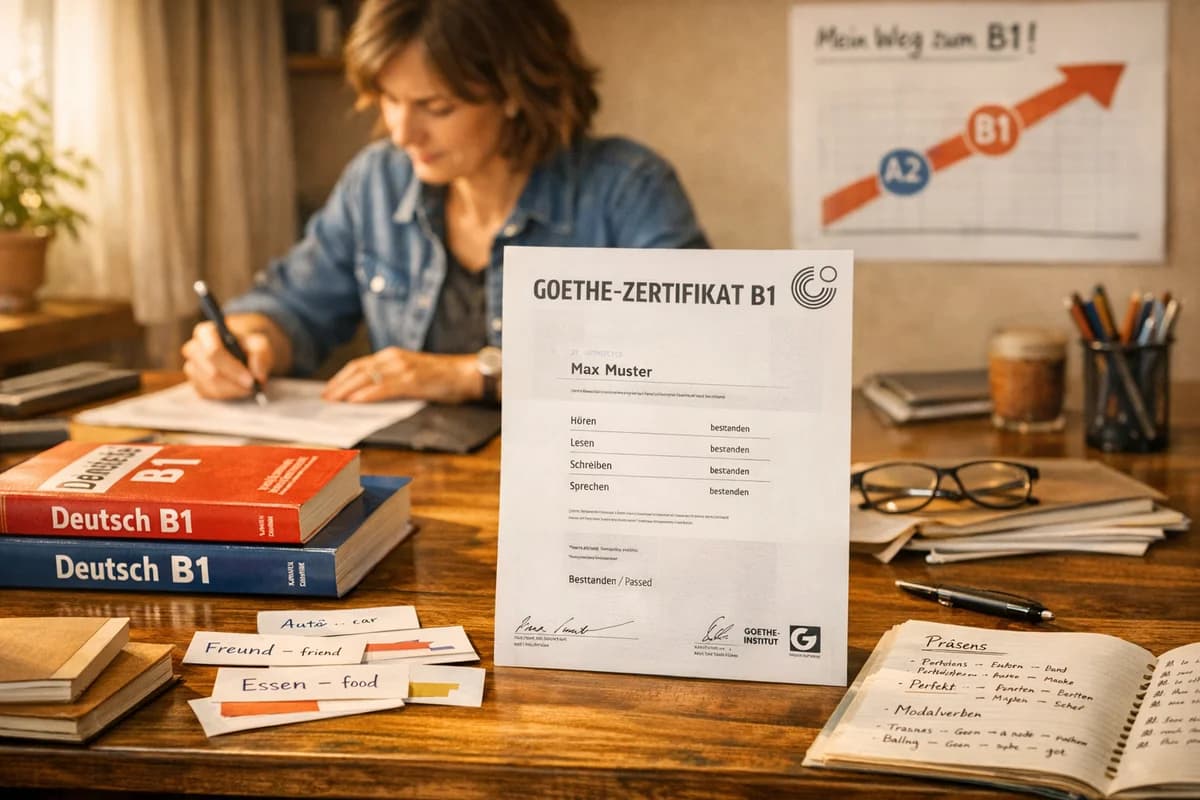
Goethe-Zertifikat (for German): Internationally recognized German language certificates. Goethe B1 or higher is accepted in all German-speaking cantons. Costs range from CHF 250 to CHF 350 depending on the level and test center.
telc (for German): Another widely recognized option. telc Deutsch B1 is accepted for naturalization. Costs are similar to Goethe, around CHF 250 to CHF 300.
DELF/DALF (for French): The standard French language diplomas. DELF B1 or higher is accepted in French-speaking cantons. Costs are around CHF 300 to CHF 400.
CELI/CILS (for Italian): Italian language certificates accepted in Italian-speaking cantons.
Some cantons also have their own language tests. For example, the Canton of Zurich offers the KDE (Kantonaler Deutschtest für die Einbürgerung), which is specifically designed for the naturalization process and costs less than some alternatives.
When choosing a test, check two things: first, that your canton accepts it; second, that the certificate covers both the spoken and written levels you need. Some tests assess all four skills in one exam, while others split them into separate modules.
Who Is Exempt
Not everyone needs to take a language test. Several groups are exempt from providing a certificate.
Native speakers: If the national language of your municipality is your mother tongue — for example, you're a German citizen living in Zurich, or a French citizen living in Lausanne — you generally don't need a certificate. You'll need to declare this and may need to provide supporting evidence (e.g., proof of schooling in that language).
People educated in Switzerland: If you completed at least 5 years of compulsory schooling in Switzerland in the local language, or attended a Swiss university or vocational training in the local language, you're typically exempt. Your diploma or school records serve as proof.
Holders of specific diplomas: If you hold a diploma from a Swiss secondary school (Maturität/maturité), a Swiss university degree, or a Swiss federal vocational diploma (EFZ/CFC) where the language of instruction was a national language, this usually counts as sufficient proof.
People with certain disabilities: If a medical condition prevents you from learning a language or taking a test, you may be exempt. This requires medical documentation and is assessed on a case-by-case basis.
Illiterate applicants: If you can demonstrate that you were unable to learn to read and write due to your life circumstances, the written requirement may be waived — but the spoken requirement still applies.
If you think you might be exempt, check with your canton before spending money on a test. Each canton has its own process for granting exemptions, and the documentation requirements vary.
How to Prepare for the Language Test
If you need to take a language test, preparation is key — especially if you're aiming for B1 spoken, which is the level most people find challenging.
Start by taking a free practice test. The fide website offers a free Modelltest that shows you exactly what the fide exam looks like — the format, the types of questions, and the difficulty level. Even if you're planning to take a different test (Goethe, telc), the fide practice test gives you a good sense of what B1 looks and feels like.
If you're already at A2 and need to reach B1, plan for 3 to 6 months of preparation. The jump from A2 to B1 is significant — A2 is about surviving in daily situations, while B1 is about expressing yourself independently. Most people underestimate this gap.
Language courses are the most effective path for most people. Look for B1 preparation courses offered by Migros Klubschule, VOX, Benedict, Flying Teachers, or your local adult education center (Volkshochschule). Intensive courses (4-5 days per week) can get you to B1 in about 3 months. Part-time courses (2-3 evenings per week) take closer to 6 months.
Supplement courses with daily practice. Listen to Swiss German radio (SRF), watch the Tagesschau, read 20 Minuten. The more you expose yourself to the language in real contexts, the more natural the test will feel.
For the written portion (A2), practice writing short texts: messages to a neighbor, emails to your child's teacher, simple complaint letters. The written test at A2 isn't about perfect grammar — it's about communicating clearly enough to be understood.
Book your test date early. Popular test centers fill up weeks in advance, and you don't want to delay your naturalization because you couldn't get a test slot.
Canton-Specific Differences
While the federal government sets the minimum at B1 spoken and A2 written, cantons can — and do — set higher requirements. Here are some important differences to be aware of.
Several German-speaking cantons require B1 for both spoken and written skills, not just spoken. This means you need a higher written level than the federal minimum. If you've been told "you need B1," always clarify whether that means B1 oral only or B1 oral and written.
Some cantons accept a wider range of certificates than others. While fide is accepted everywhere, some cantons are more restrictive about which Goethe, telc, or other certificates they recognize. Always verify with your specific municipality.
The Canton of Zurich has its own test, the KDE (Kantonaler Deutschtest für die Einbürgerung). If you're naturalizing in Zurich, this is a popular option — it's designed specifically for the naturalization context, and the municipality can sometimes arrange it directly.
Age-based exemptions vary. Some cantons offer reduced language requirements for older applicants (typically over 55 or 60), recognizing that learning a new language at an advanced age is significantly harder. Not all cantons offer this.
In bilingual cantons like Bern, Fribourg, or Valais, the required language depends on your specific municipality. If you live in the German-speaking part of Fribourg, you need German. If you live in the French-speaking part, you need French.
The bottom line: don't rely on general information alone. Contact your municipality early in the process and ask specifically: which language certificate do you accept, and at what level? Getting this wrong can cost you months.
Language Is Just One Piece of the Puzzle
Getting your language certificate is a milestone, but it's one requirement among several. Once you have it, you still need to demonstrate your knowledge of Switzerland — and that's where the citizenship test comes in.
For ordinary naturalization, most cantons require you to pass a written Einbürgerungstest covering Swiss politics, history, geography, and daily life. For facilitated naturalization through marriage, there's no written test, but SEM assesses your knowledge during the interview. Either way, you need to know your stuff.
The good news is that studying for the language test and studying for the citizenship test complement each other. As your German, French, or Italian improves, reading about Swiss politics and history becomes easier. And as you learn about Swiss systems and institutions, you naturally pick up more vocabulary and context.
To start preparing for the citizenship test alongside your language studies, you can practice with real questions online. The quizzes cover all the topics you'll encounter — from the Federal Council to cantonal knowledge. If you prefer studying on the go, there's also the iOS app with hundreds of practice questions.
Don't wait until you've passed the language test to start learning about Switzerland. Do both in parallel. By the time your language certificate arrives, you'll already be well on your way to passing the citizenship test — and one step closer to your Swiss passport. You can also learn more about the full naturalization requirements and associated costs.