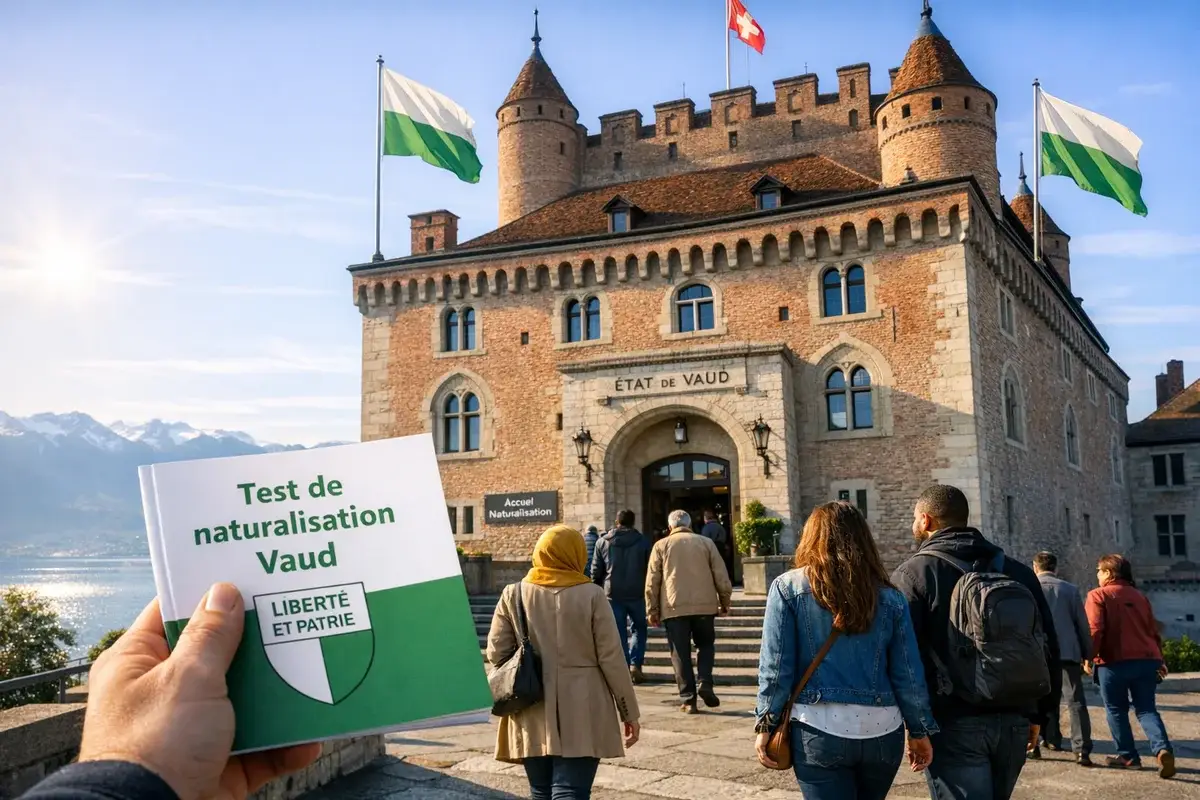
Vaud Has a Real Test – With a Public Question Bank
Candidates for naturalisation in Canton Vaud sit a knowledge test covering Switzerland, the canton and their region, across four themes: history, geography, political institutions and society.
Here is the part that changes your preparation completely: the canton publishes the official questions. On the A-Vaud-Test platform you can practise under exam conditions – 48 random questions in one hour – or work through the entire bank of 160 questions, with the correct answers available. The official sitting that counts in your procedure is organised by your commune of residence, and the canton is explicit that the test is one element among others in the decision.
You can also practise Vaud-specific questions here alongside the official material.
Who Skips the Test
Vaud publishes the exemptions precisely. You do not sit the knowledge test if you were born in Switzerland and have lived here without interruption, if you completed five years of compulsory schooling in Switzerland, if you hold an upper-secondary qualification such as a VET diploma or a matura, or if you are under twelve when the application is filed. The cantonal regulation adds that anyone who went through compulsory schooling in Switzerland is exempt as of right.
The canton also commits to taking personal circumstances into account: a physical, mental or psychological disability, a serious or long-term illness, or major difficulties with learning, reading or writing can justify adaptations – with supporting evidence, which is on you to provide.
Residence Years and Permits – Including the Communal Twist
The federal frame: 10 years of residence in Switzerland, of which 3 continuous years within the 5 before filing; under federal law, years lived here between ages 8 and 18 count double. Vaud adds its own layer: 2 years in the canton, including the year immediately before you file, and you must actually reside here through the procedure – in Vaud until the communal stage ends.
One detail that surprises people: some Vaud communes additionally require a year of residence in that commune. Ask your commune's greffe before you plan the timing.
On permits: you apply with a valid C permit (or a carte de légitimation/Ci permit, provided you previously held a C). For counting the years, B and C count in full, F counts half, and L, G, N and S do not count at all.
French: B1 Spoken, A2 Written – the fide Passport Route
The required level is B1 spoken and A2 written. The standard proof in Vaud is the fide language passport; without one, you take a French exam arranged through the secretariat.
You are exempt from providing the passport if French is your mother tongue, if you did five years of compulsory schooling in Switzerland in French, if you hold an upper-secondary qualification (CFC, matura) or a tertiary-level qualification taught in French, or if you hold a recognised certificate – the dossier checklist explicitly accepts DELF, TCF and TEF diplomas. The same personal-circumstances clause as for the test applies here too.
How to Prepare When the Questions Are Public
Vaud is one of the most transparent cantons in Switzerland: 160 official questions, all with accessible answers, plus a one-hour exam simulation of 48 random questions. The cantonal regulation sets the pass mark at 70 percent, which in Lausanne's version of the test means 33 correct answers out of 48, and you may sit the official test up to three times, with the best result counting. The strategy writes itself: work through all 160 by theme first, then switch to timed 48-question runs until passing feels routine. The practice platform does not record your results, so use it freely.
For depth beyond question-and-answer drilling, the cantonal integration office (BCI) provides «Présentation de la Suisse et du canton», written and read-aloud texts with illustrations. Remember that the questions about your commune come from a list your own commune has drawn up, so ask the greffe for it. That combination, plus structured practice by topic, covers both the memorisation and the understanding the interview stage expects.
Test Your Knowledge
Try 5 free questionsThe Dossier, the Fees and the Legal Deadlines
The application file includes a copy of your valid C permit, valid identity documents, residence attestations proving the ten years in Switzerland, and your French proof: the fide passport, a confirmation of five years of French-language schooling, an upper-secondary or tertiary diploma taught in French, or a DELF, TCF or TEF diploma. Confirmations of registration for a language exam are not enough on their own. You send the complete file by post to the Service de la population in Lausanne; there is no in-person filing.
The fees are published. The canton charges CHF 450 for an individual application and CHF 550 for a family application (CHF 200 if it decides not to consider the file), the Confederation CHF 100 per adult, CHF 50 per minor and CHF 150 for couples or families, and your commune between CHF 100 and 400 for an individual and CHF 200 and 500 for a family; Lausanne charges CHF 250 and lists a further CHF 75 for the civil-status identity check. A single adult therefore pays between CHF 650 and 950 before any language exam, and the fee stays due if the application is withdrawn or refused.
The canton publishes no overall duration, but the law sets deadlines: the commune must hold the test within six months of receiving your file and issue its closing notice within twelve, and no more than 18 months may pass between filing and the communal decision. After that come the Council of State's opinion, the federal authorisation and the solemn promise before the Council of State, which you must make within six months of the summons. Start earlier than feels necessary.