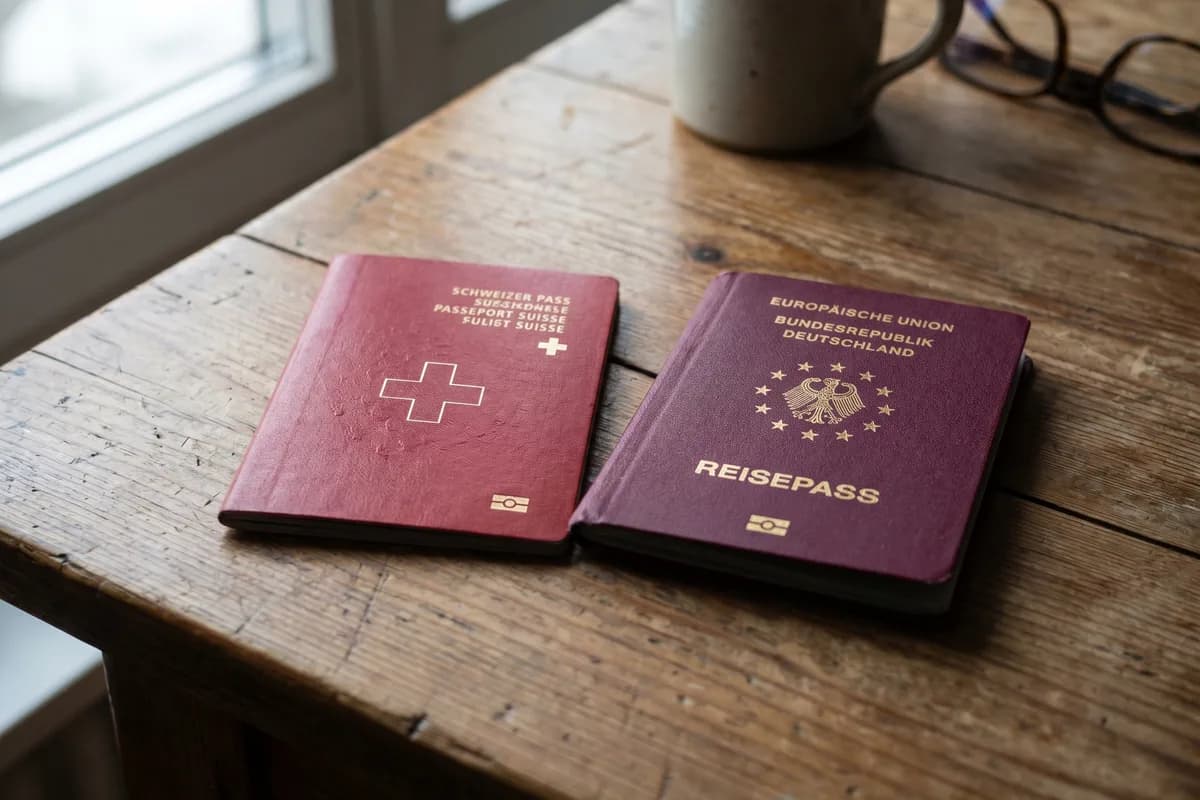
Do Both Countries Allow Dual Citizenship?
Short answer: yes – on both sides. Germans are the largest foreign community in Switzerland, so this question comes up constantly, and the good news is that the old worry of having to give up one passport is largely gone.
Switzerland has allowed dual (and multiple) nationality without restriction since 1 January 1992. If you naturalise here, Switzerland does not ask you to renounce your previous nationality – you keep your German passport as far as Swiss law is concerned. Whether you can actually keep it depends only on what your other country permits.
Germany historically discouraged multiple nationality, which is where the old "must I give up my German passport?" fear came from. That changed with the reformed Staatsangehörigkeitsgesetz (StAG), in force since 27 June 2024: Germany now generally permits multiple citizenship. So a German who becomes Swiss can, as a rule, stay German too (state 2026 – please verify the current rules for your individual case with the German authorities).
Because both sides now say yes, Switzerland–Germany dual citizenship is, for most people, straightforward. Official references: for Switzerland the State Secretariat for Migration (sem.admin.ch) and ch.ch; for the German side, the responsible German mission or naturalisation authority.
A German Becomes Swiss: What Happens to the German Passport
This is the most common scenario, so let's be concrete.
When you naturalise in Switzerland, Switzerland adds Swiss citizenship – it never strips away your German one. Swiss law has not required renunciation since 1992. So the only question is whether Germany lets you keep your German citizenship after you voluntarily acquire the Swiss one.
Under the old German rules, voluntarily acquiring a foreign nationality could mean automatically losing your German one unless you had obtained a "Beibehaltungsgenehmigung" (retention permit) in advance. That is exactly the trap that gave the topic its bad reputation.
With the StAG reform in force since 27 June 2024, Germany generally accepts multiple nationality, so for most people acquiring Swiss citizenship no longer costs you your German passport. Still, two practical rules of thumb (state 2026):
- Check before you swear in. If any doubt remains, clarify your status with the competent German authority before the Swiss naturalisation is finalised.
- Order of acquisition can matter. Acquiring Swiss citizenship through Swiss naturalisation is different from cases where a passport is held from birth. Confirm how the current German rules treat your specific situation.
In short: as far as Switzerland is concerned you keep both. The German side is now permissive too – just verify your individual case with the German authorities rather than assuming.
A Swiss Citizen Becomes German: A Short Overview
The reverse direction works much the same way today.
Switzerland does not withdraw your Swiss citizenship when you acquire German citizenship. Swiss nationals may hold other nationalities freely (sem.admin.ch). So becoming German does not endanger your Swiss passport.
Germany, since the StAG reform of 27 June 2024, has also shortened and eased its naturalisation path and generally allows applicants to keep their previous nationality. A Swiss person naturalising in Germany can therefore, as a rule, remain Swiss while gaining German citizenship (state 2026).
The exact German residency periods, language and integration requirements are set by German law and are outside the scope of this Swiss-focused guide – check them with the competent German authority. The key takeaway for Swiss readers: acquiring German citizenship no longer means losing your Swiss one, and Switzerland has never required you to choose.
Practical Consequences: Travel, Voting, Taxes, Military Service, Consular Protection
Holding two passports is convenient, but it also comes with duties in both states. Here is what actually changes day to day.
Travel and passports. You may hold and use both a Swiss and a German passport. A practical rule: enter and leave each country on that country's passport. Within the EU/Schengen area, both documents serve you well.
Voting rights. You gain full Swiss political rights – you can vote and stand for election at federal, cantonal and communal level. You keep your German voting rights too, subject to German rules. Two citizenships can mean two ballot papers.
Taxes. Dual citizenship by itself does not make you taxable in both countries – taxation generally follows residence, not the passport. Where you live and earn drives your tax liability, and the Switzerland–Germany double-taxation agreement allocates taxing rights to avoid being taxed twice. If you live and work in Switzerland, you are normally taxed in Switzerland; cross-border situations should be checked with a tax adviser.
Military / civil service. As a Swiss male citizen you become subject to Swiss compulsory service (military or civil service / Wehrpflicht). Service obligations in another country are governed by that country's law; clarify how a second citizenship affects any service duty for your case.
Consular protection. Each country protects its own nationals abroad – but, as a general principle of international law, a state normally does not extend diplomatic protection against the other country whose nationality you also hold. In your other home country, you are typically treated as its citizen first.
For the authoritative details on the Swiss side, see ch.ch and sem.admin.ch; for German obligations, the German authorities.
Requirements for Swiss Naturalisation – in Brief
Keeping your German passport only matters once you actually qualify for Swiss naturalisation. Here is the short version for the ordinary route.
- Residence: generally 10 years living in Switzerland, with at least 3 of the last 5 years before applying. Years spent in Switzerland between age 8 and 18 count double (but the real total must be at least 6 years).
- Settlement permit: you normally need a C permit at the time of application.
- Integration and language: you must be integrated, respect the constitution and public order, and prove a national language. As a guide, oral level B1 and written A2 is the federal benchmark (see fide-service.ch for recognised language certificates).
- Cantonal and communal conditions: your canton and municipality add their own residency periods and a knowledge-of-Switzerland test. Requirements differ a lot from place to place – compare them on our cantons overview.
Married to a Swiss citizen? There is a separate, often faster facilitated naturalisation route – see the linked article on naturalisation through marriage. For the full eligibility picture, read our dedicated requirements guide, and use the pricing page to see what the all-in preparation costs.
For the binding legal criteria, always rely on the State Secretariat for Migration (sem.admin.ch) and ch.ch.
Please Note: This Is Not Legal Advice
This article is for general information only and is not legal advice. Citizenship law changes, and the way it applies depends on your individual situation. The decision on your naturalisation always lies with your municipality (Gemeinde), your canton, and the State Secretariat for Migration (SEM) – and, for the German side, with the competent German authorities.
Before you act on anything here, verify the current rules with the official sources: sem.admin.ch and ch.ch for Switzerland, fide-service.ch for recognised language certificates, and the responsible German mission or naturalisation authority for the German consequences. For binding answers on a specific case, consult a qualified specialist.
Next Step: Prepare for the Citizenship Test
Once you know you can keep your German passport, the practical hurdle that remains is the knowledge-of-Switzerland test that most cantons require for ordinary naturalisation. The good news: it is very learnable, and as a German speaker the language is no barrier for you.
The test covers Swiss politics and direct democracy, history, geography, everyday life and your canton's specifics. The most reliable way to pass is repetition with realistic questions – not just reading a brochure once.
With our app you can do exactly that. Drill the material with flashcards, then sit a timed mock exam under real conditions to see where you stand, and follow a structured curriculum so nothing is left to chance. You can create a free account and start practising in minutes.
Test Your Knowledge
Try 5 free questions