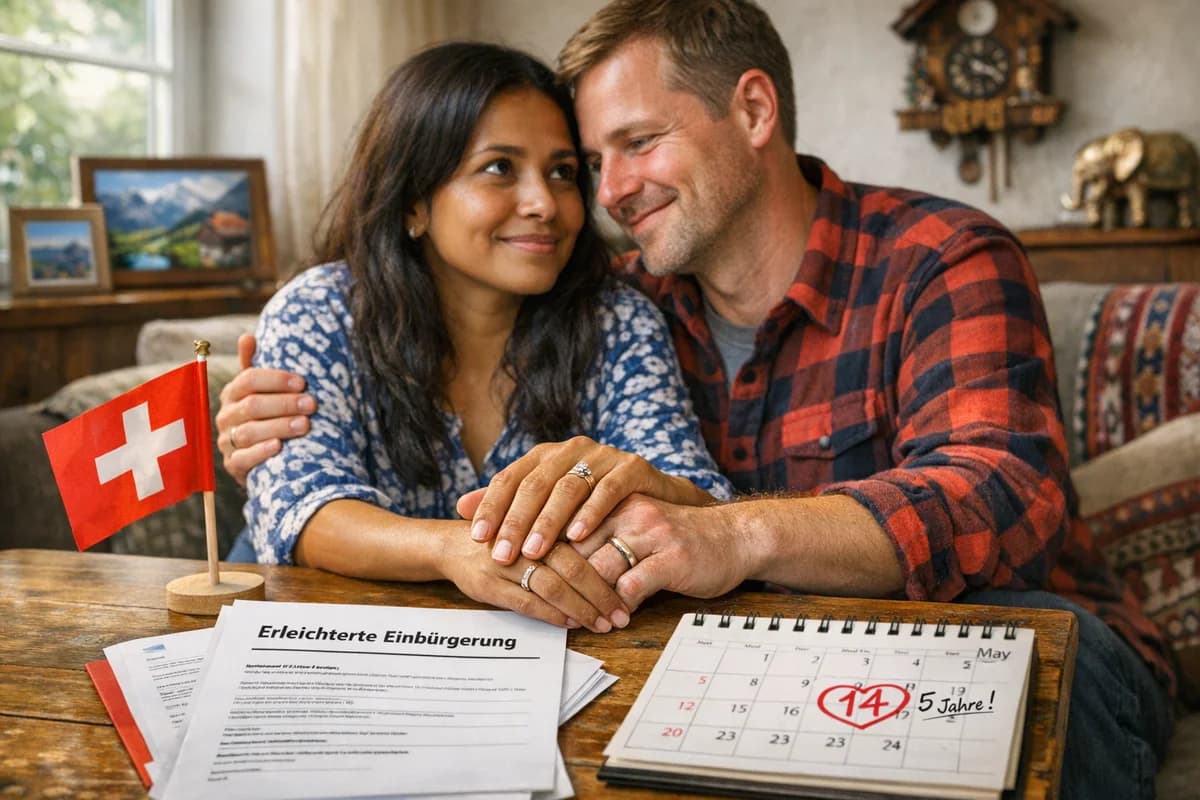
It's Not Automatic
The biggest myth about Swiss citizenship through marriage is that it happens automatically. It doesn't. Marrying a Swiss citizen does not make you Swiss — not after one year, not after ten years, not ever, unless you actively apply.
What marriage does give you is access to a faster, simpler process called facilitated naturalization (erleichterte Einbürgerung). Instead of going through the regular naturalization process — which requires 10 years of residence, a C permit, and approval at three levels of government — you can apply through a streamlined federal procedure with shorter residency requirements and lower fees.
About 8,000 people per year obtain Swiss citizenship through this path. It's the second most common route after ordinary naturalization. But every single one of them had to apply, meet the requirements, and go through an assessment. Nobody got a passport in the mail just because they signed a marriage certificate.
This distinction matters because it shapes how you should plan. If you're marrying a Swiss citizen and want citizenship eventually, you need to understand the requirements from the start — not assume it will sort itself out later.
Who Qualifies
To apply for facilitated naturalization through marriage, you need to meet two main conditions — and they depend on whether you live in Switzerland or abroad.
If you live in Switzerland: you must have been married to your Swiss spouse for at least 3 years and have lived in Switzerland for at least 5 years in total. You don't need a C permit — a B permit is sufficient. Your spouse must have been a Swiss citizen at the time of the marriage.
If you live abroad: you must have been married for at least 6 years and demonstrate close ties to Switzerland. Close ties means regular visits, contacts with people in Switzerland, and knowledge of a Swiss national language. The 5-year residency requirement doesn't apply, but the bar for proving your connection to Switzerland is higher.
Same-sex couples qualify on exactly the same terms since July 2022, when Switzerland introduced marriage for all. Registered partnerships entered before that date are treated equally.
In both cases, you must also meet integration criteria: you must be integrated into Swiss society, comply with the legal system, and not pose a threat to internal or external security. You need to speak a national language at level B1 (spoken) and A2 (written).
One detail that catches people off guard: your spouse must have been Swiss at the time you married. If your partner naturalized after your wedding, the clock doesn't start until their naturalization date — you may need to wait longer than expected.
The Process Step by Step
Facilitated naturalization is handled entirely by the federal government — specifically the State Secretariat for Migration (SEM). Unlike ordinary naturalization, your commune and canton are not involved in the decision. This makes the process simpler, but it still takes time.
Step 1: Request the application forms from SEM. You can do this online or by mail. SEM will send you the forms along with a list of required documents.
Step 2: Gather your documents. You'll need your marriage certificate, proof of residency, a language certificate (B1 spoken, A2 written), a clean criminal record, and various identity documents. If you live abroad, you'll also need evidence of your ties to Switzerland. Collecting everything can take several weeks.
Step 3: Submit the completed application to SEM along with the fee of approximately CHF 900. This covers the federal processing costs.
Step 4: Wait for SEM to process your application. They'll verify your documents, check your background, and — if everything is in order — schedule an interview. The waiting time is typically around 9 months, but can vary.
Step 5: Attend the interview. SEM conducts the interview, often by phone or video call. They'll ask about your life in Switzerland, your integration, and your knowledge of the country. This is not a formal test, but they do assess your Swiss knowledge.
Step 6: SEM makes the decision. If approved, you receive Swiss citizenship. The total process from submission to decision typically takes 18 to 24 months.
Facilitated vs Ordinary Naturalization
Understanding the difference between the two paths helps you see why facilitated naturalization is the better deal — if you qualify.
Residency requirement: Facilitated naturalization requires 5 years of residence in Switzerland (plus 3 years of marriage). Ordinary naturalization requires 10 years of residence.
Permit: For facilitated naturalization, a B permit is enough. Ordinary naturalization requires a C permit (permanent residency).
Process: Facilitated naturalization is handled by SEM at the federal level only. Ordinary naturalization requires approval at three levels — municipality, canton, and federal government. That means three separate applications, three reviews, and three sets of requirements.
Test: Facilitated naturalization has no formal Einbürgerungstest. Your knowledge is assessed in a conversational interview. Ordinary naturalization in most cantons requires passing a written citizenship test.
Cost: Facilitated naturalization costs approximately CHF 900. Ordinary naturalization typically costs CHF 2,000 to CHF 5,000 or more, depending on your canton and municipality — because you pay fees at all three levels.
Timeline: Facilitated naturalization takes about 18 to 24 months from application to decision. Ordinary naturalization often takes 2 to 4 years.
The trade-off is clear: if you're married to a Swiss citizen and meet the requirements, facilitated naturalization is faster, cheaper, and simpler. The main advantage of ordinary naturalization is that it doesn't require marriage — it's available to anyone who meets the residency and integration requirements.
What Happens If You Divorce
This is one of the most common questions — and the answer depends on timing.
If you divorce before a decision is made on your application: the application is terminated. Facilitated naturalization requires an ongoing marriage, so if the marriage ends during the process, SEM will close your case. You'd need to start over through ordinary naturalization if you still want Swiss citizenship.
If you divorce after receiving citizenship: you keep your citizenship. Swiss law does not revoke citizenship because of divorce. Once you're Swiss, you're Swiss — your marital status doesn't change that.
There is one exception: fraudulent marriages. If SEM determines that the marriage was entered into primarily to obtain citizenship — a so-called Scheinehe — they can revoke your citizenship. SEM revokes approximately 50 citizenships per year on these grounds.
The discovery window is important: SEM has 2 years from the moment they discover the fraud to initiate revocation proceedings. But there's also an absolute limit — revocation is only possible within 8 years of the citizenship being granted. After 8 years, your citizenship cannot be revoked for this reason, regardless of what comes to light.
What counts as fraud? It's not just about whether the marriage was "real" emotionally. SEM looks at whether the applicant concealed relevant facts during the process — for example, that the couple was already separated, or that a divorce was planned. If you were honest throughout the process and the marriage simply didn't last, you have nothing to worry about.
How to Prepare
Even though facilitated naturalization doesn't have a formal written test, you still need to demonstrate knowledge of Switzerland during the interview. And the language requirement is non-negotiable. Here's how to get ready.
Language certificate: You need at least B1 for spoken skills and A2 for written skills in a Swiss national language (German, French, Italian, or Romansh). If you don't already have a certificate, plan ahead — getting one can take months between course enrollment, preparation, and exam scheduling. Accepted certificates include fide, telc, Goethe, and DELF/DALF.
Documents: Start gathering documents early. Birth certificates, marriage certificates, and criminal record extracts from your home country often need to be apostilled or legalized, which takes time. Some documents have expiry dates, so coordinate the timing carefully.
Swiss knowledge for the interview: Even without a formal test, the SEM interview will cover your knowledge of Swiss politics, geography, history, and daily life. You should know the basics — how the federal system works, the cantons, the political system, and the social insurance system. Preparing for the interview is essentially like studying for the citizenship test, just without the multiple-choice format.
To practice Swiss knowledge, you can take practice quizzes online covering all the topics that come up in the interview. There's also a dedicated iOS app that lets you study on the go with hundreds of practice questions.
⏰ Don't wait: Language certificates can take 3-6 months to obtain. Book your test date early — popular centers fill up weeks in advance. Start preparing today to avoid another year of waiting.
Test Your Knowledge
Try 5 free questions