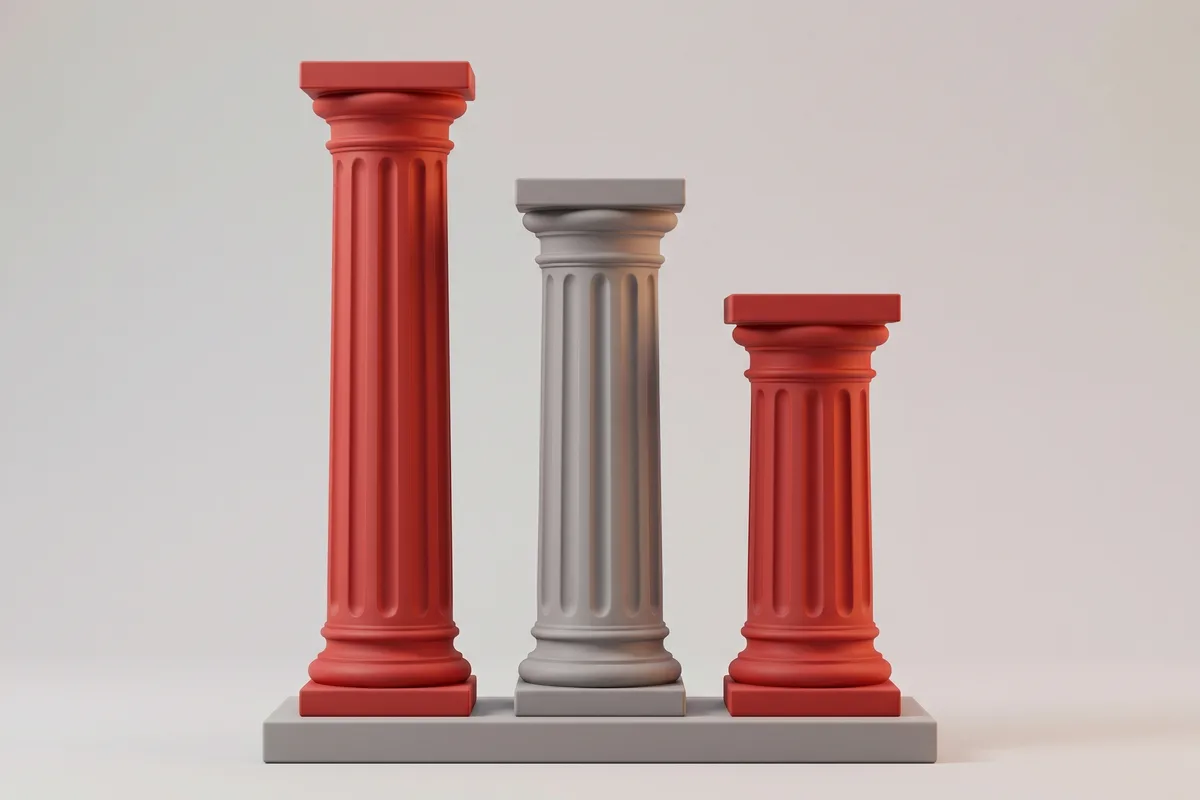
The Three-Pillar System at a Glance
In Switzerland, your retirement income doesn't come from a single source. It rests on three pillars – three separate systems that build on top of each other. Together they're meant to let you keep living roughly the way you're used to once you stop working.
The idea is simple. Each pillar has its own job:
- 1st pillar (AHV/IV): the state pension. It covers basic living needs and is mandatory for everyone.
- 2nd pillar (occupational pension / pension fund, BVG): maintains your accustomed standard of living. Mandatory for employees above a certain income.
- 3rd pillar (private provision): voluntary, to close any gaps and save tax.
The three-pillar principle is even anchored in the Federal Constitution (Article 111). You'll find the official basics on the government portal ch.ch. Below we go through each pillar in plain language. One note up front: this is general information, not financial advice – for your personal situation, talk to an independent advisor or your pension fund.
1st Pillar – AHV/IV (the State Pension)
The first pillar is the AHV (old-age and survivors' insurance) together with the IV (disability insurance). Its job is to cover your basic living needs in old age, or if you become disabled, or for surviving family members after a death.
Three things make it special:
- It's mandatory for everyone. Anyone living or working in Switzerland pays in – employees from their first franc of salary, and even people without paid work contribute from a certain age.
- It runs on a pay-as-you-go basis (Umlageverfahren). The contributions paid in today are immediately used to pay out today's pensions. You're not saving in a personal account; the working generation finances the retired generation.
- It's solidarity-based. Higher earners pay in more than they will ever get back, which helps fund the minimum pensions.
For employees, the AHV/IV contribution is split roughly half-and-half between you and your employer and deducted straight from your wage. The official details are on the government social-insurance pages at sem.admin.ch and ch.ch. The exact contribution rates and the reference retirement age can change – check the current figures there (Stand 2026).
2nd Pillar – Occupational Pension (Pension Fund / BVG)
The second pillar is the occupational pension, run through your employer's pension fund (Pensionskasse) and governed by the BVG law. While the first pillar only covers the basics, the second pillar is meant to let you keep your accustomed standard of living in retirement.
How it works:
- It's mandatory for employees above an income threshold. Once your annual salary with one employer exceeds a defined minimum, you must be insured in a pension fund. Below that threshold (and for many self-employed people) it isn't compulsory.
- Employer and employee both pay in. The contributions are split between you and your employer – by law your employer must pay at least as much as you do.
- It's funded capital (Kapitaldeckungsverfahren). Unlike the AHV, the money is saved up in your own pension account over your working years. At retirement you receive it as a monthly pension, a lump sum, or a mix.
When you change jobs, your accumulated capital (the Freizügigkeitsleistung) moves with you to the new fund. The exact threshold and conversion rate are set by law and can be adjusted – the current values are published via ch.ch (Stand 2026).
3rd Pillar – Private Provision (Pillar 3a and 3b)
The third pillar is private, voluntary saving. Nobody forces you to do it, but it's how many people close the gap between the first two pillars and the income they actually want in retirement. It comes in two flavours:
- Pillar 3a (tied provision / gebundene Vorsorge): This is the tax-favoured one. You can pay in up to an annual cap and deduct that amount from your taxable income, which lowers your tax bill. In return, the money is tied – you can normally only withdraw it for retirement, buying your own home, becoming self-employed, or leaving Switzerland for good. The maximum yearly contribution is set each year (Stand 2026 – check the current figure on ch.ch) and differs between employees who already have a pension fund and people without one.
- Pillar 3b (flexible provision / freie Vorsorge): This is everything else you save freely – ordinary savings accounts, investments, certain life-insurance policies. It's flexible: no cap, no withdrawal restrictions, but generally no special tax deduction either.
In short: 3a = tied but tax-advantaged, 3b = free but without the tax break.
How the Three Pillars Work Together
The pillars aren't alternatives – they build on each other. Here's the logic at a glance:
- 1st pillar – AHV/IV (state): what it is – the state pension; goal – cover basic needs; mandatory – yes, for everyone.
- 2nd pillar – Pension fund (BVG): what it is – the occupational pension; goal – keep your standard of living; mandatory – yes, for employees above the threshold.
- 3rd pillar – Private (3a / 3b): what it is – private provision; goal – close the gaps; mandatory – no, voluntary.
The key number to remember: pillars 1 and 2 together aim for roughly 60% of your last salary. That's the design target of the system – enough to keep your accustomed standard of living, but not a full replacement of your working income.
That 60% figure is exactly why the third pillar matters. If you want to get closer to your previous income, or if you have gaps in pillars 1 and 2 (for example from years working abroad, part-time work, or a late start in Switzerland), private provision is how you top up. The earlier you start saving in pillar 3a, the more those tax-advantaged francs can grow.
Why It Comes Up in the Citizenship Test
The three-pillar system isn't just exam trivia – it's part of everyday Swiss life, and that's exactly why it shows up in the citizenship test. Most cantonal tests have a social system / insurance block (Sozialsystem und Versicherungen), and the three pillars are a classic topic there.
Typical questions you should be able to answer:
- What does the first pillar (AHV) secure? → The basic living needs / existence.
- Which pillar is the occupational pension, and how is it funded? → The second pillar (pension fund / BVG), paid by employer and employee.
- What's the difference between pillar 3a and 3b? → 3a is tied and tax-advantaged; 3b is free.
- Which pillars are mandatory? → The first (everyone) and the second (employees above the income threshold). The third is voluntary.
Knowing this also signals genuine integration into Swiss life – understanding how you're insured here is part of being at home in Switzerland.
The best way to lock it in is active practice. Drill the social-system questions with flashcards, then run a full mock exam to see where you stand. When you're ready to prepare seriously, you can unlock the full question bank.
Test Your Knowledge
Try 5 free questions