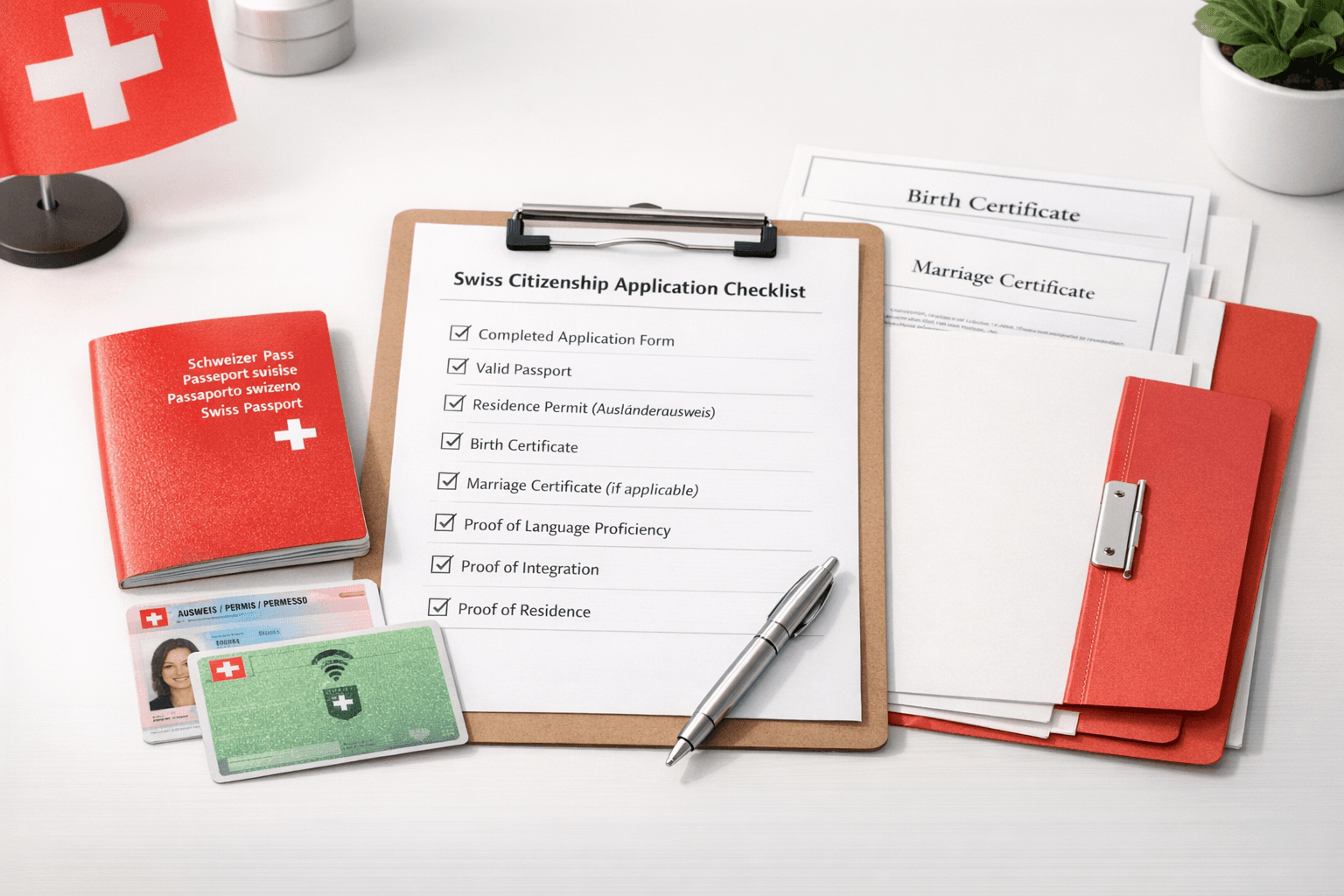
Why Document Preparation Matters
The Swiss naturalization process is strict about documentation. Missing or incorrect documents are the number one reason for delays and rejections. The State Secretariat for Migration (SEM) and cantonal authorities will return your application if required documents are missing — and you will lose your place in the queue.
Based on 2026 SEM guidelines, most applications require 15-20 documents, including originals, certified translations, and copies. Some documents need to be less than 6 months old. Others must be originals or certified copies.
Start gathering documents at least 6 months before you plan to apply. Some documents from your home country can take weeks or months to obtain, especially if they need an apostille or official translation.
Pro tip: Create a dedicated folder for your citizenship application. Keep copies of everything you submit. Authorities may request documents you have already provided, and having copies ready saves time.
Core Identity Documents
These documents establish who you are and your legal status in Switzerland. All are required without exception.
Valid Passport — Must be valid for at least 12 months beyond your application date. Bring the original plus a clear copy of the bio page.
C Permit (Niederlassungsbewilligung) — Permanent residence permit. You must hold a C permit at the time of application. Bring the original card plus front and back copies.
Complete Residence Permit History — Copies of ALL residence permits you have held in Switzerland. This includes F permits (counted at half value), B permits, and your current C permit. Do not skip any permits — authorities need your complete history to verify the 10-year residency requirement.
Certificate of Domicile (Wohnsitzbescheinigung) — Available from your municipal office. Confirms how long you have lived in your current municipality. Most cantons require 2-5 years of residence in the same canton before applying.
Civil Status Documents
These documents prove your family and marital status. Requirements vary depending on your situation.
Birth Certificate — Required for everyone. Must be the full certificate showing parents' names. If not in a Swiss national language (DE/FR/IT/Romansh), you need a certified translation.
Marriage Certificate — If currently married or previously married. If divorced, you also need the divorce decree. If widowed, the death certificate of your spouse.
Children's Birth Certificates — If including children in your application, each child needs their own birth certificate.
Name Change Documentation — If you have legally changed your name (marriage, divorce, court order), provide the official documentation.
Validity: Civil status documents from your home country typically need to be issued within the last 6-12 months. Check with your canton — some accept older documents, others require recent ones.
Language Certificate
You must prove your language proficiency in the national language of your municipality.
Required Level: Federal minimum is B1 for speaking/listening and A2 for reading/writing (CEFR). Some cantons require higher levels — check our canton guides.
Accepted Tests: fide test (most common), Goethe-Zertifikat B1, telc B1, DELF B1 (French), CELI/CILS (Italian). Your canton may also offer its own test.
Exemptions: You may not need a certificate if you completed 5+ years of Swiss schooling or hold a Swiss diploma (Matura, EFZ/CFC). Check with your municipality.
Validity: Language certificates are generally valid for life. However, if your certificate is very old (10+ years), authorities may request a new one to verify current proficiency.
Financial Documents
You must prove financial independence and compliance with Swiss tax obligations.
Federal and Cantonal Tax Returns — The most recent 2-3 years. Some cantons require up to 5 years of tax history. Contact your tax office for official copies.
Salary Statements — The last 6 months of pay slips from your employer. If self-employed, profit and loss statements plus tax declarations.
Social Welfare Declaration (Sozialhilfe-Freiheit) — Proof that you have not received social assistance benefits in the past 3-5 years (varies by canton). This document is available from your social services office.
Debt Register Extract (Betreibungsregisterauszug) — Available from your local debt enforcement office. Shows any outstanding debts or enforcement proceedings. Most cantons require a clean record or proof that debts have been settled.
Note: Unemployment insurance (ALV) is NOT the same as social assistance and does not count against you.
Criminal Record Certificate
A clean criminal record is required for Swiss citizenship.
Swiss Criminal Record — Available from the Federal Office of Justice (FOJ). Apply online at www.fedpol.admin.ch. Processing takes 1-2 weeks. Costs approximately CHF 20.
Foreign Criminal Record — If you have lived in countries other than Switzerland, you may need a criminal record extract from each country. This typically requires an apostille and certified translation.
Validity: Criminal records must be issued within the last 6 months. Older certificates will not be accepted.
Important: Pending criminal proceedings or unpaid fines must be resolved before you can apply. Minor traffic offenses (speeding tickets, parking fines) are generally not a problem if resolved. More serious offenses may require waiting 3-5 years after the sentence is completed.
Certified Translations
Documents not in a Swiss national language require certified translation.
Which Documents Need Translation: Birth certificates, marriage certificates, criminal records, and other civil status documents from abroad must be translated if not in German, French, Italian, or Romansh.
Who Can Translate: Only certified translators (vereidigte Ubersetzer/traducteurs jures) are accepted. Your cantonal website typically has a list of approved translators.
Translation Format: The translation must be on the translator's official letterhead, include their certification number, signature, and date. Some cantons require the translator to stamp the translation.
Cost: CHF 50-150 per document depending on length and language.
Additional Documents (May Apply)
Depending on your situation, you may need additional documents:
Recommendation Letters — Some cantons require 1-3 letters from Swiss citizens who can vouch for your integration. Check your cantonal requirements.
Employment Confirmation — Letter from your employer stating your position, duration of employment, and salary.
Proof of Integration — Evidence of community involvement (club memberships, volunteer work, etc.). This can strengthen your application.
Biometric Passport Photos — 2-3 recent photos meeting Swiss biometric specifications (35x45mm, neutral background, neutral expression).
Diplomas and Certificates — If claiming language test exemptions based on Swiss education, include your diplomas or school transcripts.
Document Validity Rules
Different documents have different validity periods. Timing matters when gathering your paperwork.
6-Month Validity: Criminal records, tax declarations, debt register extracts, and social welfare declarations must typically be issued within the last 6 months.
6-12 Month Validity: Civil status documents (birth, marriage certificates) from abroad should generally be issued within the last 6-12 months, though this varies by canton.
12-Month Validity: Your passport must be valid for at least 12 months beyond your application date.
Unlimited Validity: Language certificates, Swiss diplomas, and marriage/divorce decrees generally do not expire.
Common Document Mistakes to Avoid
Based on 2026 SEM data, these are the most common mistakes that cause application delays:
- Translations older than 12 months — non-certified translations or translations without the translator's stamp
- Incomplete permit history — missing F or early permits that help calculate residency
- No cantonal tax clearance — some cantons specifically require proof of tax compliance
- Old recommendation letters — letters older than 6 months are often rejected
- Wrong format photos — non-biometric photos that do not meet specifications
- Missing signature on translations — translator forgot to sign or date their certification
- Incomplete application forms — blank sections or unsigned declarations
- No municipal residence proof — applicants skip the certificate of domicile
- Outdated criminal records — records older than 6 months are rejected
- Self-translated documents — documents translated by yourself without notarization
Before submitting, triple-check: all documents within validity periods, all translations certified, all signatures present and dated, your photo meets specifications, and all cantonal requirements are met.
Test Your Knowledge
Try 5 free questionsFinal Document Checklist Summary
Use this final checklist before submitting your application:
Identity & Residence
- Valid passport (12+ months validity)
- C permit (original + copies)
- Complete residence permit history (all permits held)
- Certificate of domicile from municipality
Civil Status
- Birth certificate (original + certified translation if needed)
- Marriage/divorce certificates if applicable
- Children's birth certificates if included
Language
- Language certificate (B1 spoken/A2 written) or proof of exemption
Financial
- Federal and cantonal tax returns (2-3 years)
- Salary statements (6 months)
- Social welfare declaration (no benefits 3-5 years)
- Debt register extract
Criminal & Security
- Swiss criminal record (issued within 6 months)
- Foreign criminal records if applicable (with apostille + translation)
Additional
- Biometric passport photos (2-3)
- Recommendation letters (if required)
- Employment confirmation
Remember: Start gathering documents 6 months in advance. Make copies of everything. Check validity dates. Verify translations are certified.
Ready to start your citizenship journey? Practice for your canton's citizenship test with our comprehensive quiz platform.
Test Your Knowledge
Try 5 free questions