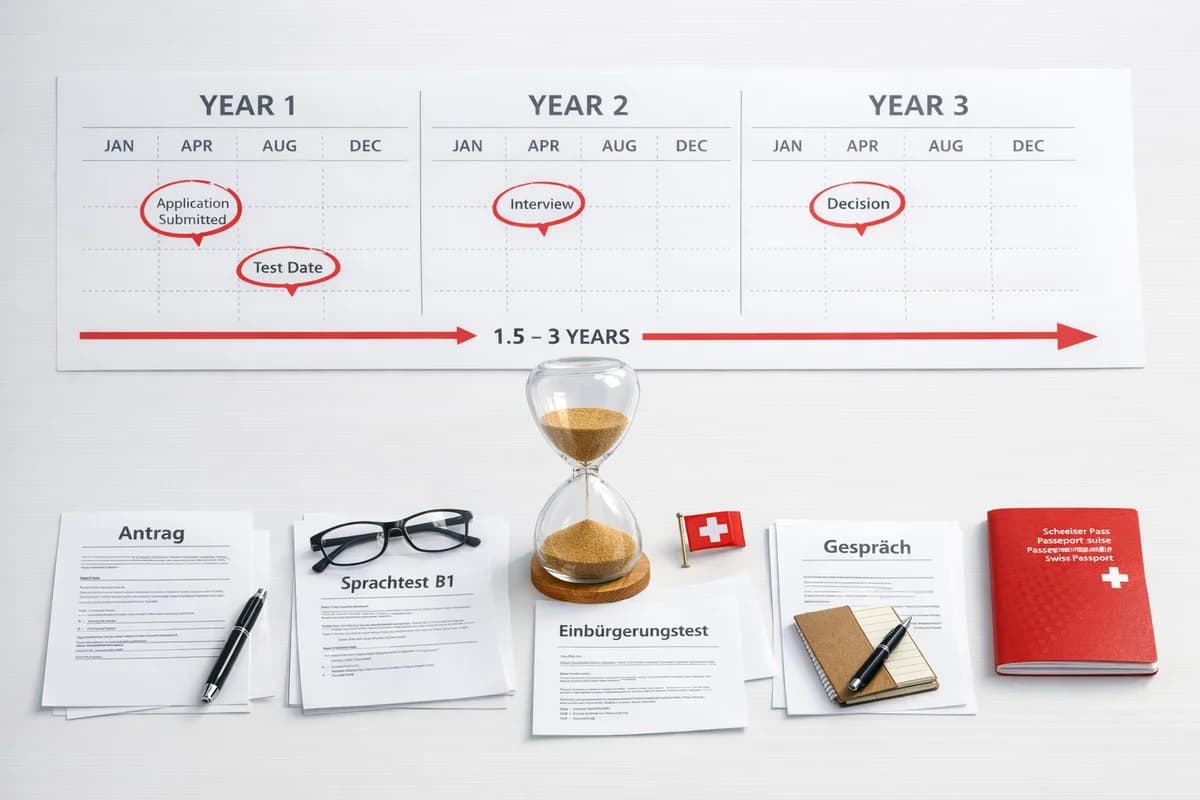
The Short Answer: 1.5 to 3 Years
Swiss naturalization takes between 1.5 and 3 years from application to citizenship ceremony. Most applicants fall in the 2-2.5 year range.
The process moves through three levels:
- Municipality (Gemeinde): 3-12 months
- Canton (Kanton): 6-18 months
- Confederation (Bund): 3-6 months
Why such a wide range? Several factors affect your timeline:
- Your canton – Some process faster than others
- Your municipality – Smaller communes can be quicker or slower
- Application completeness – Missing documents cause delays
- Time of year – Summer and holiday periods slow things down
- Your personal situation – Complex cases take longer
This guide breaks down each stage, what to expect, and how to avoid common delays.
⏰ Don't wait: Test registration deadlines vary by canton – some require 2-3 months advance notice. Start gathering your documents today so you're ready when slots open up.
Stage 1: Municipal Level (Gemeinde) – 3 to 12 Months
Your journey begins at the local municipality (Gemeinde/Commune). This first stage typically takes 3-12 months.
What Happens:
Month 1-3: Document Submission and Initial Review
You submit your application with:
- Valid passport or ID
- Residence permit (C or B)
- Proof of language skills (fide test certificate)
- Birth certificate
- Criminal record excerpt
- Proof of residency (Attestation de domicile)
- Tax returns
- Certificate of health insurance
The municipality checks your documents are complete. Missing items will cause delays – respond quickly to any requests.
Month 3-8: Integration Assessment and Interview
This is where most delays happen. The municipality assesses:
- Your integration into local life
- Participation in community activities
- Knowledge of Swiss customs
- Financial independence
- Clean criminal record
You may be invited to an interview (Einbürgerungsgespräch) where officials ask about your life in Switzerland. Some cantons use a written test instead.
Month 8-12: Municipal Decision
The Gemeinde commission votes on your application. If approved, it moves to the cantonal level. If rejected, you can appeal within 30 days.
How to Speed This Up:
- Submit complete documents upfront
- Join local clubs/associations before applying
- Respond quickly to any additional requests
- Schedule your interview promptly
Test Your Knowledge
Try 5 free questionsStage 2: Cantonal Level (Kanton) – 6 to 18 Months
After municipal approval, your application moves to the cantonal level. This is typically the longest stage, lasting 6-18 months.
What Happens:
Month 1-4: Document Review and Security Check
The cantonal migration office (Migrationsamt) reviews:
- Your municipal application file
- Your residency history
- Your financial situation
- Your integration evidence
- Any potential security concerns
They may request additional information or documentation. Respond promptly – delays here can add months to the timeline.
Month 4-12: Political and Legal Review
The cantonal government conducts:
- Background checks with federal authorities
- Verification of your residency calculations
- Review of any legal impediments
- Assessment of your tax compliance
For facilitated naturalization (erleichterte Einbürgerung), this is when SEM (federal State Secretariat for Migration) conducts their investigation.
Month 12-18: Cantonal Decision
The cantonal government grants their part of citizenship. You'll receive official notification. If approved, your application moves to the federal level.
Why This Stage Takes So Long:
- Cantons have limited staff handling hundreds of applications
- Security checks with federal agencies take time
- Complex cases require additional review
- Some cantons meet only certain times per year
How to Speed This Up:
- Choose a canton with faster processing if you have options
- Ensure your municipal file is complete and accurate
- Provide any requested documents immediately
- Follow up periodically (but not too frequently)
Stage 3: Federal Level (Bund) – 3 to 6 Months
The final stage is the shortest but still important. The federal State Secretariat for Migration (SEM) reviews your application for 3-6 months.
What Happens:
Month 1-2: Final Security and Eligibility Review
SEM conducts:
- Final security background check
- Verification that you meet all federal requirements
- Review of any federal impediments
- Confirmation of cantonal and municipal approvals
This is a formality in most cases – if the canton approved you, SEM typically does too.
Month 2-3: Federal Decision
SEM grants their part of citizenship. You'll receive official notification by mail.
Month 3-6: Citizenship Ceremony Invitation
Once all three levels have approved, you'll receive an invitation to the Einbürgerungsfeier (citizenship ceremony). This typically happens within 3 months of the federal decision.
Why This Stage Is Faster:
- SEM has extensive experience with these applications
- Most issues were already resolved at cantonal level
- Federal requirements are straightforward and consistent
What Happens at the Ceremony:
- You receive your naturalization certificate (Einbürgerungsurkunde)
- You take an oath to the Swiss Confederation
- You may receive a symbolic gift (book about the canton, etc.)
- You can now apply for your Swiss passport
After the Ceremony:
Congratulations! You're now a Swiss citizen. The entire journey took 1.5-3 years, but you finally have your Swiss passport.
Test Your Knowledge
Try 5 free questionsWhat Affects Your Timeline?
Several factors can speed up or slow down your naturalization process:
Factors That Speed Things Up:
✅ Complete application – Submit all required documents upfront ✅ Strong integration evidence – Active community involvement, local references ✅ Clean record – No financial issues or criminal problems ✅ Language proof ready – Valid fide test certificate ✅ Responsive communication – Quick replies to authority requests ✅ Choosing faster cantons – Some process significantly faster than others
Factors That Slow Things Down:
❌ Incomplete documents – Missing information causes months of delays ❌ Integration concerns – Weak community participation requires additional review ❌ Financial issues – Debt, welfare dependence, or bankruptcy ❌ Complex cases – Previous rejections, legal complications, or security concerns ❌ Applying during peak times – Summer months and holiday periods slow processing ❌ Living in slow cantons – Some cantons take 18+ months just at their level
Cantonal Comparison (Processing Times):
- Zurich – 2-2.5 years – Organized, moderate speed
- Bern – 2-3 years – Thorough, can be slower
- Aargau – 2-2.5 years – Average processing time
- Basel-Stadt – 1.5-2 years – Faster, recent fee reductions
- Geneva – 2.5-3 years – Slower, high volume of applications
The Bottom Line:
While you can't control everything, you can influence your timeline significantly by:
- Preparing thoroughly before applying
- Choosing where you live wisely (if possible)
- Staying organized and responsive throughout
- Building strong integration evidence early
Tips for a Smooth Process
While you can't control everything, these steps will help avoid common delays:
Before You Apply:
- Check your eligibility – Confirm you meet 10-year residency requirement
- Get language certification – Complete fide test before applying
- Gather all documents – Have everything ready: birth certificate, criminal record, tax returns
- Build integration evidence – Join clubs, volunteer, get reference letters
- Choose your timing – Avoid applying during summer or holiday seasons
During the Process:
- Respond quickly – Reply to all authority requests within days, not weeks
- Stay organized – Keep copies of everything in a dedicated folder
- Follow up appropriately – Check on status every 2-3 months, not every week
- Be patient but persistent – It's a long process, but stay engaged
- Prepare for the test – If your canton requires a citizenship test, start studying early
Red Flags to Avoid:
⚠️ Don't change jobs or address mid-process without notifying authorities ⚠️ Don't ignore requests for additional information ⚠️ Don't miss scheduled interviews or appointments ⚠️ Don't make large financial changes without advice ⚠️ Don't travel abroad for extended periods during processing
Remember: The naturalization process is a marathon, not a sprint. Starting prepared and staying engaged throughout will get you to the finish line faster.
Test Your Knowledge
Try 5 free questions