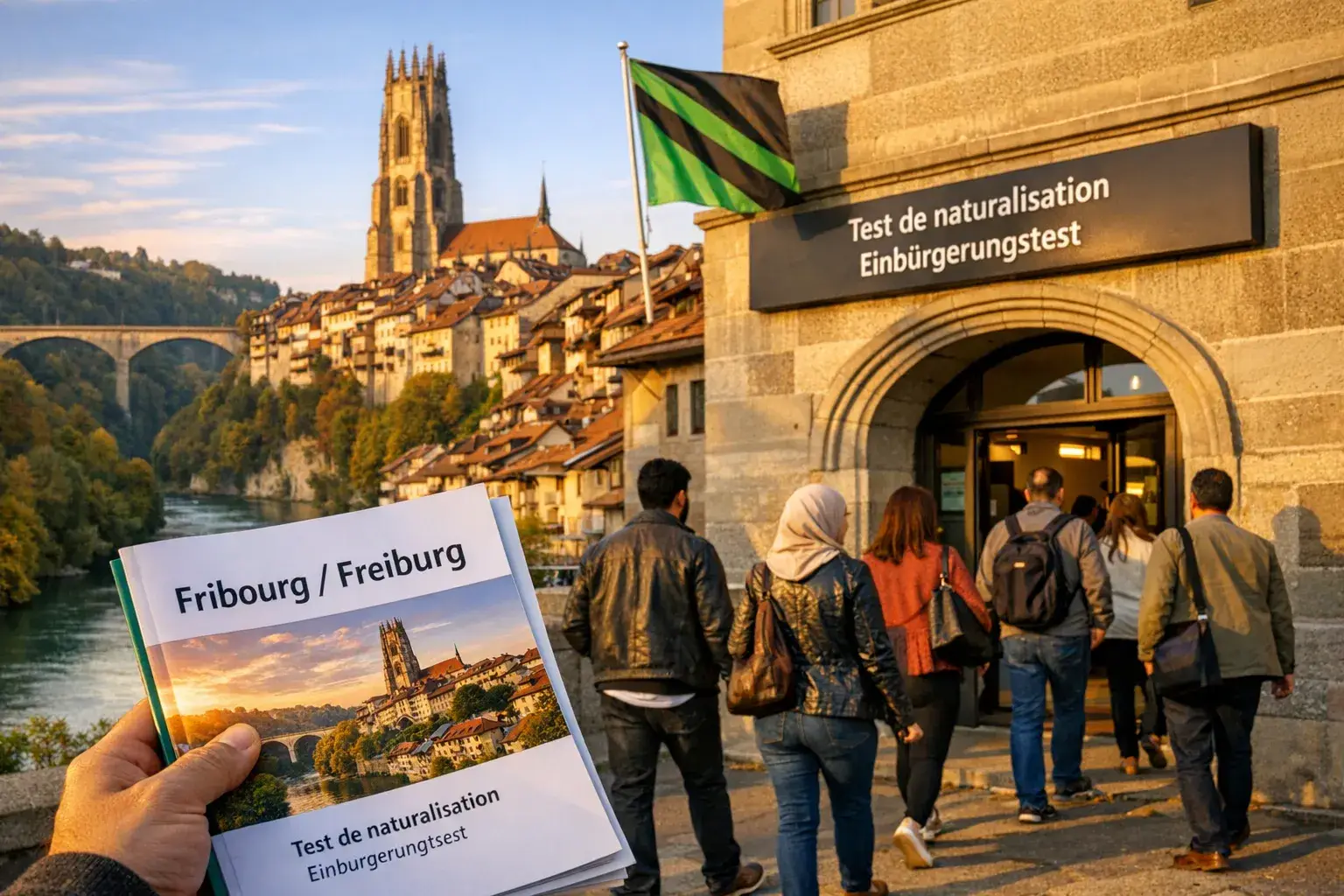
Fribourg Has No Written Test: Three Interviews Instead
Canton Fribourg does not run a written citizenship test, and no commune in the canton does either. The canton's own naturalisation page puts it plainly: the interviews of the procedure are not a "véritable examen"; Fribourg has chosen "entretiens plus informels". What the law requires is "appropriate knowledge of public and political life" (art. 8 of the cantonal citizenship act, LDCF), and that knowledge is checked in conversation.
Three interviews carry the procedure. First, an investigator of the Service de l'état civil et des naturalisations (SENa) interviews you for the investigation report, on average about twelve months after you file. Second, your commune's naturalisation commission, a body of 5 to 11 elected residents, hears you before the conseil communal decides on communal citizenship. Third, for first-generation applicants, the Grand Conseil's naturalisation commission hears you before parliament votes on the decree. Both commissions may skip the hearing when the file already shows a fully accomplished integration.
Everything else on this page follows from that structure: there is no exam date, no pass mark and no retake. What you prepare for is a conversation in French or German about your life in Switzerland and about the country, the canton and your commune. The Fribourg canton page lists every source behind the figures below.
Who Can Apply: Permit, Residence and Language
The federal frame applies first: a C permit, 10 years in Switzerland with 3 of them in the 5 years before filing, and years between ages 8 and 18 counting double. Only B, C, Ci and F permits count, years on an F permit at half value. Since 1 January 2018 only C-permit holders can file at all.
On top of that, article 9 LDCF asks for 3 years of residence in the canton, 2 of them in the last 5 years. Second-generation applicants, born in Switzerland or schooled here for more than half of compulsory school, need 2 years in the canton, and years spent in Bern, Vaud, Neuchâtel, Geneva, Jura and Zurich count as Fribourg years under a reciprocity agreement. Communes may add a residence requirement of up to 3 years; the canton says they range from 1 to 3 years, and the City of Fribourg asks for 2.
Language depends on your commune's official language: French or German at A2 written and B1 spoken, shown with an ALTE-standard certificate such as fide. You need no certificate if one of the two is your mother tongue, if you attended at least five years of compulsory school in French or German, or if you completed upper-secondary or tertiary education in one of them. The remaining conditions are the usual ones, with two Fribourg numbers: no social assistance in the 3 years before filing unless fully repaid, and no conviction showing disregard for the legal order in the 5 years before filing. All checked on 5 September 2026.
What the Interviews Cover, and the Canton's Own Brochure
The canton publishes the interview topics itself. Expect questions on your participation in economic life (training, work, plans), on social and cultural life (associations, regional events), on any police record, on Swiss customs, traditions and way of life (the events that mark the year, regional festivals), on public and political life (how federalism works, the names and size of communal, cantonal and federal authorities, how they are elected, whether you can name local, cantonal and national politicians) and on geography, history and current affairs.
The study material is official too. Every year the SENa publishes the brochure "Informations civiques de base pour la naturalisation"; the 2026 edition runs from the rights and duties of citizens through the neighbouring countries and the four national languages to the seven districts with their capitals, the Vanil Noir as the canton's highest peak, the lakes of Morat, Gruyère, Schiffenen and the Lac Noir, the Federal Council and Fribourg's members of the federal chambers, the Conseil d'Etat with 7 members and the Grand Conseil with 110 deputies, the prefects, the communal authorities and the popular rights, including Fribourg's own popular motion.
Communes add courses of their own. The City of Fribourg's commission gives civic instruction courses and invites applicants from age 14; attendance is compulsory only for applicants turned down for insufficient knowledge of public and political life. Bulle has offered a free, optional two-hour preparation course several times a year since May 2018. The SENa may run a civic course for CHF 30 to 50. Our 50 Fribourg questions cover the cantonal part of all this, from 1157 and 1481 to the Sense district and the 110 seats.
Test Your Knowledge
Try 5 free questionsThe Procedure: SENa, Commune, SEM, Grand Conseil
Fribourg is one of the few cantons where the cantonal service holds the file from the first day to the last. The fr.ch page lists nine steps, and the SENa's process schema puts the legal basis next to each one:
- Preliminary questionnaire. One per person over 12, by post or at the counter. The SENa checks your civil-status data and registers you in the Infostar register, which takes at least 3 months.
- Filing. With the form the SENa mails you, you file the complete dossier without an appointment and pay CHF 200 the same day. Incomplete files are not accepted.
- Investigation report. A SENa investigator interviews you, on average within 12 months, by video if you agree. Children over 12 are interviewed individually.
- Commune. The first formal decision. The naturalisation commission hears you, the conseil communal decides on communal citizenship and the file goes back to the SENa.
- SEM. The second formal decision, on the file and without a hearing: the federal naturalisation authorisation.
- Update. The SENa sends you forms, a document list and the last invoice. Only complete files returned in time reach the Grand Conseil's commission.
- Grand Conseil. The third and last formal decision. The commission examines every file and may interview you, the Conseil d'Etat submits the draft decree, the Grand Conseil adopts it.
- Decree. Naturalisation takes effect on the day of the decree, which appears without names in the Feuille officielle.
- Reception. The SENa invites you personally; you make the pledge before the Conseil d'Etat and receive the naturalisation certificate and the certificate of origin. Attendance is compulsory.
The canton puts the whole procedure at 24 to 36 months. After a refusal by the conseil communal or the Grand Conseil, article 54 LDCF imposes a 2-year wait before a new application; communal decisions can be appealed to the prefect, cantonal ones to the Cantonal Court.
Costs: CHF 200 Now, CHF 800 to 1,500 for the Canton
The cantonal fee is billed by step, following the tariff annexed to the RDCF, and the SENa gives the total. You pay CHF 200 when you file; the balance is invoiced before the file goes to the Grand Conseil, and in total the canton charges as a rule CHF 800 to 1,500 (SENa information sheet of 1 January 2025). Second-generation applicants pay less. Behind the total sit items such as CHF 100 to 250 for filing and preliminary examination, 150 to 200 per person for the investigation report, 60 for forwarding the file to the commune, 100 to 200 for the cantonal opinion and the transmission to the SEM, 100 to 200 per person for the review by the Grand Conseil's commission and 100 for closing the procedure and issuing the certificate. Fees stay due for the steps completed if you withdraw or are refused.
Communal fees come on top and every commune sets its own. The City of Fribourg bills ordinary applications by item, each between CHF 25 and 350 (preliminary examination, additional enquiry, civic course, hearing, decision, transmission, closing at a flat CHF 100), and grants students, apprentices and recipients of supplementary benefits or social assistance one third of the ordinary fee, at least CHF 400. Bulle charges CHF 600 for a first-generation file and CHF 300 for the second generation, plus CHF 100 or 50 for any additional hearing. Villars-sur-Glâne and Murten publish their own tariffs.
The Confederation adds CHF 100 for a single person, 150 for a married couple and 50 for a minor applying alone. A language certificate, translations and extracts are charged separately by their providers. All figures checked on 5 September 2026.
Avoid Costly Retakes
View pricingHow to Prepare for the Interviews
Start with the SENa brochure and read it twice: once for the facts, once to be able to say them out loud. The interviewers want to hear that you know how the country is run, so practise explaining federalism in your own words, naming the seven members of the Federal Council and the seven of the Conseil d'Etat, describing how the 110 deputies of the Grand Conseil are elected, and locating the seven districts and their capitals on a map of the canton.
Then go local. Know the name of your syndic or syndique, whether your commune has a conseil général or an assemblée communale, what the commune spends its money on and which associations and festivals shape the year, from the Bénichon to the Fête-Dieu procession in the city of Fribourg. In bilingual communes such as Fribourg or Murten, decide early whether you will be interviewed in French or German and prepare in that language; the canton says that being able to hold a conversation is the best sign of integration.
Finally, rehearse. The SENa investigator, the communal commission and possibly the Grand Conseil's commission will all ask open questions, so practise answering in full sentences rather than ticking boxes. Our Fribourg question bank with 50 cantonal questions and the federal lessons gives you the facts; a course such as Bulle's two-hour session or the City of Fribourg's civic instruction gives you the conversation. For anything about your own file, ask the SENa: Route des Arsenaux 41, 1701 Fribourg, +41 26 305 14 17, www.fr.ch/sena.
Practice Anywhere
Download iOS App