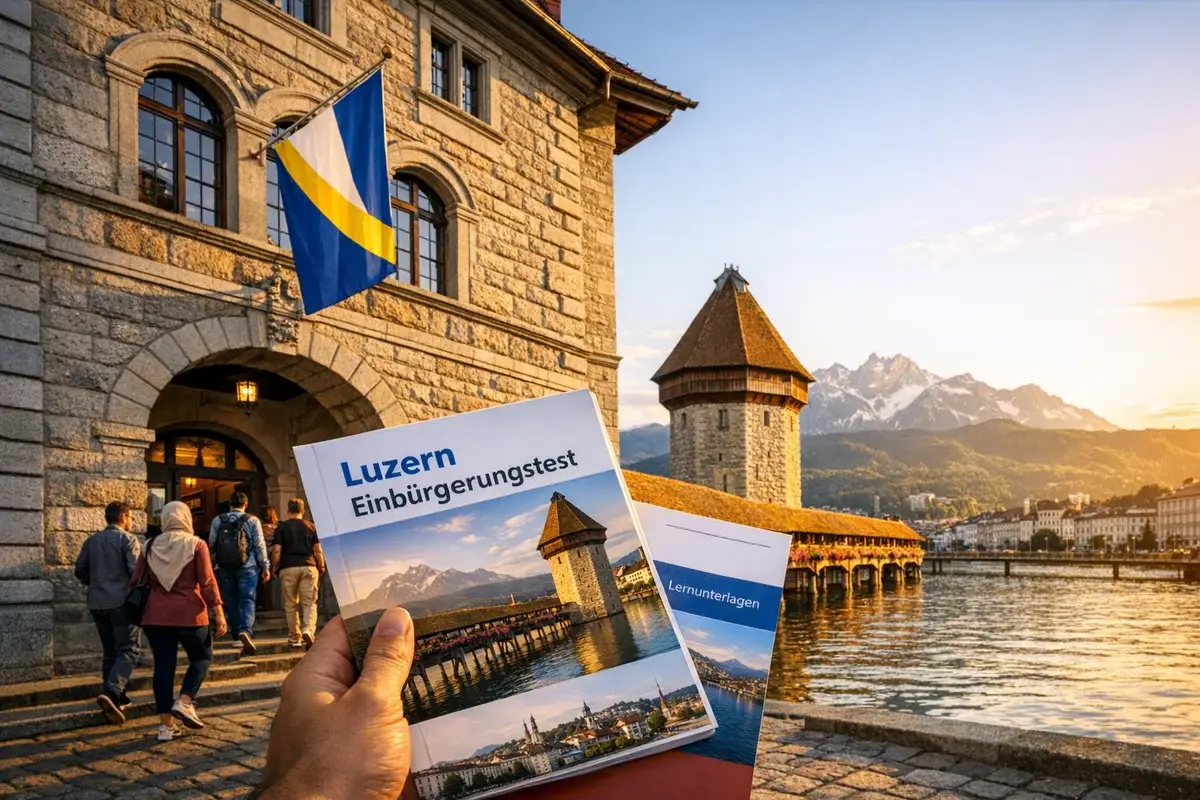
Lucerne Has No Cantonal Citizenship Test
If you search for the Lucerne citizenship test, the first thing to know is that there is none, at least not a cantonal one. The Kantonales Bürgerrechtsgesetz (KBüG), in force since 1 January 2018, requires you to be familiar with local living conditions: basic knowledge of the geographic, historic, political and social conditions at federal, cantonal and communal level, participation in local social and cultural life, and contacts with Swiss citizens (section 25). How your commune checks that is up to the commune. Neither the act nor the ordinance prescribes a written exam, a question bank or a pass mark.
In the City of Lucerne the check is a personal interview with the seven-member Einbürgerungskommission. In 2025 the commission dealt with 240 applications, rejected none and suspended four because civic knowledge was lacking. Other communes may add written questions to the interview, so ask your Gemeindekanzlei how it proceeds. You can practise Lucerne-specific questions here to build the knowledge every commune expects.
Who Can Apply
Before the interview comes the paperwork, and the residence rules are strict. You need 10 years in Switzerland, 3 of them within the 5 years before the application; the years between the ages of 8 and 18 count double, with at least 6 actual years. Permits B and C count in full, permit F and the FDFA legitimation card half, nothing else counts, and you must hold a C permit when you apply.
At communal level Lucerne asks for 3 years in the naturalising commune within the last 5 years, including at least 1 uninterrupted year immediately before naturalisation. There is no separate cantonal residence period. If you move during the procedure, the commune and the canton stay competent once the examination for the assurance is complete.
German is required at B1 spoken and A2 written. The proof counts as provided if German is your mother tongue, if you attended compulsory school in German for five years, if you completed upper-secondary or tertiary education in German, or if you hold a certificate based on a recognised test such as Goethe, telc or fide. You also need a clean federal criminal record, no debt enforcement, no certificates of unpaid debts, no tax arrears, and no social assistance in the three years before the application or during the procedure unless it has been repaid in full.
What the Commune Checks and How to Prepare
The interview covers the three elements of section 25: your basic knowledge of Switzerland, the Canton of Lucerne and your commune, your participation in local life, and your contacts with Swiss people. Expect questions on how the federal, cantonal and communal levels work, on Lucerne's history and geography and on everyday life in your commune, asked in German. The commission also forms a view of your everyday German and of the other integration criteria.
Two official preparation tools exist. The City of Lucerne runs naturalisation courses on politics and geography with Caritas Zentralschweiz, four evenings or mornings with ten lessons; 95 applicants from the city attended in 2025, and further Caritas courses are open across the canton. The canton's Abteilung Gemeinden publishes «Kenntnisse der Schweiz», 100 questions and answers on civics, history, geography and society. It was written for the facilitated procedure, but it covers exactly the basic knowledge the communes expect. Add structured practice by topic with Lucerne questions and you cover both the facts and the understanding the interview is looking for.
Test Your Knowledge
Try 5 free questionsFees and Duration
The federal and cantonal fees are fixed on a cantonal sheet in force since 1 January 2017: CHF 450 for an adult (CHF 100 federal, CHF 350 cantonal), CHF 250 for a minor filing an own application (50 plus 200) and CHF 600 for spouses filing jointly (150 plus 450). The communal fee comes on top; the act only says it may at most cover costs, so it differs from commune to commune. The City of Lucerne charges a flat CHF 500 per application and waives it for minors filing alone and for adults under 25 at the time of filing. Budget separately for documents, a language certificate if you need one, and a preparation course.
The duration depends mainly on your commune. In the City of Lucerne the communal phase averaged 14 months in 2025, up from 10 in 2024. Once the commune has assured citizenship, the canton and the Confederation usually need four to six months together. The city reckons with about one and a half years overall.
How the Procedure Runs
Everything starts at your Gemeindekanzlei, in the City of Lucerne at the Bürgerrechtswesen on Obergrundstrasse 1. Before applying you must be entered in the Swiss civil register at the civil registry office. The application includes extracts from the civil register, the federal criminal register and the debt enforcement register of your commune, proof of residence and the language certificate; the commune informs the Department of Justice and Security immediately and has a naturalisation report drawn up.
Then comes the interview and the decision on the assurance of communal citizenship. By law the communal assembly decides, unless the voters have delegated the decision to the communal council, the communal parliament or a commission, as the City of Lucerne has done. The commune publishes the names of those it has assured citizenship to, and a negative decision can be appealed to the department. The commune forwards the file to the Abteilung Gemeinden, which checks it, requests any missing documents and applies to the State Secretariat for Migration for the federal authorisation. Shortly before the end you receive the form «Beachten der Rechtsordnung». With the federal authorisation in hand, the department grants cantonal citizenship, and once that decision is legally binding you are Swiss.
If Your Knowledge Is Not Enough Yet
There is no exam to fail and no waiting period to sit out. If the commission finds that you do not yet meet a condition, the City of Lucerne examines whether the application can be suspended for a set period so that you can catch up; in 2025 four applications were suspended, all for lacking civic knowledge, and none was rejected. A refusal would have to be reasoned in writing and can be appealed to the Department of Justice and Security.
Use a suspension well. Attend one of the Caritas courses, work through the canton's 100 questions, read your commune's website and local newspaper, and practise Lucerne and Swiss questions by topic so that the gaps the commission named are closed before the next conversation.