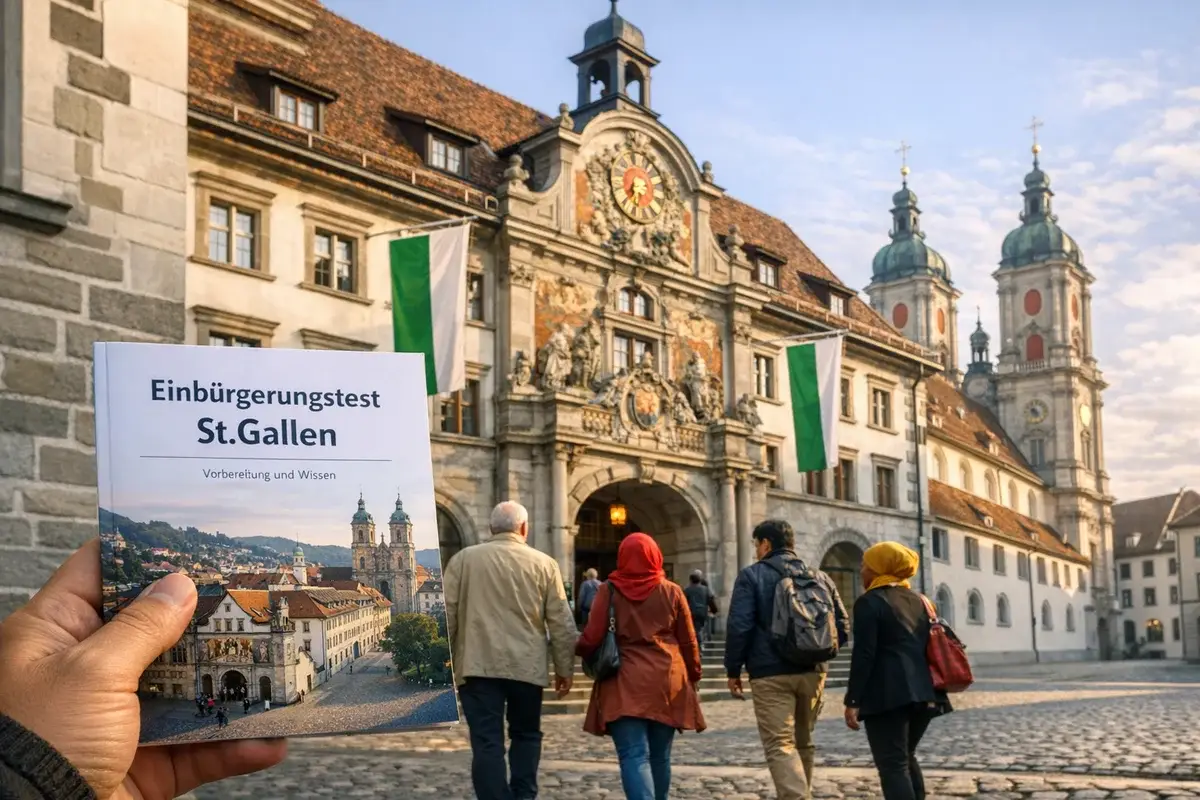
In St. Gallen the Civics Test Comes Before the Application
There is no cantonal citizenship test in St. Gallen, but that does not mean you can skip studying. The cantonal citizenship act (BRG) requires you to be familiar with Swiss and local conditions: interest in public affairs, knowledge of how the state is built, and basic knowledge of geography, history, politics and society (article 14). The Einbürgerungsrat of your commune, the naturalisation council, checks this in the naturalisation interview, and how it checks is up to the council.
In practice most St. Gallen communes, including the City of St. Gallen, require one specific proof before you even file: the Staatskundetest of Arge Integration Ostschweiz, a written civics exam of about one hour for CHF 120. In the city it is compulsory for everyone aged 15 or over, the certificate may be at most two years old on the day you file, and tests from other providers are not accepted. Since 4 September 2026 minors who attended all three years of Oberstufe in Switzerland are exempt; adults never are. You can practise St. Gallen-specific questions here alongside the Arge material.
Who Can Apply
The residence rules are the strictest part. You need 10 years in Switzerland, 3 of them within the 5 years before the application; the years between 8 and 18 count double, with at least 6 actual years. Permits B and C count in full, F half, N, L and S not at all, and you must hold a C permit when you apply. On top of that the canton requires the last 5 years without interruption in the Canton of St. Gallen and in the same political commune, with no double counting. Spouses and registered partners of Swiss citizens need, after three years together, 3 years in the canton and 2 in the commune.
German is required at B1 spoken and written, one level above the federal A2 minimum in writing. The proof is a test unless your German is obvious; the City of St. Gallen waives it for native speakers and after five years of compulsory school in German, and names the fide test at about CHF 250 as an example.
You also need orderly finances without open debt enforcement, no relevant criminal record and no pending criminal proceedings, participation in economic life or education, support for your family's integration, and a signed declaration that you accept the rule of law and the values of the Federal Constitution. Before filing, you must be entered in the Swiss civil register.
What the Staatskundetest Looks Like
The Arge test is written and lasts about one hour; sittings run through the year in St. Gallen, Goldach, Rapperswil-Jona, Uznach and Wil, and the fee is CHF 120. Arge publishes sample questions: open answers and matching tasks rather than pure multiple choice, spread over six areas. Geography, history and languages (name two cantons bordering Germany, match the national languages to their shares), democracy and federalism (name two parties in the Federal Council, who elects the district judges), rights and duties (registration duties, what the Federal Constitution is), social security and health (at what age women and men receive the old-age pension), work and education (an example of upper-secondary education, the main sectors of the economy) and the Canton of St. Gallen (which river flows through the canton to the North Sea, which towns are not in the canton).
To prepare, Arge runs a civics course in six modules that mirror the test areas, plus a presentation on your commune, and publishes teaching material for the canton and its regions. Work through that, then practise St. Gallen and Swiss questions by topic until the facts sit. Remember that the test certificate is only the ticket: in the naturalisation interview the council wants to hear you connect that knowledge with life in your commune.
Test Your Knowledge
Try 5 free questionsFees and Duration
St. Gallen is one of the more expensive cantons, and the City of St. Gallen publishes the full table. A single adult over 25 pays CHF 2,200 (1,400 commune, 700 canton, 100 Confederation), a single person under 25 CHF 1,000 (200, 700, 100), a married couple CHF 3,050 (1,900, 1,000, 150), a family CHF 3,150 (1,900, 1,100, 150) and a single parent with children CHF 2,350. The cantonal tariff allows the canton up to CHF 2,000 and the communes up to CHF 1,800 for individuals and CHF 2,500 for couples; the canton puts average communal fees at CHF 500 to 1,000 per person. The communal fee is invoiced and must be paid before the interview, otherwise the application is rejected; part of it is refunded if the application fails later. Add the Staatskundetest (CHF 120), the language test (fide about CHF 250) and residence certificates for ten years (over CHF 100).
The city reckons with about one and a half to two years for the whole procedure; the canton gives no figure and refers you to your commune. Two legal deadlines frame the end: after the SEM's federal authorisation the canton must decide within one year, otherwise the authorisation lapses, and the communal decision becomes void if cantonal citizenship is not granted within five years for reasons on your side.
How the Procedure Runs
Everything starts at the Einbürgerungsrat of your commune or the office it designates, in the City of St. Gallen the Administration Einbürgerungen of the Bevölkerungsdienste at Poststrasse 28. Pass the Staatskundetest and obtain the German proof first, then file the application with the letter of application stating your motives, a photo, residence certificates for the last ten years, civil-status documents, copies of permit and passport, the two certificates and the signed declaration on the legal order. The administration checks the file, the canton queries the criminal register, the commune invoices its fee, and after payment the council invites you to the naturalisation interview.
If the council approves, it publishes its decision with your name, date of birth, nationality and address and displays the file for 30 days; voters of the commune may lodge a written, reasoned objection, on which the citizens' assembly or the communal parliament would decide. A refusal can be appealed to the cantonal department within 14 days. After the binding communal decision, the file goes to the Amt für Gemeinden und Bürgerrecht, which applies to the SEM for the federal authorisation and invoices the cantonal and federal fees. With the authorisation in hand the cantonal government grants cantonal citizenship, and with that decision you are Swiss; you can order your passport and receive the next voting material automatically.
If You Fail the Test or Someone Objects
A failed Staatskundetest has no legal consequence, because it happens before the application: you register for one of the next Arge sittings, which run several times a year in five towns, and pay the CHF 120 again. Until you hold a certificate that is less than two years old, the city will not process your application, so plan the test early.
An objection during the 30-day display is the other hurdle. It must be written and reasoned, may not be discriminatory, and only carries weight if it shows that the file is incomplete or wrong or that the council misjudged your suitability. The Einbürgerungsrat first rules on its validity; if it is valid, you get the chance to respond, and the citizens' assembly or communal parliament then votes on the council's motion without amendments. If the council itself refuses you, it must give you the chance to comment or withdraw first, and you can appeal to the cantonal department within 14 days. And do not move before the publication: a change of commune or canton before then makes the application void.