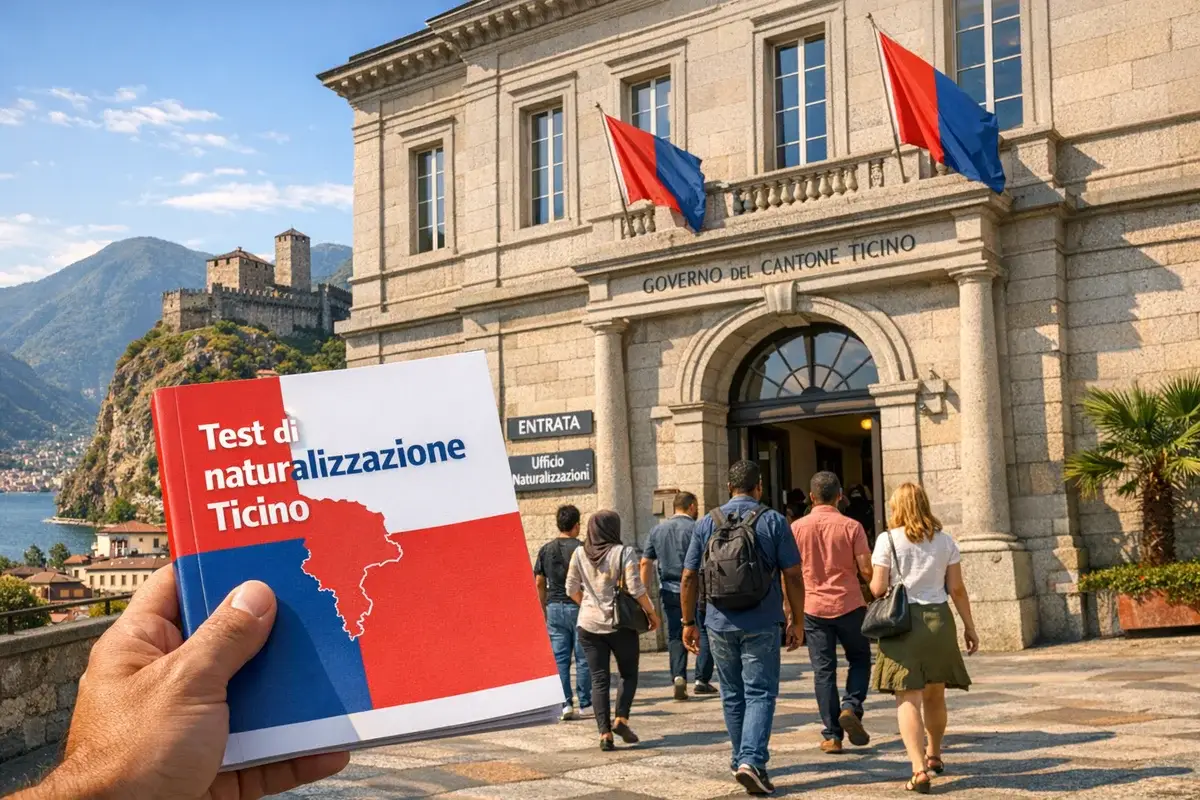
Ticino Is Different: a Mandatory Course, Then the Test
No other canton structures its knowledge requirement quite like Ticino. Knowledge of the geographic, historical, political and social context of Switzerland and Ticino is demonstrated through a citizenship formation course – the "corso di formazione alla cittadinanza" – organised by the cantonal Institute of Continuing Education (IFC), followed by a test you must pass for certification.
Attendance at the course is obligatory, and the canton is explicit about the order of operations: before enrolling in the course or the exam, first have your commune's cancelleria confirm that you meet all the other conditions for a naturalisation application. Start there, then drill Ticino-specific questions alongside the course material.
Who Is Exempt from the Course, and Who from the Test
The exemption rules are precise, and they come from article 7 of the cantonal regulation (RLCCit). If you attended at least five years of schooling in Ticino, between compulsory school and upper-secondary education at a recognised Ticino school, your knowledge counts as proven: no course, no test. Bellinzona's own page says the same in one line: five years of compulsory school in Ticino (kindergarten excluded) or a secondary qualification from a Ticino school exempts you from the citizenship course.
If you earned an upper-secondary or tertiary qualification in Ticino without those five school years, you can request exemption from ATTENDING the course, but not from the test: you still sit it, pass it and obtain the certification. The request goes to the Servizio naturalizzazioni on the form your commune's cancelleria hands out, with your qualifications attached.
For serious personal circumstances, a grave illness or disability that prevents learning, a motivated request with a medical certificate goes to the Servizio naturalizzazioni, which decides after consulting its medical examiner: refusal, partial or full exemption. Spouses who apply together are examined separately, so each of you needs your own certification.
Italian: Written A2, Spoken B1 – CELI or fide
The language requirement is Italian at A2 written and B1 spoken. Ticino accepts CELI or fide certifications as proof; course and exam information sits with the cantonal Service for the Integration of Foreigners.
You need no certificate if Italian is your mother tongue, if you attended at least five years of compulsory school in Italian, as a rule in Ticino, or if you completed upper-secondary or tertiary education in Italian, as a rule in Ticino. The same medical-exemption route as for the course applies when a serious illness or disability prevents learning the language.
Residence, Permits and Fees: the Figures in the Law
The federal frame is fixed for every canton: a valid C permit, 10 years of residence in Switzerland with 3 of them in the 5 years before filing, years between ages 8 and 18 counting double with a minimum of 6 actual years. Years on an N or L permit do not count, years on an F permit count half.
On top of that, article 12 of the Ticino citizenship act (LCCit) asks for 5 years in the canton and 3 years in the commune where you apply, the last 2 of them without interruption, and no social assistance in the 10 years before the application unless fully repaid. That ten-year rule has applied since 1 September 2021 and covers the day of filing and the whole procedure.
The fees are written into article 13 of the regulation: the canton charges CHF 800 per individual application, CHF 100 per minor child included and CHF 200 if you withdraw before the decision, payable before the message goes to the Gran Consiglio and regardless of the outcome. Each commune sets its own fee by ordinance; Bellinzona charges CHF 1,200 for an ordinary individual application. The Confederation adds CHF 100 for a single person, 150 for a married couple and 50 for a minor. All amounts checked on 5 September 2026; the Ticino canton page lists every source.
How to Prepare for the Course Test
The course itself is the backbone of preparation – its programme covers exactly the four domains the certification tests: geography, history, politics and society, for both Switzerland and Ticino. Course dates and programmes are published by the IFC.
The canton also maintains an official citizenship handbook ("manuale sulla cittadinanza") and a frequently-asked-questions collection – worth reading before and alongside the course. Active recall does the rest: topic-by-topic practice questions for Ticino turn passive course notes into answers you can produce under a bit of pressure.
Test Your Knowledge
Try 5 free questionsWho to Contact
Two addresses carry the whole procedure. Your commune's cancelleria verifies your conditions and issues the forms. The cantonal Servizio naturalizzazioni in Bellinzona handles the exemption decisions and the procedure itself: Via Lugano 4, 6500 Bellinzona, +41 91 814 72 85, di-usc.naturalizzazioni@ti.ch.
If a first attempt at the course test goes wrong, the regulation is precise: the result is "sufficiente" or "insufficiente", you may repeat the test at the earliest six months later (art. 10 RLCCit), and the result can be appealed under the Ticino school act. The path back runs through the same institutions: the IFC for the next test session, the Servizio for anything requiring a decision.