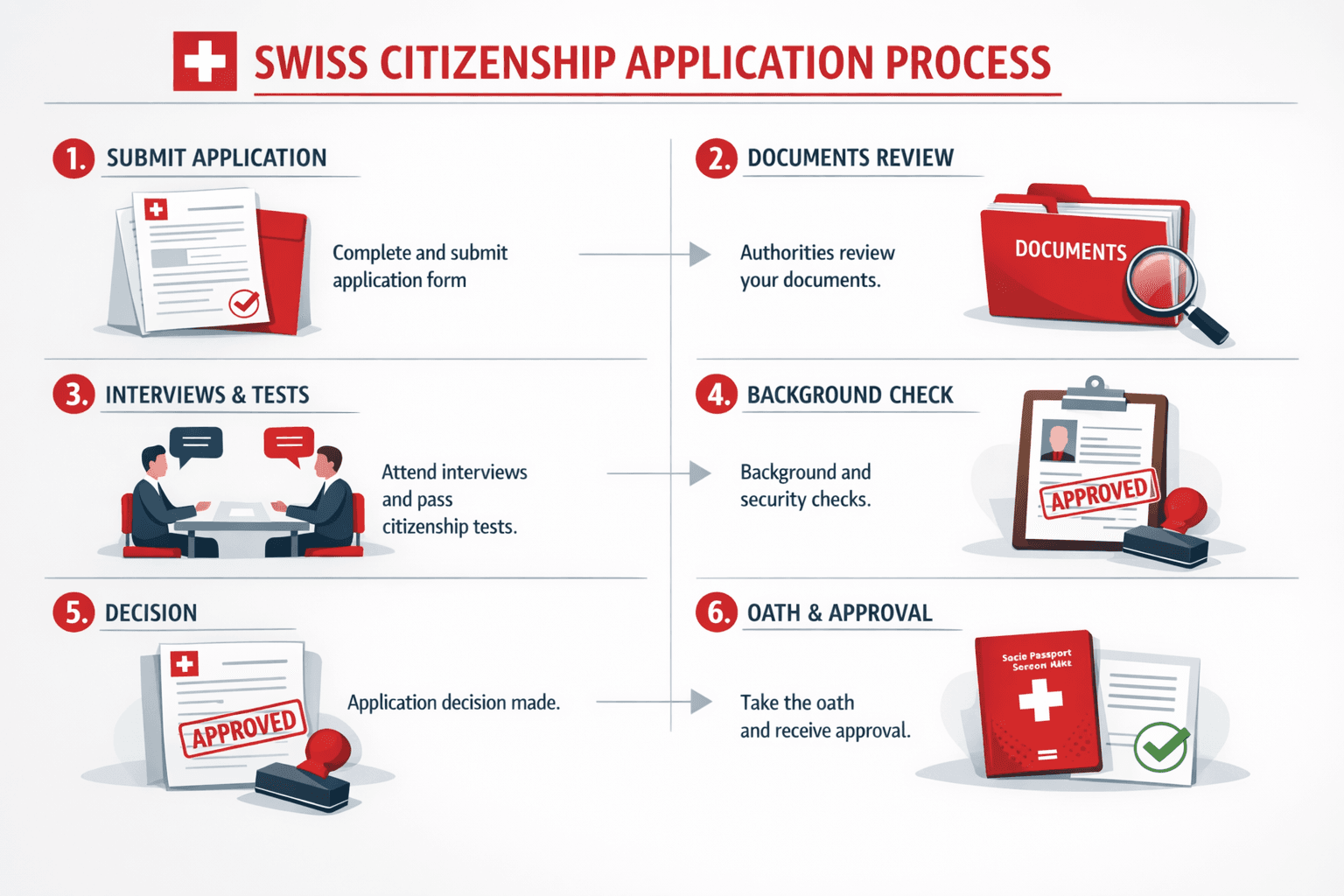
Who This Guide Is For
This guide is for anyone who wants to apply for Swiss citizenship through ordinary naturalization (ordentliche Einbürgerung). You've probably read about the requirements and timelines elsewhere — but this guide focuses on the practical HOW.
What you'll learn:
- Exactly where to go to start your application
- Which forms you need to fill out
- What documents to prepare
- What happens at each stage of the process
- How long each step typically takes
- What to do if something goes wrong
The 3-Stage Process:
Swiss naturalization works like a funnel:
- Municipality (Gemeinde) — You start here. Local officials review your application, interview you, and decide whether to recommend you.
- Canton (Kanton) — If approved locally, your file goes to the cantonal government. They verify everything meets cantonal and federal requirements.
- Confederation (Bund) — The final step. The State Secretariat for Migration (SEM) confirms all federal requirements are met.
All three levels must approve. Only then do you become Swiss.
Timeline Overview:
The entire process typically takes 3 to 5 years:
- Municipal stage: 12-24 months
- Cantonal stage: 12-24 months
- Federal stage: 12-24 months
Phase 0: Preparation (Before You Apply)
Before you walk into the Gemeindeamt, make sure you're actually eligible and have everything ready. Starting with an incomplete application will add months to your timeline.
Step 1: Verify Your Eligibility
You must meet these requirements BEFORE applying:
- 10 years residence in Switzerland (years 8-18 count double)
- C-permit holder (permanent residence)
- Language certification: B1 oral/A2 written (or higher, depending on canton)
- No serious criminal record
- Financially independent (no social assistance for 3+ years)
- 3 of the last 5 years spent in Switzerland
If you're not sure about any of these, contact your Gemeindeamt to clarify BEFORE applying.
Step 2: Get Your Language Certificate
Most cantons require a fide-recognized language certificate. Book your fide test early — it can take weeks to get an appointment.
If you already completed 5 years of Swiss schooling (with 3 at secondary level) or hold a Swiss Matura/EFZ/CFC, you may be exempt. Confirm with your municipality.
Step 3: Gather Your Documents
Start collecting documents at least 3-6 months before you plan to apply. Some documents from abroad take time to obtain and may need translations.
Essential documents:
- Valid passport or ID
- C-permit (copy)
- Birth certificate (translated if needed)
- Language certificates
- Criminal record excerpt (from Switzerland and home country)
- Tax returns (3-5 years)
- Proof of residency (Attestation de domicile)
- Employment proof or income statements
- Health insurance certificate
- Passport photos
Step 4: Build Integration Evidence
The municipality will assess how well you're integrated into Swiss life. Start preparing evidence:
- Membership in local clubs or associations
- Volunteer work
- Reference letters from Swiss colleagues or neighbors
- Evidence of participation in community events
The stronger your integration profile, the smoother your application will proceed.
Phase 1: Municipal Application (Gemeinde)
This is where your citizenship journey begins. The municipal stage typically takes 12-24 months.
Step 1: Contact Your Gemeindeamt
Your first point of contact is the municipal administration (Gemeindeamt, Einwohnerdienste, or Service des habitants). Call or visit in person to:
- Inform them of your intention to apply
- Request the official application forms
- Ask about specific local requirements
- Confirm current fees (typically 500-4,000 CHF)
- Ask about waiting times
Some municipalities allow you to start the process online. Check your municipality's website.
Step 2: Complete the Application Forms
You'll receive a package of forms to complete. This typically includes:
- Personal information form — Your details, family background, residence history
- Residence calculation sheet — Documentation of your years in Switzerland
- Integration questionnaire — Questions about your life in Switzerland
- Financial declaration — Information about income, assets, debts
Fill these out carefully. Incomplete or incorrect information will cause delays.
Step 3: Submit Your Document Package
Once you've completed the forms, submit them along with all your documents. Make sure you have:
- Valid passport/ID
- C-permit copy
- Birth certificate (with translation if needed)
- Marriage certificate (if applicable)
- Language certificates
- Criminal record excerpts
- Tax returns
- Proof of residency
- Employment verification
- Health insurance confirmation
The municipality will review your submission for completeness. If anything is missing, they'll request it. Respond quickly to avoid delays.
Step 4: Pay the Municipal Fee
Municipal fees vary widely — from around 500 CHF to over 4,000 CHF depending on the commune. You'll typically pay this when you submit the application or shortly after.
Step 5: The Naturalization Interview
Most municipalities conduct an Einbürgerungsgespräch (naturalization interview). This is NOT a test of your knowledge — it's a conversation about:
- Your personal background and journey to Switzerland
- Your reasons for wanting citizenship
- Your integration into local life
- Your understanding of Swiss values and customs
Be prepared to discuss:
- Your work and family situation
- Your participation in community activities
- Your knowledge of local news and events
- Your future plans in Switzerland
The interviewers want to understand if you're genuinely integrated into Swiss society. Be honest, be yourself, and show that you've built a life here.
What Happens Next:
After your interview, the municipal commission will review your complete file and vote on your application. This typically takes 3-6 months after the interview.
If approved, your file moves to the cantonal level. If rejected, you can appeal within 30 days.
Phase 2: Cantonal Review (Kanton)
After municipal approval, your application moves to the cantonal level. This stage typically takes 12-24 months.
What Happens at the Cantonal Level:
The cantonal Bürgerrechtsamt (citizenship office) conducts a thorough review of your entire file. Their job is to verify that you meet both cantonal AND federal requirements.
The Review Process:
1. Document Verification
The canton will review every document from your municipal file:
- Verify authenticity of certificates
- Check that translations are official
- Confirm your residency calculations are correct
- Validate your language certificates
- Review your financial records
If anything needs clarification, they'll contact you. Respond promptly.
2. Security and Background Check
The canton coordinates with federal authorities to:
- Check for any criminal records across Switzerland
- Verify your immigration history
- Confirm there are no pending legal proceedings
- Check for any security concerns
This is routine — don't worry unless you have something in your past that hasn't been disclosed.
3. Citizenship Test (if applicable)
Some cantons (like Zurich, Bern, Aargau) require a formal written citizenship test — the Grundkenntnistest (GKT). This covers:
- Swiss politics and government
- Swiss history
- Swiss geography
- The social system
- Cantonal-specific information
If your canton requires this test, you'll be notified and can prepare using official study materials. Pass rates vary by canton — check your canton's official figures.
4. Additional Requirements
Some cantons have additional specific requirements:
- Integration report — A detailed statement about your life in Switzerland
- Local references — Letters from Swiss citizens who know you
- Employment verification — Confirmation from your employer
- Financial disclosure — Detailed asset and debt information
Check with your cantonal office about what they specifically require.
Timeline and Fees:
The cantonal review typically takes 12-24 months from when they receive your file. Cantonal fees range from 500-3,000 CHF depending on the canton. You'll usually pay this when the cantonal process begins.
Test Your Knowledge
Try 5 free questionsWhat Happens Next:
Once the canton is satisfied that you meet all requirements, they grant their approval. Your file then moves to the federal level for the final review. This usually takes 3-6 months for the transfer and processing to begin.
If the canton has concerns, they may request additional information or documentation. In rare cases, they may reject the application. You have the right to appeal cantonal decisions.
Phase 3: Federal Approval (Bund)
The final stage is with the federal State Secretariat for Migration (SEM). This is typically the shortest stage, taking 12-24 months.
What SEM Does:
SEM conducts the final federal review of your application. Their role is to confirm that you meet all requirements under federal law.
The Federal Review Process:
1. Final Eligibility Check
SEM verifies:
- You meet the 10-year residency requirement (with correct calculations)
- You hold a valid C-permit
- Your language certificates meet federal standards
- There are no federal legal impediments
2. Security Clearance
SEM coordinates with federal security agencies to:
- Conduct final background checks
- Verify there are no national security concerns
- Confirm your immigration status is clear
3. Documentation Review
SEM reviews the cantonal decision and confirms:
- All proper procedures were followed
- The cantonal approval is valid
- Your file is complete and accurate
Timeline and Fees:
The federal review typically takes 12-24 months. The federal fee is:
- 100 CHF for a single person
- 150 CHF for a married couple applying together
- 50 CHF for each minor child included in a parent's application
You'll usually pay this fee when SEM notifies you that they're processing your application.
What Happens Next:
Once SEM approves your application, you'll receive official notification by mail. This is the moment you've been waiting for — all three levels have approved!
You'll receive:
- Federal approval notification — Official confirmation from SEM
- Instructions for the ceremony — Information about scheduling your Einbürgerungsfeier
- Request for passport photos — For your naturalization certificate
The citizenship ceremony usually happens within 3-6 months after federal approval.
Phase 4: The Citizenship Ceremony (Einbürgerungsfeier)
Congratulations! After all three levels have approved, you'll be invited to your Einbürgerungsfeier — the ceremony where you officially become Swiss.
What to Expect:
The ceremony is typically organized by your municipality and usually includes:
1. Official Welcome
You'll be welcomed by municipal representatives, often the mayor or local officials. Family members are usually welcome to attend.
2. Taking the Oath
You'll take a formal oath to the Swiss Confederation. The exact wording varies by canton, but typically includes swearing to:
- Respect the Swiss Constitution and laws
- Fulfill your duties as a Swiss citizen
- Uphold the interests of Switzerland
3. Receiving Your Certificate
You'll receive your Einbürgerungsurkunde — your naturalization certificate. This is the official document confirming you are now a Swiss citizen. Keep this safe — you'll need it when applying for your Swiss passport.
4. Symbolic Gifts
Many municipalities present new citizens with:
- A book about the canton or municipality
- A small Swiss flag
- Local specialties or products
- A copy of the Federal Constitution
5. Celebration
Some ceremonies include refreshments or a small reception where you can celebrate with other new citizens and officials.
After the Ceremony:
You're now officially Swiss! Here's what to do next:
1. Apply for Your Swiss Passport
Visit your local passport office to apply for your Swiss passport and ID card. You'll need:
- Your naturalization certificate
- Passport photos
- Your existing foreign passport (will be returned)
- Payment for the passport fees
2. Register Your Citizenship
Update your registration with your municipality. They'll update your status in their records.
3. Voting Rights
As a Swiss citizen, you can now vote in federal elections. Some cantons automatically register new citizens to vote; others require you to register. Check with your local authorities.
Welcome to Switzerland! 🇨🇭
You've completed a journey that took 3-5 years and significant effort. You're now part of the Swiss community with all the rights and responsibilities that come with citizenship.
Cantonal Variations – What's Different Where You Live
While the federal requirements are the same across Switzerland, cantons have significant differences in how they implement the naturalization process.
Language Requirements:
Most cantons follow the federal minimum (B1 oral, A2 written), but some require higher levels, as listed below:
- Schwyz – B2 oral, B1 written
- Nidwalden – B2 oral, B1 written
- Thurgau – B2 oral, B1 written
- Zug – B2 oral, B1 written
- Solothurn (2026+) – B2 oral, A2 written
Always verify with your canton before taking language tests.
Citizenship Test Requirements:
Written test required:
- Zurich (GKT with 124 questions)
- Bern (GKT)
- Aargau (GKT)
- Several others
Interview only (no written test):
- Most cantons in Central Switzerland
- Several smaller cantons
Both test AND interview:
- Some cantons use both methods
Timeline Variations:
Processing times vary significantly, as shown below:
- Zurich – 3-4 years; organized but busy
- Bern – 3-5 years; thorough process
- Aargau – 3-4 years; average
- Basel-Stadt – 2-3 years; faster — recent fee reductions
- Geneva – 4-5 years; slower — high volume
- Vaud – 3-4 years; moderate
- Ticino – 3-4 years; moderate
Fee Variations:
Cantonal fees also differ widely, as shown below:
- Zurich – 500 CHF (250 CHF if under 25)
- Bern – 1,150 CHF per adult
- Basel-Stadt – cantonal fee abolished (from 1 Jul 2026); under-25s pay only the CHF 100 federal fee, over-25s still pay a municipal fee (≈CHF 900 in Basel city)
- Geneva – 1,250 CHF (850 CHF if under 25)
- Zug – 500 CHF
Important: Always check with your local authorities for current requirements and fees. These can change, and some cantons are actively reforming their processes.
Tips for Success – How to Smooth the Process
The naturalization process is long and complex, but there are ways to make it go more smoothly.
Before You Apply:
✅ Start document preparation early — Some documents from abroad take weeks or months to obtain. Begin gathering everything 6-12 months before you plan to apply.
✅ Verify language requirements — Check if your canton requires higher than federal standards. Don't pay for a test that doesn't meet your canton's requirements.
✅ Build integration evidence proactively — Join local clubs, volunteer, participate in community events. The stronger your integration profile, the easier the municipal stage.
✅ Check your debt register — Clear any outstanding debts before applying. Active debt enforcement proceedings can block your application.
✅ Confirm your residency calculations — Make sure you understand how your years count, especially if you spent time in Switzerland as a child.
During the Process:
✅ Respond promptly to all requests — When authorities request additional information, respond within days, not weeks. Delays add up.
✅ Keep copies of everything — Create a dedicated folder with copies of all submitted documents and correspondence.
✅ Follow up appropriately — Check on your status every 3-4 months, not every week. Show you're engaged without being annoying.
✅ Prepare thoroughly for the interview — Research your municipality, know local news, be ready to discuss your life in Switzerland genuinely.
✅ Study for the test — If your canton has a written test, use official study materials and practice questions.
Common Pitfalls to Avoid:
❌ Don't change jobs or address mid-process — Major changes trigger additional reviews and delays.
❌ Don't ignore authority requests — Failing to respond can cause your application to be set aside.
❌ Don't travel abroad for extended periods — Long absences can raise questions about your residency.
❌ Don't miss appointments — Missed interviews or tests can significantly delay your process.
❌ Don't make major financial changes — Large purchases or career changes without advice can complicate your application.
What to Do If Rejected:
If your application is rejected at any level:
- Understand the reason — Authorities must explain why. Read the decision carefully.
- Consider an appeal — You typically have 30 days to appeal. Get legal advice if the rejection seems unfair.
- Address the issues — If possible, fix the problem (language skills, debts, documentation) and reapply.
- Wait the required period — Some cantons require a waiting period before you can apply again.
Remember: Patience and persistence are key. The process tests your commitment to becoming Swiss almost as much as it tests your eligibility.
Avoid Costly Retakes
View pricingFrequently Asked Questions
Q: Can I apply while holding a B-permit?
A: No. You must hold a C-permit (permanent residence) at the time of application. However, years spent on a B-permit count toward your 10-year total.
Q: Do years spent in Switzerland as a child count differently?
A: Yes. Years between ages 8-18 count double. Someone who lived in Switzerland from age 10 to 18 would have 8 actual years but 16 counted years.
Q: Can I apply if I've received social assistance (Sozialhilfe)?
A: You typically need to be free of social assistance for 3 years before applying. However, if you've repaid it in full, you may be eligible. Requirements vary by canton — some require 5 or even 10 years.
Q: How much does the entire process cost?
A: Total costs typically range from 2,000-6,000+ CHF depending on where you live. This includes federal (100 CHF), cantonal (500-3,000 CHF), and municipal (500-4,000 CHF) fees, plus language tests and document translations.
Q: How long does the process take?
A: The entire process typically takes 3-5 years from application to ceremony. Municipal stage: 12-24 months. Cantonal stage: 12-24 months. Federal stage: 12-24 months.
Q: What happens if I fail the citizenship test?
A: You can retake the test. Waiting periods and retake conditions vary by canton — ask your municipality for specifics.
Q: Can I apply through facilitated naturalization instead?
A: Facilitated naturalization is available to spouses of Swiss citizens, third-generation foreigners, and some other specific cases. It's faster and bypasses municipal/cantonal levels. Check if you qualify.
Q: Do I need to give up my original citizenship?
A: Switzerland permits dual citizenship. You can keep your original citizenship when becoming Swiss. However, check your home country's laws — some countries don't allow dual citizenship.
Q: Can I apply if I have a criminal record?
A: Minor offenses may not disqualify you, but serious convictions typically will. Each case is reviewed individually. Be honest about your record — hiding it is worse than disclosing it.
Q: What language level do I need?
A: The federal minimum is B1 oral/A2 written. However, some cantons require B2 oral/B1 written (Schwyz, Nidwalden, Thurgau, Zug), and Solothurn requires B2 oral/A2 written since 2026. Always check your canton's requirements.