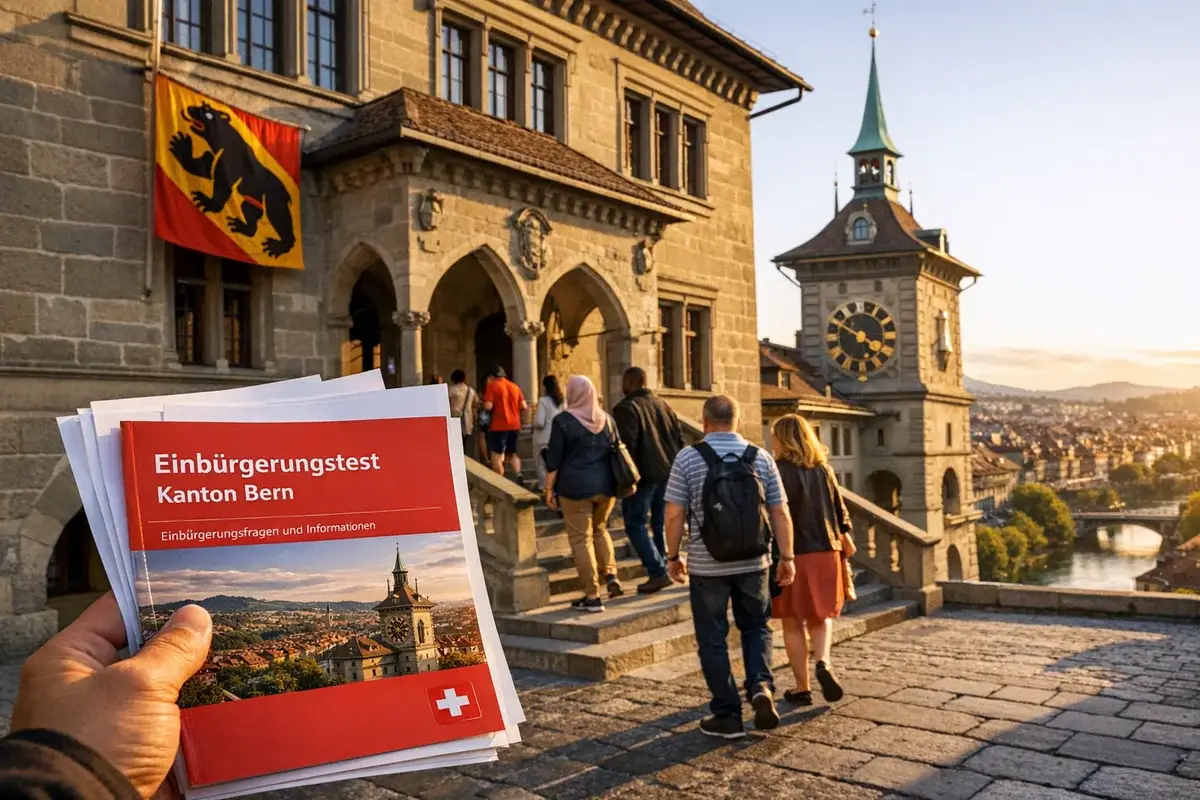
The Citizenship Test in the Canton of Bern
To become Swiss in the Canton of Bern you have to pass the cantonal citizenship test before you file your application with the commune. The citizenship ordinance says so in article 7: the test is written, in the official language of your administrative district, lasts 90 minutes and is passed with at least 60 percent correct answers. In the City of Bern it has 48 multiple-choice or matching questions.
Not everyone takes it. Children under 16 at the time of filing are exempt, as is anyone who attended compulsory school under a Swiss curriculum for at least five years, kindergarten included, or completed an upper secondary education under a Swiss curriculum or a tertiary education in Switzerland. Everyone else needs the confirmation of a passed test among the application documents.
Who Can Apply?
The federal frame applies: a settlement permit C and 10 years of residence in Switzerland, 3 of them in the 5 years before the application. The years between 8 and 18 count double, but at least 6 actual years are required; time on an F permit counts half, time on an L or N permit not at all.
Bern adds two years of uninterrupted residence in the canton and two years in the naturalising commune. The language is that of your administrative district, German or French, at B1 spoken and A2 written, shown with a certificate recognised by the SEM such as the fide language passport. No proof is needed if it is your mother tongue, if you attended compulsory school in it for at least five years or completed an apprenticeship, a gymnasium or a degree in it.
One rule is stricter than in most cantons: anyone who receives social assistance at the time of the application or received it in the ten years before is naturalised only if the benefits have been fully repaid.
What the Test Looks Like
The ordinance lists three blocks of topics: geography, history, languages, religions and public holidays of Switzerland and the Canton of Bern; political and social conditions, democracy, federalism and the rights and duties of citizens; and social security, health, work and education. Questions are written to be understood at language level A2 and answers are judged by that standard.
The commune organises the test, alone or with other communes, or delegates it to public or private providers such as the BFF Bern or the BWD Bern; it has to be offered at least three times a year. You must take it where your commune sends you, because a test taken in another commune or at another school is not recognised. After passing you receive a confirmation of unlimited validity.
If you fail, you can repeat the test as often as you want; there is no waiting period in the law, and the commune recommends a voluntary naturalisation course. For a disability, a serious illness or a pronounced reading or writing difficulty the commune can grant relief in justified cases: more time, an oral test, or a course instead of the test.
Registration and Costs
You register for the test through your commune, which tells you where and when it takes place. You pay for it yourself: the canton tells communes to charge between CHF 260 and 390, and the City of Biel, for example, charges CHF 300 per person. Every repeat costs again.
Avoid Costly Retakes
View pricingThe naturalisation fees come on top. The canton charges CHF 1,150 for a single adult, CHF 1,725 for married couples and registered partners and CHF 575 for minors applying alone; CHF 240 to 1,000 if the application is rejected. The federal government charges CHF 100 per person, CHF 150 for couples and CHF 50 for minors. Each commune sets its own fee, the City of Bern CHF 400 for a single adult, CHF 600 for couples and CHF 200 for young people under 18. Children included in their parents' application pay nothing at any level. The commune invoices the communal and cantonal fees together after it has promised communal citizenship, and the procedure only continues once they are paid.
The ordinance sets guideline periods: the commune normally decides within twelve months of a complete application, the canton within a further twelve months.
Preparation Tips
The canton itself names the preparation material: the Federal Chancellery brochure Der Bund kurz erklärt, also available as the CH info app; ECHO, Informationen zur Schweiz by HEKS; Die Schweiz verstehen by hep Verlag; and the free hep PLUS app. A naturalisation course is optional.
Start with the federal topics: the political system, direct democracy, Swiss history and geography. Then Bern: the Grosser Rat with 160 members, the Regierungsrat, the separation of the Jura in 1979, the Aare, the Bernese Oberland and the bilingual canton. Our seven Bern lessons with practice questions cover exactly these topics.
Test Your Knowledge
Try 5 free questionsAfter the Test
With the confirmation you file the application with your commune. It examines the requirements, holds an individual, minuted naturalisation interview with you, writes the official report and decides on the promise of communal citizenship, normally within twelve months. Passing the test does not spare you the interview: the commune still checks there whether you are familiar with Swiss and local life.
The file then goes to the canton's civil status and citizenship service, which obtains the federal naturalisation permit from the State Secretariat for Migration (SEM) and grants cantonal citizenship. With that decision you hold communal, cantonal and Swiss citizenship, and the commune informs you.
One detail matters if you move: leaving the commune before the promise of citizenship makes the application lapse, and you start again in the new commune, although a test confirmation from a Bern commune remains valid. After the promise, the Canton of Bern remains competent.