Three ways to check the same thing: how the cantons test knowledge in 2026
Federal law asks every candidate for the same things: a C permit, ten years in Switzerland, respect for the legal order, a national language at B1 spoken and A2 written, participation in economic life and familiarity with Swiss living conditions. How that familiarity is checked is left to the cantons, and many cantons pass the question on to their communes. Between 4 and 6 September 2026 we read the citizenship act, the ordinance, the fee tariff and the official pages of all 26 cantons and rewrote each canton page from them. This guide compares what those sources say.
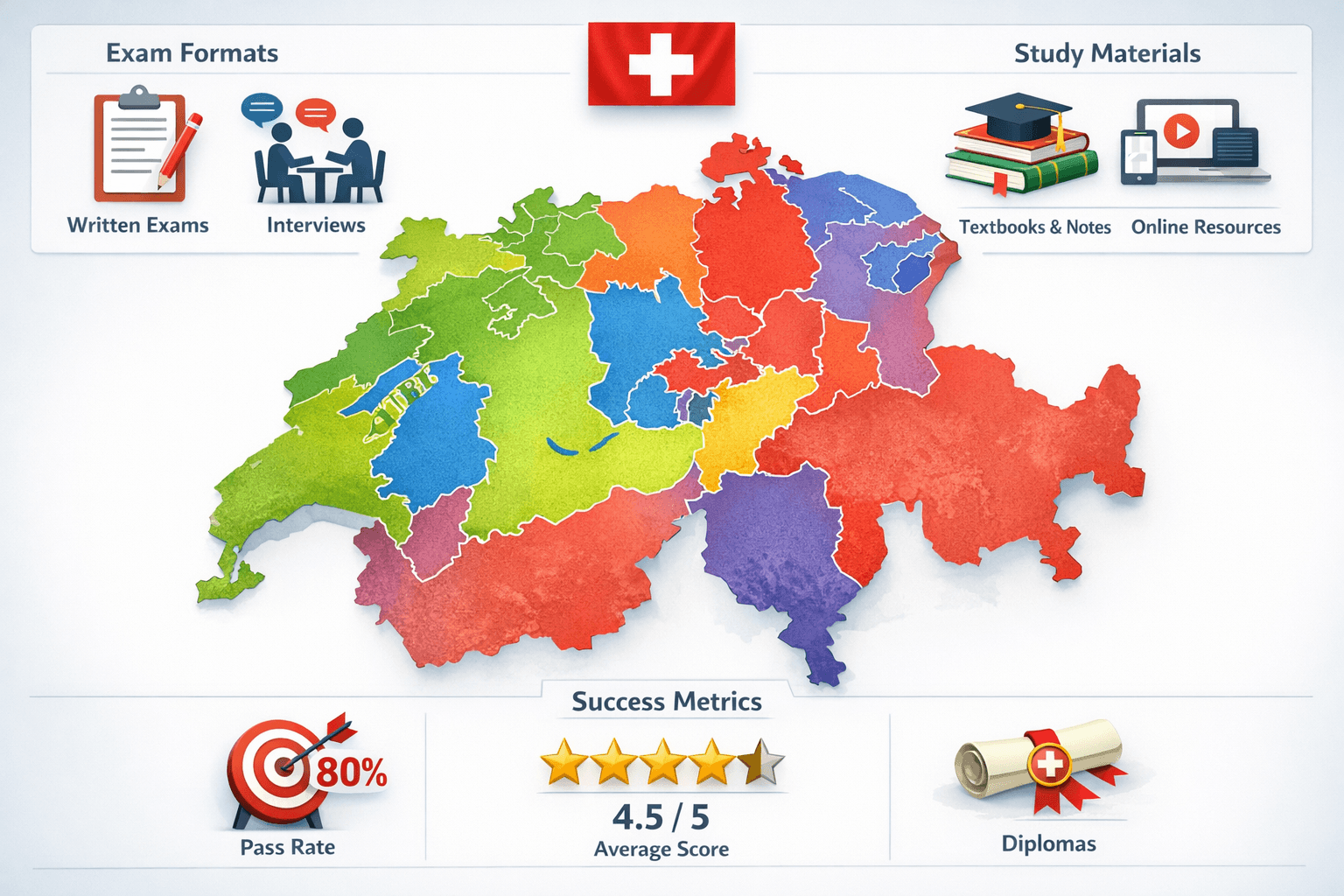
Three patterns cover the country. Twelve cantons put a formal cantonal test or exam in front of you, usually before you may even file: Aargau, Bern, Zürich, Geneva and Vaud with a written test, Obwalden, Uri and Appenzell Ausserrhoden with a cantonal civics exam, Ticino and Solothurn with a compulsory course that ends in an exam, Glarus with an oral exam, and Neuchâtel with 16 oral questions from a published catalogue. Seven cantons leave the check to the commune or the Bürgergemeinde, which may hold a test or an interview: St. Gallen, Thurgau, Schwyz, Graubünden, Valais, Schaffhausen and Zug. Seven cantons have no test at all and rely on interviews: Basel-Stadt, Basel-Landschaft, Luzern, Fribourg, Appenzell Innerrhoden, Nidwalden and Jura, where a questionnaire is answered during the interview.
The previous version of this guide listed fifteen cantons under written computer-based tests and placed Luzern, Basel-Landschaft, Nidwalden and Jura among them. None of them has a written test, and Bern's test is not the one Aargau runs. The corrected picture below follows the sources linked on each canton page; the canton overview leads to all 26.
Cantons with a formal cantonal test: Aargau, Bern, Zürich, Geneva, Vaud, Obwalden, Uri, Appenzell Ausserrhoden, Ticino, Solothurn, Glarus, Neuchâtel
These twelve cantons tell you in advance what is tested, and most of them make the test a condition for filing.
- Aargau: the Staatsbürgerlicher Test, 45 questions with four answers each, 40 minutes, passed from 34 correct answers, from age 16, CHF 50 per sitting, repeatable after two months; the certificate must be no older than six months when you file. There is no exemption for Swiss schooling, only for an impairment.
- Bern: a written test of 90 minutes, passed from 60 percent, taken before filing at the body the commune designates, offered at least three times a year and repeatable without limit; the city of Bern asks 48 questions. Exempt: children under 16, five years of compulsory school under a Swiss curriculum, an upper-secondary or tertiary qualification in Switzerland. The canton lets communes charge CHF 260 to 390; Biel charges 300.
- Zürich: the Grundkenntnistest, 50 questions drawn from a catalogue of 350, taken digitally on site, 35 on the Confederation, 10 on the canton and 5 on the commune, passed from 30 correct answers. Exempt: five years of compulsory school in Switzerland including three at lower-secondary level, an upper-secondary qualification in Switzerland, current school attendance, children under 12.
- Geneva: a written test of the OCPM on geography, history, politics and society of Switzerland and Geneva, before the application; the canton publishes neither the number of questions nor the pass mark. Exempt if nothing suggests a lack of integration and you were born in Geneva and have lived there ever since, or are under 25 with five years of school, upper-secondary or tertiary education in Geneva; 12- to 25-year-olds without exemption take a simplified oral test.
- Vaud: the communal written multiple-choice test on geography, history, politics and society, in equal parts on Switzerland, the canton and the commune, 48 random questions in one hour from the cantonal list of 160 questions plus a communal list, passed from 70 percent, three attempts at most. Exempt: born in Switzerland and lived here without interruption, five years of compulsory school, an upper-secondary qualification, or under 12 at filing.
- Obwalden: the written exam of basic civic knowledge at the BWZ before filing, six blocks, mostly multiple choice, about 90 minutes, a minimum score in every block, CHF 60, certificate valid two years; children of 12 to 15 write an easier 60-minute exam. The cantonal information event must be attended first.
- Uri: the Staatskundetest run by the bwz uri for the Justizdirektion twice a year, one evening of two lessons, in standard German, CHF 180, oral for attested illiteracy. Exempt after five years of school in Switzerland, under 16, or where the knowledge is obvious.
- Appenzell Ausserrhoden: the cantonal Staatskundetest in Trogen before filing, registered after the first interview; dates in 2026: 21 September, 26 October, 30 November. Format, number of questions, pass mark and fee are not published.
- Ticino: the compulsory civic-education course of the IFC with a test on geography, history, politics and society of Switzerland and Ticino, graded sufficient or insufficient, repeatable after six months at the earliest. Five years of school in Ticino exempt from course and test; an upper-secondary or tertiary qualification from Ticino exempts from the course only.
- Solothurn: the compulsory Neubürgerkurs for everyone from 18, at least 12 hours and in practice 20 lessons, CHF 400, closing with a written exam in two parts of 1.5 hours in total, passed with the mark 4.0; one repeat without a new course. A Swiss apprenticeship, Matura or Kantonsschule allows a dispensation.
- Glarus: the oral naturalisation exam of the KBS Glarus on behalf of the canton, before filing and after the compulsory information evening, covering history, geography, culture, civics, political rights and social insurance of Switzerland, the canton and your commune; the certificate is valid four years and the commune only enters into your application with it. The commune's own interview follows, about an hour in Glarus Süd.
- Neuchâtel: 16 oral questions at the interview with the COSM, four each on geography, history, politics and society, at least one per theme on the canton, passed with 10 correct answers; the full catalogue is published (June 2026 edition). Exempt: five years of compulsory school in Switzerland, an upper-secondary qualification from Switzerland, or the course Vivre en Suisse et à Neuchâtel.
If you live in one of these cantons, the test is the most predictable part of the whole procedure: the format is known, and in Zürich, Vaud, Neuchâtel and Valais the question catalogue is public.
Test Your Knowledge
Try 5 free questionsCantons where the commune decides: St. Gallen, Thurgau, Schwyz, Graubünden, Valais, Schaffhausen, Zug
In these seven cantons the law names the knowledge to be checked but leaves the method to the commune, the Bürgergemeinde or a cantonal service, so two neighbouring communes can differ.
- St. Gallen: the Einbürgerungsrat of each commune decides how to check; most communes require the written Staatskundetest of the Arge Integration Ostschweiz, about one hour, CHF 120, in St. Gallen, Goldach, Rapperswil-Jona, Uznach and Wil. In the city it is compulsory from 15, the certificate may be at most two years old, and other providers are not accepted; since 4 September 2026 minors with three years of lower-secondary school in Switzerland are exempt.
- Thurgau: the communal authority checks by test or interview unless the knowledge is obvious. Kreuzlingen holds a written test in four areas from 15, repeatable once within six months; Amriswil asks 30 questions in 15 minutes and requires 40 of 50 points, one repeat after three months; Weinfelden tests in writing but exempts six years of Volksschule in Switzerland; Frauenfeld and Arbon let the naturalisation commission test basic knowledge.
- Schwyz: the communal authority assesses basic knowledge of history, geography, democracy, federalism, political rights, social security and education in the personal hearing, or sends you to the exam at the BBZ Pfäffikon: 75 minutes, 35 to 41 open and multiple-choice questions on Switzerland and the canton, based on the booklet ECHO and the dossier on the canton.
- Graubünden: the Bürgergemeinde must hold a recorded naturalisation interview and may add a written test, for which it has to allow preparation with aids or courses and which must be passable with B1/A2; Chur runs preparation courses and its own test, followed by the interview.
- Valais: the commune checks your familiarity with Switzerland, Valais and the commune in a hearing of 15 to 30 minutes, at its discretion with a written test beforehand (Brig-Glis and Visp); a third of the questions should be local, there are no marks, but the overall assessment must be positive. Afterwards the sub-commission of the Grand Conseil's justice commission hears you for 10 to 15 minutes. The canton publishes its questionnaire Valais with about 140 possible questions and their answers.
- Schaffhausen: no cantonal test. The city holds an interview led by a member of the city executive with the city chancellery's specialist and two delegates of the Grosser Stadtrat, on German and basic knowledge of Switzerland, canton and city, using the city's brochure and civics scheme; Neuhausen am Rheinfall examines orally in the ordinary and in writing in the simplified procedure, after voluntary preparation courses.
- Zug: no written cantonal test. Whoever did not attend compulsory school or training in Switzerland under a Swiss curriculum is invited, after the commune's assurance, to the civic interview at the cantonal civil-status and citizenship service on history, civics, rights and duties, prepared with the cantonal course in three parts. Before that the Bürgerrat examines your suitability in an interview; Oberägeri asks oral test questions on Switzerland and the Ägerital and records the answers.
Here the right preparation depends on your commune's practice, so ask the commune first which form it uses and whether it names a course or a question set.
Cantons without a test: Basel-Stadt, Basel-Landschaft, Luzern, Fribourg, Appenzell Innerrhoden, Nidwalden, Jura
Seven cantons check familiarity with Swiss life only in conversation. That does not make them easier: the interviews cover the same civics, and several of these cantons ask for more residence, more language or higher fees than the test cantons.
- Basel-Stadt: the Bürgergemeinde checks basic knowledge of Confederation, canton and commune in the naturalisation interview; whoever completed compulsory school in Switzerland and all of lower-secondary school in Basel-Stadt is presumed familiar.
- Basel-Landschaft: the Bürgerrat or Gemeinderat checks language, integration and basic knowledge in the integration interview and reports to the Sicherheitsdirektion within six weeks; in Liestal the interview with the naturalisation commission expressly has test character, in Allschwil the Bürgerrat asks about civics, geography, democracy, rights and duties, history, neutrality and customs. The Sicherheitsdirektion holds its own interview.
- Luzern: no cantonal test; each commune decides how it checks, and the city of Luzern interviews with its commission.
- Fribourg: appropriate knowledge of public and political life is checked in interviews, with the SENa investigator for the enquiry report, with the communal naturalisation commission and, in the first generation, with the Grand Conseil's naturalisation commission; both commissions may waive the hearing when the file shows complete integration.
- Appenzell Innerrhoden: the Grosser Rat's commission for law and security examines the requirements and hears you; in the district of Oberegg a delegation of the Bezirksrat does so in the presence of a delegation of that commission. The canton's Handreichung marks in yellow the information it calls indispensable for a successful interview.
- Nidwalden: two interviews, the enquiry interview of the cantonal police for the enquiry report and the commune's naturalisation interview on familiarity with Swiss, cantonal and communal life, customs and basic geography and history; the commune also relies on your CV, employer information and references.
- Jura: the Service de la population holds an interview in which you answer a questionnaire on Switzerland and Jura in four themes, geography, history, civics and general knowledge; the canton publishes neither the number of questions nor a pass mark, and has commissioned an 18-lesson preparation course from AvenirFormation for CHF 250.
For these cantons the preparation is the same as for an oral exam: know the institutions of Confederation, canton and commune, the main dates of the canton's history and the practical side of Swiss life, and be able to say it in the local language.
All 26 cantons at a glance: check, residence, language, cantonal fee, published duration
One line per canton, in the order of the sources read on 4 to 6 September 2026. Residence is what the canton and commune require on top of the federal ten years; the language level is spoken/written; the fee is the canton's for a single adult unless stated, the commune's and the federal CHF 100 come on top; the duration is what the canton or its largest commune publishes.
- Aargau: written test 45 questions, 40 minutes, 34 correct; 5 years in the canton, 3 in the commune; German B1/A2; canton CHF 750, commune 1,500; about 12 months at cantonal level.
- Appenzell Innerrhoden: hearing by the Grosser Rat commission; 5 years in the canton, 2 immediately before; German B1/A2; CHF 1,000 from age 20; about 1.5 years.
- Appenzell Ausserrhoden: cantonal civics test in Trogen; 3 years in the same commune; German B1 spoken and written; CHF 1,000, couples 1,500; about 1.5 years.
- Bern: written test, 90 minutes, 60 percent; 2 years in the canton and 2 in the commune; German or French B1/A2; canton CHF 1,150, couples 1,725, plus the test; commune and canton each decide within 12 months as a rule.
- Basel-Landschaft: integration interview; 5 years in the canton, 2 to 5 in the commune; German B1 in all four skills; canton up to 2,000, in practice 1,550, Bürgergemeinde up to 2,000; 1.5 to 2 years.
- Basel-Stadt: interview; 2 years in the commune; German B1/A2; canton nothing since 1 July 2026, city of Basel 800, Riehen 1,700, Bettingen 1,400, free under 25; 1.5 to 2 years.
- Fribourg: three interviews; 3 years in the canton, 2 of them in the last 5, commune up to 3; French or German B1/A2; canton 800 to 1,500; 24 to 36 months.
- Geneva: written OCPM test; 2 years in the canton with the last 12 months immediately before; French B1/A2; 850 under 25, 1,250 from 25, couples 1,360 or 2,000; currently 20 to 24 months.
- Glarus: oral KBS exam plus communal interview; 5 years in the canton, the last 3 in the commune; German B1/A2; canton up to 1,000, up to 1,500 in exceptional cases; 1.5 to 2 years in Glarus Süd.
- Graubünden: Bürgergemeinde interview, optional written test; 5 years in the commune, 2 immediately before; German, Romansh or Italian B1/A2; canton 100 to 1,300, couples 150 to 1,600; 6 plus 6 months at the Bürgergemeinde, no total.
- Jura: interview with questionnaire; the last 2 years in the same commune; French B1/A2; canton 200 under 25, 500 to 1,000 per file from 25; no duration published.
- Luzern: communal interview; 3 years in the commune within the last 5, 1 immediately before; German B1/A2; canton 350, city of Luzern 500; about 1.5 years in the city.
- Neuchâtel: 16 oral questions, 10 correct; 2 years in the canton; French B1/A2; per file 650 minor, 1,500 adult, 1,900 couple, commune 150 to 200; commune decides within 3 months, no total.
- Nidwalden: two interviews; 5 years in canton and commune; German B2/B1; canton 1,000 to 1,500, couples 1,300 to 1,800; the canton speaks of several years.
- Obwalden: written BWZ exam; 5 years in canton and commune; German B1/A2; canton 1,000, couples 1,600, 300 per child; no total published.
- St. Gallen: Arge civics test in most communes; 5 years in canton and commune; German B1 spoken and written; canton 100 to 2,000, city 700, commune 100 to 1,800, city 1,400 from 25; 1.5 to 2 years in the city.
- Schaffhausen: city interview, Neuhausen exam; 2 years in the commune; German B1/A2; canton 850 plus commune 1,150, a fixed 2,000 per application; about 2 years.
- Solothurn: compulsory course with exam; 4 years in the canton, 2 immediately before, 2 in the commune; German B2/A2 since 2026; canton 200 to 3,000, in practice 1,500 to 2,500, Bürgergemeinde 500 to 3,000, course 400; 2 to 2.5 years.
- Schwyz: hearing or BBZ exam; 5 years in the commune; German B2/B1; canton 100 to 500, families 100 to 1,000; 1 to 2 years by the canton, 2 to 3 by the communes.
- Thurgau: communal test or interview; 5 years in the canton, the last 3 in the commune; German B2/B1; canton 800 per adult; about 2.5 years.
- Ticino: compulsory IFC course with test; 5 years in the canton, 3 in the commune; Italian B1/A2; canton 800 per application; no total published.
- Uri: bwz uri civics test; 5 years in canton and commune; German B1/A2; canton 500 to 1,500, in practice 1,000, communes the same; no total published.
- Vaud: communal written test, 48 questions, 70 percent; 2 years in the canton, 1 immediately before; French B1/A2; canton 450, families 550, commune 100 to 400; 18 months at most to the communal decision.
- Valais: hearing, optional test, Grand Conseil sub-commission; 5 years in the canton, 3 in the commune; French or German B1/A2; canton 600, families 1,000, plus 55; 2 to 3 years in Sion.
- Zug: civic interview and Bürgerrat interview; 5 years in the canton, the last 3 in the commune; German B2/B1 since 2025; Bürgergemeinde Zug 2,000, couples 2,400, canton on request; about 2 years.
- Zürich: Grundkenntnistest 50 questions, 30 correct; 2 years in the commune, under 25 in the canton; German B1/A2; canton 500, half under 25, commune 200 to 2,400, city 1,200; about 2 years.
The figures are as at 6 September 2026 and each canton page links the act, ordinance, tariff and pages they come from.
Practice Anywhere
Download iOS AppWhat makes a canton demanding, and how to prepare for yours
The old ranking of easy and hard cantons rested on a test format that most cantons do not use. Four things actually set the bar, and they do not line up with the test map.
Language above the federal minimum. Nidwalden, Schwyz, Thurgau and Zug want German at B2 spoken and B1 written, Solothurn B2 spoken since 2026, and St. Gallen, Appenzell Ausserrhoden and Basel-Landschaft B1 written instead of A2. Every other canton stays at B1/A2, and most accept the fide language passport.
Years at the door. Zürich, Bern, Basel-Stadt, Schaffhausen, Jura, Neuchâtel, Geneva and Vaud ask for two years in the canton or commune; Nidwalden, Obwalden, Uri and St. Gallen ask for five uninterrupted years in both canton and commune, Schwyz five in the commune. Moving house during the procedure ends it in Appenzell Ausserrhoden, and in Obwalden if the enquiries are not yet complete.
What it costs. Basel-Stadt charges nothing at cantonal level since 1 July 2026 and the city CHF 800; Jura charges CHF 200 under 25 and 500 to 1,000 per file; Zürich CHF 500. At the other end, Schaffhausen fixes CHF 2,000 per application, the Bürgergemeinde Zug takes 2,000 to 2,400, and in Grenchen SO the total reaches 3,000 to 5,500. Add the course where it is compulsory: Solothurn CHF 400, Jura 250, Uri 180 for the test, Aargau 50.
What is published. Neuchâtel prints its entire 16-question catalogue, Vaud its list of 160 questions, Valais 140 questions with answers, Zürich draws from a catalogue of 350, Aargau and Bern publish format and pass mark. Geneva, Appenzell Ausserrhoden and Jura publish nothing about their test beyond the themes.
Prepare for the form your canton uses. For a written test, practise timed questions on the three levels, Confederation, canton and commune, until the numbers sit: parliament seats, government members, districts, communes, the year the canton joined. For an interview or hearing, practise saying the same facts aloud in the local language and add your own story, how you live and work in the commune. For a course canton, book early: the Solothurn courses were full until the end of 2025, and the Uri test of 10 November 2026 was booked out on 6 September.
Avoid Costly Retakes
View pricing