Why Does Switzerland Celebrate on 1 August?
Switzerland's National Day falls on 1 August. It commemorates the Federal Charter of 1291 (Bundesbrief), the alliance traditionally dated to the beginning of August 1291 in which the three "forest cantons" of Uri, Schwyz and Unterwalden pledged to support one another. According to the legend, the oath was sworn on the Rütli meadow above Lake Lucerne – which is why the Rütli is still seen as the symbolic birthplace of the Confederation.
Historians point out that the Confederation actually grew over centuries rather than being founded on a single day, and that 1291 was chosen later as a convenient symbolic date. But for the meaning of 1 August that hardly matters: the day stands for the idea of independent communities joining together by free will – a core thread in how Switzerland sees itself. You can read the official account on the federal portal ch.ch.
For the citizenship test, remember the short version: 1 August = 1291 = Bundesbrief = Uri, Schwyz, Unterwalden. That single line answers a surprising number of questions.
How 1 August Became a Public Holiday
The date is old, but the holiday is surprisingly young. 1 August was first celebrated nationally in 1891, on the 600th anniversary of the Confederation. The Federal Council had agreed to set the date to 1291 and 1 August, and church bells rang across the country that evening. From then on the day was marked more or less regularly, but for a long time it stayed a normal working day in most places.
The big change came late: in a popular vote in 1993, the Swiss people approved making 1 August a nationwide paid public holiday, on a par with a Sunday. The rule took effect from 1994. Since then, 1 August is a day off across all of Switzerland – the only public holiday guaranteed federally for the whole country.
That little timeline is a classic test item, so keep the three numbers handy: 1891 (first celebration), 1993 (popular vote) and 1994 (in force). For details you can check the State Secretariat for Migration at sem.admin.ch.
Typical Customs on 1 August
You don't need to memorise the customs for an exam – you just need to recognise them, and you'll probably take part in them yourself. The most important ones:
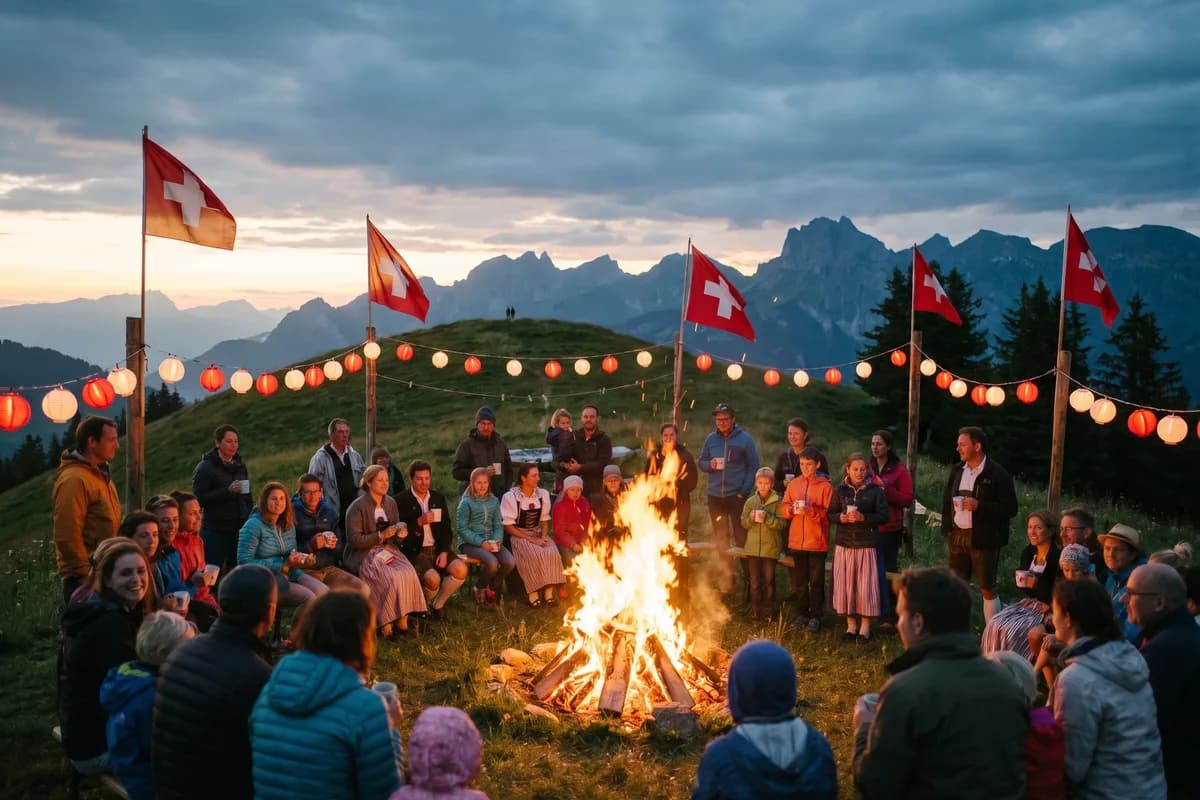
- Bonfires on the hills (Höhenfeuer): As darkness falls, fires are lit on hilltops and mountain ridges across the country. They recall old signal fires and are the most iconic image of the evening.
- Paper lanterns (Lampions and Laternen): Children parade with glowing paper lanterns, often in the colours of their canton or with the Swiss cross.
- Official ceremonies (Bundesfeiern): Towns and villages hold official celebrations with speeches – a member of the local council, a Nationalrat, sometimes a Federal Councillor. The national anthem ("Schweizerpsalm") is usually sung.
- Farm brunch (1.-August-Brunch): Many farms open their doors for a hearty buffet brunch, a tradition run by the Swiss Farmers' Union since the 1990s.
- 1.-August-Weggen: A small bread roll with a little Swiss flag stuck in it, sold in bakeries in the days before.
- Fireworks (Feuerwerk): Private and public fireworks round off the evening – though in dry summers many cantons restrict them for fire-safety reasons.
If the interviewer asks what people do on 1 August, naming bonfires, lanterns, a Bundesfeier with a speech and the farm brunch is a perfect, natural answer.
Other Swiss Traditions and Festivals
The National Day is the most political holiday, but Swiss customs go far beyond it – and a few come up in tests and small talk just as often. A quick tour of Swiss traditions and customs:
- Fasnacht (carnival): The pre-Lenten carnival, with the famous Basler Fasnacht starting at 4 a.m. with the "Morgenstreich", and lively Lucerne and Bernese versions. Masks, lanterns, drums and piccolos.
- Sechseläuten (Zürich): Zurich's spring festival in April, where the "Böögg" – a snowman figure stuffed with fireworks – is burned. The faster his head explodes, the better the summer is said to be.
- Alpabzug and Älplerchilbi: In autumn, decorated cattle are led down from the alpine pastures (Alpabzug / Désalpe), often followed by a village festival of thanks, the Älplerchilbi.
- Yodelling, alphorn and Schwingen: Yodelling and the long wooden alphorn are signature Swiss folk traditions, while Schwingen – Swiss wrestling in sawdust rings – is a national sport with its own huge festival every few years.
You don't need every detail. Being able to say what Fasnacht, Sechseläuten and an Alpabzug are – and that yodelling, the alphorn and Schwingen are traditional Swiss culture – is more than enough, and it shows genuine interest in the country.
In the Naturalisation Interview: Know Your Local Customs
Many municipalities and cantons invite applicants to a personal naturalisation interview. It is not a trick exam – it is a conversation to see whether you live here as part of the community. Local customs are one of the easiest and friendliest topics to come up.
A few things really help:
- Know the festivals of your own municipality. Does your village hold a Fasnacht, an autumn fair (Chilbi), a wine festival, an Alpabzug? Where does the 1 August celebration take place – on the village square, by the lake, up on a hill? Being able to name the local version of a tradition makes a strong impression.
- Connect a tradition to your own life. "Last year we went to the farm brunch in our village, and we watch the bonfire from the hill above us" is worth more than a textbook definition. It shows you actually take part.
- Don't panic about gaps. Nobody expects you to know every regional custom in Switzerland. Honesty plus curiosity beats memorised lists.
If you want a structured way to rehearse this kind of question, work through realistic prompts with the interview preparation guide and try the mock interview practice before your appointment.
Learn More About Culture and Values
Customs and festivals are only one slice of what the citizenship test and the interview cover. The same topics keep returning: the political system and direct democracy, the four national languages, geography and the cantons, history – and, yes, holidays like 1 August. The good news is that these facts stick quickly once you practise them in context rather than just reading them.
A simple plan that works:
- Start with the basics – the four languages, the 26 cantons, the Federal Council and how votes and initiatives work.
- Add the cultural layer – national holiday, traditions, festivals, and the customs specific to your own canton.
- Test yourself – short quizzes beat passive reading. Use flashcards for facts and figures, then sit a full mock exam to find your weak spots.
Want to go deeper than the August Bedeutung and a handful of customs? Our practice app turns the whole syllabus into bite-sized questions in German, French, Italian and English, so you build real confidence – not just memorised trivia. Create a free account to start, or see what the full version unlocks on the pricing page.
Test Your Knowledge
Try 5 free questions