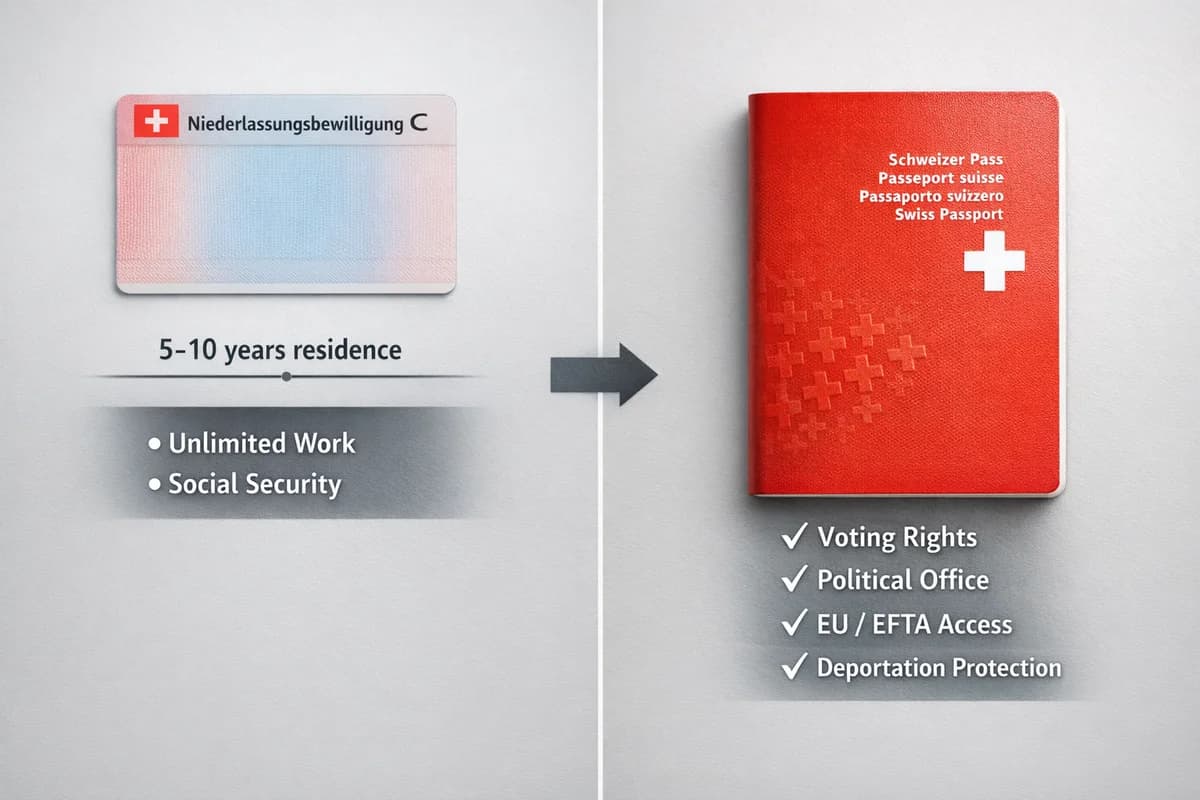
What Is the C Permit
The C permit (Niederlassungsbewilligung) is Switzerland's permanent residence permit. Unlike the B permit, which is tied to a specific job and must be renewed annually, the C permit grants you the right to live and work in Switzerland indefinitely. It's the most secure immigration status you can have as a foreign national.
More importantly for this discussion, the C permit is a mandatory prerequisite for ordinary naturalization. You generally cannot apply for Swiss citizenship through the ordinary route unless you have held a C permit for a certain period. The B permit doesn't count — you need that C.
The C permit comes with rights that the B permit lacks: you're no longer tied to a specific employer, you can switch jobs freely, and in many cantons, you have easier access to property ownership. It also represents a higher level of integration — the assumption is that if you've been in Switzerland long enough to get a C permit, you're established here.
About 1.8 million foreign nationals live in Switzerland, and roughly 600,000 hold C permits. It's a significant milestone on the path from newcomer to citizen. Many people who eventually naturalize spend years on a B permit before making the jump to C.
If you're currently on a B permit, understanding the C permit requirements is essential. It's not just about immigration status — it's about unlocking the door to citizenship.
How to Get a C Permit
The requirements for a C permit vary depending on where you're from. Switzerland distinguishes between EU/EFTA citizens and third-country nationals.
If you're from an EU or EFTA country: you can generally apply for a C permit after 5 years of continuous residence in Switzerland. You need to show that you're integrated — you've been working or studying, you speak the local language, you're not dependent on social benefits, and you have no criminal record. The migration office will review your file, and if everything is in order, you'll receive your C permit. No complicated approval process — it's largely automatic if you meet the criteria.
If you're from a third country (non-EU/EFTA): the bar is higher. You typically need 10 years of continuous residence before you can apply for a C permit. You must have held a B permit during that time. Like EU citizens, you need to demonstrate integration: language skills, employment, financial independence, clean criminal record. Third-country nationals may also face quotas and additional requirements depending on bilateral agreements.
There's also the "early C permit" option for well-integrated persons. If you've been in Switzerland for 5 years and can demonstrate excellent integration (B1 language skills, steady employment, no social aid), you may qualify for a C permit even as a third-country national. This is discretionary and not guaranteed.
The application itself is made through your cantonal migration office. You'll need to provide proof of residence, employment history, tax returns, and a clean criminal record. Processing times range from a few months to up to a year, depending on the canton.
From C Permit to Citizenship Application
Once you have your C permit, you've cleared one major hurdle. But the C permit doesn't automatically lead to citizenship — you still need to meet additional requirements and go through the application process.
The residency requirement for ordinary naturalization is 10 years total in Switzerland, with the last 3 years immediately preceding your application spent with a C permit. This means you can have 7 years on a B permit and 3 years on a C permit, and you meet the residency criteria. Time on an L permit generally doesn't count toward the 10-year total, with some exceptions.
Having a C permit demonstrates one aspect of integration, but naturalization requires more. You'll need to show:
Language skills at B1 spoken and A2 written — higher than the C permit requirement (A2 spoken, A1 written). Many people with C permits discover they need to level up their language skills before applying for citizenship.
Integration into Swiss society — participation in local life, respect for Swiss laws and values, and no threat to security. This is assessed through your naturalization file and the interview.
Knowledge of Switzerland — you'll need to pass the citizenship test (Einbürgerungstest) covering politics, history, geography, and daily life. This is separate from any language test you may have taken for the C permit.
Financial stability — no debt collection proceedings (Betreibungen) and no reliance on social assistance. Your tax returns will be reviewed.
The good news: if you've had a C permit for 3 years, you're likely well-integrated and already meet many of these requirements. The main work is often upgrading language skills and studying for the citizenship test.
Early C Permit for the Well-Integrated
Switzerland offers a path to a C permit after just 5 years for people who demonstrate exceptional integration. This can accelerate your journey toward citizenship.
The early C permit (frühe Niederlassungsbewilligung) is available to both EU/EFTA citizens and third-country nationals who have lived in Switzerland for 5 years and can show:
B1 level in the local language (spoken) — one level higher than the standard C permit language requirement. This demonstrates strong communication skills and real integration.
Steady employment or self-employment for at least 3 years. You're financially independent and not relying on social assistance.
No criminal record and good conduct. You respect Swiss laws and values.
Proof of integration through participation in local life — club memberships, volunteer work, children in local schools, community involvement.
The early C permit is discretionary. The migration office will review your entire file and decide whether your integration is truly exceptional. Not everyone who applies receives it. But if you do, it's a significant advantage — you reach the C permit 5 years earlier than the standard 10-year timeline for third-country nationals.
For citizenship purposes, an early C permit counts exactly the same as a regular C permit. Once you have it, the 3-year waiting period before you can apply for citizenship begins. This means a well-integrated third-country national could theoretically be on a path to citizenship after just 8 years in Switzerland (5 years to early C permit + 3 years with C permit), instead of the standard 13 years (10 years to regular C permit + 3 years with C permit).
If you think you might qualify, it's worth applying. The fee is typically a few hundred francs, and the worst outcome is a refusal — you'll just continue on your normal timeline toward a regular C permit.
Language Gap Between C Permit and Citizenship
One of the most common surprises for C permit holders is that their existing language certificate isn't enough for citizenship. The requirements are different.
For the C permit, you need A2 spoken and A1 written in the local language. For citizenship, you need B1 spoken and A2 written. That's one full level higher for speaking. Many people obtain their C permit with an A2 certificate, only to discover years later that they need to take another language test to reach the citizenship requirement.
This gap is intentional. Citizenship demands a higher level of integration than permanent residence. B1 spoken means you can participate confidently in conversations about politics, community issues, and civic life — not just manage everyday interactions.
If you're planning ahead: when you take your language test for the C permit, consider aiming for B1 right away. Many language centers offer B1 tests. If you can pass B1 when you apply for your C permit, you'll already meet the citizenship language requirement and won't need to test again later.
The gap between A1 and A2 written is smaller, but still significant. A1 is basic literacy — filling out forms, reading simple signs. A2 means you can read letters from authorities, understand basic news articles, and write coherent messages. This is the level you'll actually use as a Swiss citizen.
If you already have a C permit and an A2/A1 certificate, plan to level up to B1/A2 before starting your citizenship application. Language courses for B1 are widely available, and you can often continue studying at the same school where you prepared for your C permit test. You'll likely need 3 to 6 months of focused study to bridge the gap from A2 to B1.
Start Preparing While You Wait
The timeline from first arriving in Switzerland to receiving citizenship is long — typically 10 to 13 years for third-country nationals, 5 to 8 years for EU citizens. That's a lot of waiting. But you can make that time productive.
If you're still on a B permit or waiting for your C permit: start studying for the citizenship test now. The test covers Swiss politics, history, geography, and daily life. You don't need to wait until you have your C permit to start learning. By the time you're eligible to apply, you'll have been studying for years and will be well-prepared.
If you already have your C permit and are waiting out the 3-year period before applying: this is the perfect time to level up your language skills from A2/A1 to B1/A2. You can also dive deep into Swiss knowledge — read newspapers, follow Swiss politics, visit museums, participate in local events. The more integrated you are, the smoother your naturalization will go.
To practice for the citizenship test, you can use einbuergerungstests.ch to take practice quizzes covering all the topics you'll encounter. The platform tracks your progress and helps you identify weak areas. There's also a dedicated iOS app for studying on the go.
Don't view the waiting period as dead time. It's an opportunity to prepare. The C permit is the gateway to citizenship — use that time to walk through it prepared, not scrambling at the last minute to learn what you should have studied years earlier.
The Swiss passport is waiting at the end of the road. Start walking toward it today.