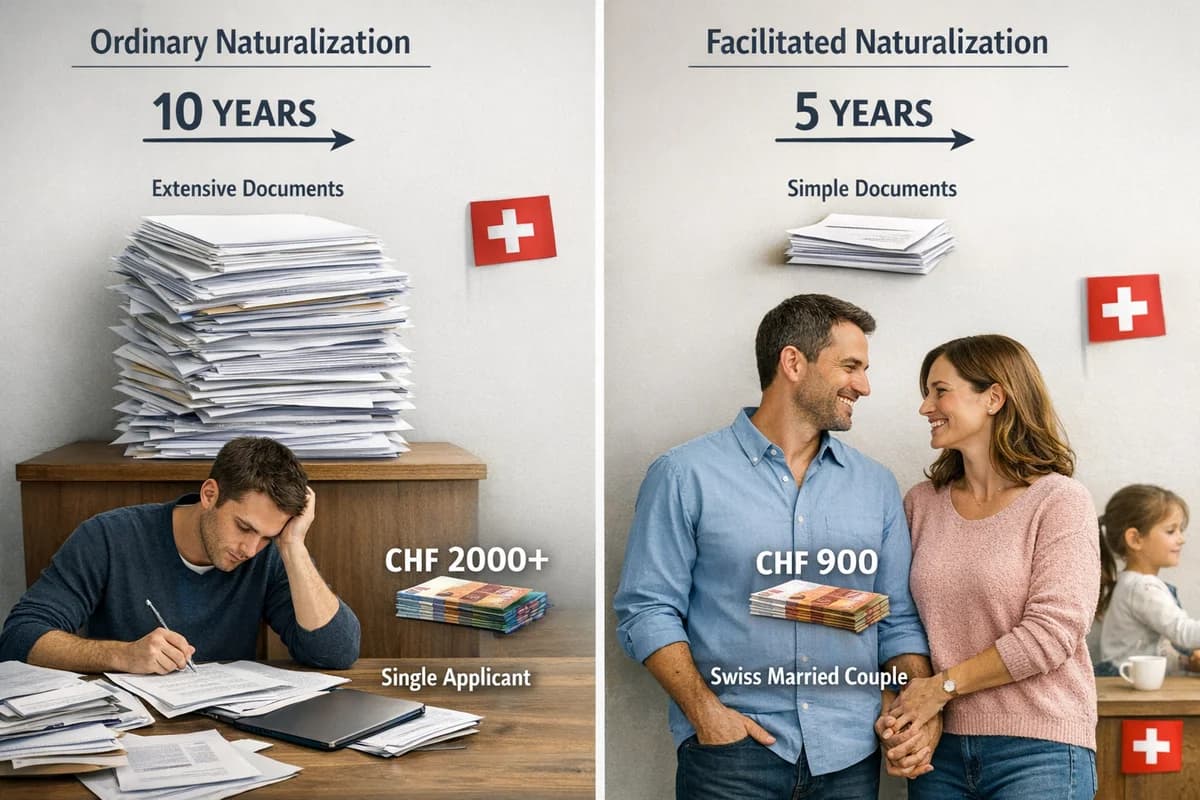
Two Paths to Swiss Citizenship
Switzerland offers two distinct naturalization paths: ordinary naturalization (ordentliche Einbürgerung) and facilitated naturalization (erleichterte Einbürgerung). The key difference lies in your personal situation – specifically, your family connections to Swiss citizens.
Ordinary naturalization is the standard path for anyone who doesn't qualify for facilitated. It involves a three-level approval process (municipality, canton, federation) and typically takes 2-4 years.
Facilitated naturalization is an accelerated, simplified process available only to specific groups:
- Spouses of Swiss citizens (after 3 years of marriage and 5 years total residence in Switzerland)
- Children of Swiss citizens (when born abroad, if their parent acquired Swiss citizenship through facilitated naturalization or the child lost Swiss citizenship due to marriage rules)
- Third-generation immigrants (born in Switzerland, grandparents lived here, completed compulsory schooling)
This guide breaks down every aspect of both paths so you can understand which applies to you, what to expect, and how to prepare.
Who Qualifies for Each Path?
Ordinary Naturalization Requirements:
You qualify for ordinary naturalization if you:
- Have lived in Switzerland for at least 10 years (years between age 8-18 count double)
- Have lived in the same municipality for at least 2-3 years (varies by canton)
- Hold a C residence permit (or B permit with additional conditions in some cantons)
- Demonstrate successful integration – no welfare dependencies, no serious criminal record, respect for Swiss laws and values
- Meet language requirements – minimum B1 (speaking/listening) and A2 (reading/writing) in a Swiss national language
- Pass the naturalization test (Einbürgerungstest) covering Swiss and cantonal knowledge
Special cases:
- Stateless persons and recognized refugees need only 5 years of residence
- Children under 12 years follow their parents' application
- Second-generation immigrants (born in Switzerland) need only 5 years of residence
Facilitated Naturalization Requirements:
Spouses of Swiss citizens:
- Must have been married for at least 3 years
- Must have lived in Switzerland for at least 5 years total (including 3 years of marriage period)
- Must be well integrated – no welfare dependency, no serious criminal offenses
- Must demonstrate language proficiency – minimum B1 orally, A2 in writing (stricter than ordinary)
- No naturalization test required, but you may have an interview to assess integration
Children under 18:
- Must have lived in Switzerland for at least 5 years
- Must be well integrated
- Must demonstrate language proficiency appropriate for age
- Application made by the Swiss parent
- No naturalization test required
Third-Generation Immigrants:
- Must be born in Switzerland
- Must have completed compulsory schooling in Switzerland (minimum 5 years)
- At least one grandparent must have been born in Switzerland or have resided here legally
- Must hold a C residence permit
- Must demonstrate successful integration
- Must meet language requirements (B1 oral, A2 written)
- No naturalization test required, but must demonstrate basic knowledge of Switzerland
How the Processes Differ
Ordinary Naturalization Process (3-Level Approval):
The ordinary naturalization process involves three separate approval levels, each with the power to reject your application:
Level 1: Municipality (Gemeinde) – 3-12 months
- Submit application to your local municipality
- Municipality reviews your documents, conducts background check
- You may be invited to an interview or naturalization test
- Municipal council votes on your application
- If approved, application forwarded to canton
Level 2: Canton (Kanton) – 6-18 months
- Cantonal migration office reviews municipal decision
- May request additional documents or information
- Cantonal government makes final decision
- If approved, application forwarded to federal level
Level 3: Confederation (Bund) – 3-6 months
- State Secretariat for Migration (SEM) reviews complete file
- Verifies all federal requirements are met
- Federal decision issued
Timeline: 2-4 years total (most cases 2-3 years)
Facilitated Naturalization Process (Federal-Only Approval):
The facilitated process is much simpler – it bypasses municipal and cantonal approval:
For spouses and children:
- Application submitted directly to the State Secretariat for Migration (SEM)
- SEM verifies eligibility (marriage duration, residence years, integration)
- SEM conducts interview to assess integration and language skills
- No municipal or cantonal approval needed
- Federal decision issued directly
Timeline: 12-18 months total
For third-generation immigrants:
- Application submitted to cantonal migration office
- Canton verifies eligibility (birth in Switzerland, schooling, grandparent residence)
- Canton conducts language assessment
- Canton forwards to SEM for final federal approval
- Federal decision issued
Timeline: 18-24 months total
Cost Comparison: Which Is More Affordable?
Ordinary Naturalization Costs:
The total cost varies significantly by municipality and canton, but expect to pay:
Federal Fee: CHF 100-200 (per person)
Cantonal Fees: CHF 200-2,000 (varies widely)
- Some cantons charge CHF 200-500
- Others charge CHF 800-1,500
- A few cantons still charge up to CHF 2,000-3,000 (though this is being phased out)
- Note: Many cantons are reducing fees for 2026, especially for applicants under 25
Municipal Fees: CHF 200-2,400 (varies by commune)
- Small municipalities: CHF 200-500
- Medium municipalities: CHF 500-1,000
- Large cities: CHF 800-2,400
Additional Costs:
- Language exam (if you don't have a certificate): CHF 300-600
- Naturalization test preparation course: CHF 200-500 (optional)
- Translation of documents: CHF 50-200 per document
- Legal consultation (if needed): CHF 1,000-3,000
Total Estimated Range: CHF 800-5,000 (most people pay CHF 1,500-3,000)
Facilitated Naturalization Costs:
Federal Fee: CHF 900 (fixed fee for facilitated naturalization)
No Cantonal or Municipal Fees: Since the process bypasses local approval, you don't pay cantonal or municipal fees
Additional Costs:
- Language exam (if required): CHF 300-600
- Translation of documents: CHF 50-200 per document
- Legal consultation (if needed): CHF 1,000-3,000
Total Estimated Range: CHF 1,200-3,000 (most people pay CHF 900-1,500)
Cost Comparison Summary:
- Facilitated is generally cheaper – you avoid municipal and cantonal fees
- Fixed federal fee of CHF 900 vs variable fees in ordinary process
- However – facilitated naturalization has stricter language requirements that may mean additional language training costs
- Third-generation immigrants pay similar to facilitated (CHF 900 + potential cantonal fees)
Test Requirements: What Must You Prove?
Ordinary Naturalization: Written Test Required
Most applicants for ordinary naturalization must pass the Einbürgerungstest (naturalization test):
What's on the test:
- Swiss federal system (politics, history, geography)
- Canton-specific knowledge (your canton's government, history, notable features)
- Rights and obligations of Swiss citizenship
- Public holidays, school system, insurance system
Format:
- Most cantons use written computer-based tests (60-90 minutes)
- Some cantons use oral interviews instead
- 40-60 questions (multiple choice and/or written answers)
- Must achieve passing score (usually 60-70% or higher)
Exemptions:
- 5+ years of Swiss compulsory schooling (with 3 at secondary level)
- Swiss upper-secondary diploma (Matura, apprenticeship certificate, etc.)
- Age under 12 (follows parent's application)
Facilitated Naturalization: No Written Test (But May Have Interview)
Spouses of Swiss citizens:
- No written test required
- However, SEM conducts an interview to assess integration
- Interview covers:
- Your motivation for becoming Swiss
- Knowledge of Swiss system (basic level)
- Integration into Swiss society
- Family situation and connection to Switzerland
- Language assessment is stricter: B1 oral, A2 written (same as ordinary; enforcement is often stricter)
Children under 18:
- No test required
- Language assessment appropriate for age
- Integration assessed through school records and behavior
Third-Generation Immigrants:
- No written test required
- Must demonstrate basic knowledge of Switzerland through interview or written statement
- Topics include:
- Basic understanding of Swiss political system
- Knowledge of your canton and commune
- Rights and obligations of Swiss citizenship
- Language assessment: B1 oral, A2 written (same as facilitated spouse route)
Language Requirements: How Proficient Must You Be?
Language Levels Explained:
Switzerland uses the Common European Framework of Reference for Languages (CEFR):
- A2: Elementary – Can understand sentences and frequently used expressions
- B1: Intermediate – Can deal with most situations likely to arise while traveling
Ordinary Naturalization Language Requirements:
Minimum Requirements:
- Speaking and Listening: B1 level
- Reading and Writing: A2 level
What This Means in Practice:
- Can understand main points of clear standard input on familiar matters
- Can handle most situations while traveling in the language region
- Can produce simple connected text on topics that are familiar or of personal interest
- Can describe experiences, events, dreams, hopes, and ambitions
Accepted Proof:
- Language certificate from recognized institution (Goethe-Institut, Alliance Française, etc.)
- Swiss school diploma (minimum 3 years secondary level)
- University degree in the language
- Some cantons may accept interviews or internal assessments
Facilitated Naturalization Language Requirements:
For Spouses of Swiss Citizens:
- Speaking and Listening: B1 level (same as ordinary)
- Reading and Writing: A2 level (same as ordinary)
- However, enforcement is often stricter – you must demonstrate proficiency through an interview or test
For Third-Generation Immigrants:
- Speaking and Listening: B1 level
- Reading and Writing: A2 level
- Proof of completion of Swiss compulsory schooling often accepted
For Children:
- Age-appropriate language skills
- Assessed through school reports and integration records
Cost of Language Certification:
- Language exams: CHF 300-600 per attempt
- Language courses: CHF 1,500-3,000 for full course to reach B1
Which Path Applies to You?
Decision Guide:
You qualify for facilitated naturalization if:
- You're married to a Swiss citizen:
- Check: Have you been married for at least 3 years?
- Check: Have you lived in Switzerland for at least 5 years total (including 3 years during marriage)?
- → If YES to both: You qualify for facilitated naturalization
- You're a child of a Swiss citizen (under 18):
- Check: Have you lived in Switzerland for at least 5 years?
- Check: Is one of your parents Swiss?
- → If YES to both: Your parent can apply for facilitated naturalization on your behalf
- You're a third-generation immigrant:
- Check: Were you born in Switzerland?
- Check: Did you complete compulsory schooling here (minimum 5 years)?
- Check: Did at least one grandparent live in Switzerland or was born here?
- → If YES to all: You qualify for facilitated naturalization
You must use ordinary naturalization if:
- You don't meet any of the facilitated criteria above
- You're divorced from a Swiss spouse (unless you meet third-generation criteria)
- You're in a registered partnership (not marriage) with a Swiss citizen
- You've lived in Switzerland for 10+ years but don't have Swiss family connections
Can You Switch Between Paths?
From facilitated to ordinary: Generally no – if you don't qualify for facilitated, you must use ordinary. However, if your facilitated application is rejected, you can later apply for ordinary naturalization.
From ordinary to facilitated: In some cases:
- If you marry a Swiss citizen while your ordinary application is pending, you may be able to switch to facilitated
- However, this requires withdrawing your ordinary application and starting over
- Consult SEM or a legal expert before making this decision
Test Your Knowledge
Try 5 free questionsFinal Steps: How to Move Forward
Step 1: Confirm Your Eligibility
Use this guide to determine which path applies to you:
- Married to Swiss citizen? → Check marriage duration and residence years
- Child of Swiss citizen? → Check your age and residence years
- Third-generation immigrant? → Check birth location, schooling, and grandparent history
- None of the above? → You'll use ordinary naturalization
Step 2: Start Language Preparation
Both paths require language proficiency:
- Start early – it can take 6-12 months to reach B1 level from scratch
- Take a language course or use online learning platforms
- Schedule your official language exam well in advance
- For ordinary naturalization: prepare for the Einbürgerungstest
Step 3: Gather Your Documents
Common documents needed:
- Valid passport or ID
- Residence permit (C permit for ordinary, C or B for facilitated in some cases)
- Marriage certificate (for facilitated spousal route)
- Birth certificates (for children and third-generation)
- Proof of residence (tax returns, rental agreements)
- Language certificates
- Proof of integration (employment records, school records)
Step 4: Submit Your Application
For facilitated naturalization:
- Apply directly to SEM (State Secretariat for Migration)
- Include all supporting documents
- Pay federal fee (CHF 900)
- Wait for interview scheduling
For ordinary naturalization:
- Apply to your local municipality
- Municipality reviews and forwards to canton
- Canton reviews and forwards to federation
- Prepare for naturalization test
Step 5: Prepare While You Wait
Naturalization takes time – use it wisely:
- Practice for the test if ordinary naturalization (our app offers 500+ questions)
- Improve your language skills through daily practice
- Deepen your integration through community involvement
- Stay informed about Swiss current events and civic issues
Practice Anywhere
Download iOS App