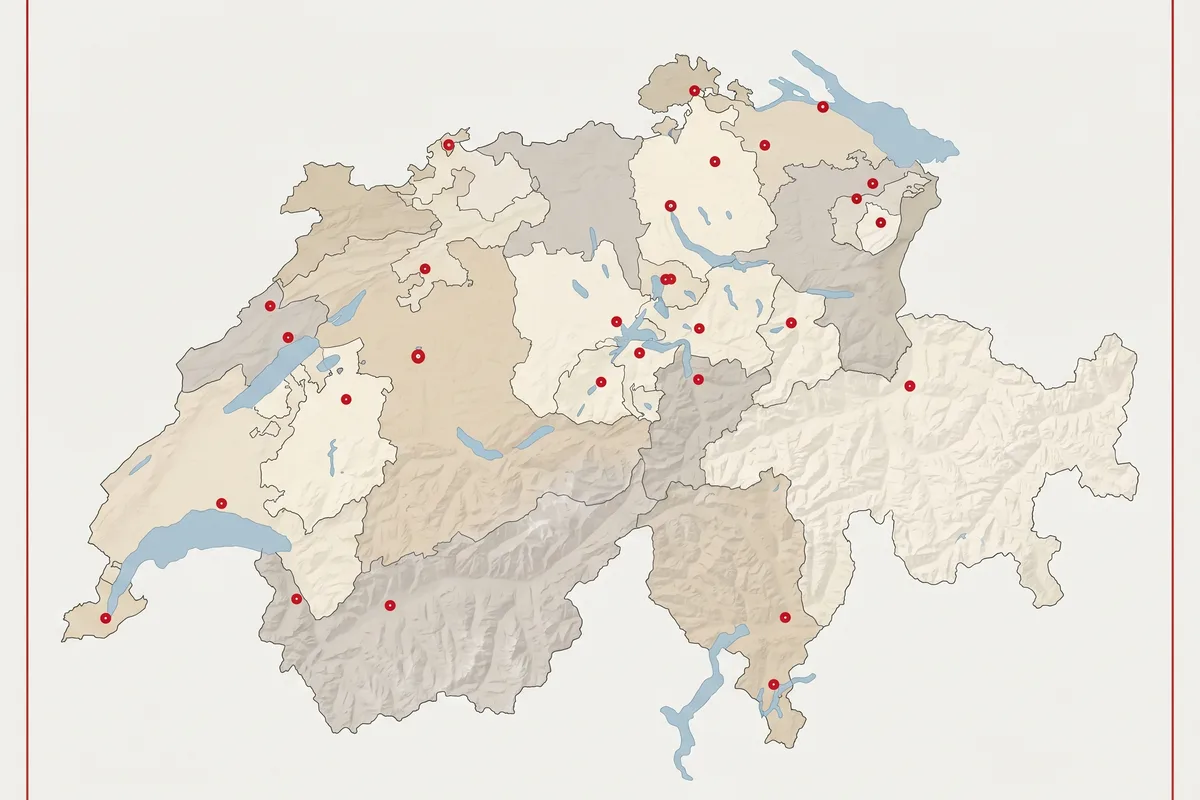
How Many Cantons Does Switzerland Have?
Switzerland has 26 cantons. That's the number you absolutely have to know – it comes up in almost every citizenship test, no matter which canton you apply in.
Here's the detail that trips people up: those 26 are made up of 20 full cantons (Vollkantone) and 6 half-cantons (Halbkantone). The half-cantons exist for historical reasons (we'll get to which ones below). In the Council of States – the chamber that represents the cantons in the federal parliament – a full canton sends 2 members, a half-canton sends 1. And when a national vote needs a "majority of the cantons" (the Ständemehr), a half-canton counts as half a vote. So 23 territories on the map, but officially 26 cantons.
Quick history: the Swiss Confederation began in 1291 with just three cantons and grew over the centuries. The current count of 26 has been stable since 1979, when Jura became the youngest canton. The official term for the whole country in Latin is Confoederatio Helvetica – which is exactly why the country code is CH. You can explore every canton, with its own practice questions, on our cantons overview.
The Complete List of All 26 Cantons
Here is the full reference: every canton with its capital (the Hauptstadt or Kantonshauptort), its two-letter abbreviation, and its main language region. The table is ordered by abbreviation, the way the official Swiss federal lists do it (this order, by the way, follows the cantons' traditional rank of precedence).
- Zürich – Capital: Zürich (ZH), German
- Bern / Berne – Capital: Bern (BE), German (French in the Bernese Jura)
- Luzern – Capital: Luzern (LU), German
- Uri – Capital: Altdorf (UR), German
- Schwyz – Capital: Schwyz (SZ), German
- Obwalden – Capital: Sarnen (OW), German
- Nidwalden – Capital: Stans (NW), German
- Glarus – Capital: Glarus (GL), German
- Zug – Capital: Zug (ZG), German
- Fribourg / Freiburg – Capital: Fribourg (FR), French and German (bilingual)
- Solothurn – Capital: Solothurn (SO), German
- Basel-Stadt – Capital: Basel (BS), German
- Basel-Landschaft – Capital: Liestal (BL), German
- Schaffhausen – Capital: Schaffhausen (SH), German
- Appenzell Ausserrhoden – Capital: Herisau (AR), German
- Appenzell Innerrhoden – Capital: Appenzell (AI), German
- St. Gallen – Capital: St. Gallen (SG), German
- Graubünden / Grigioni – Capital: Chur (GR), German, Romansh and Italian (trilingual)
- Aargau – Capital: Aarau (AG), German
- Thurgau – Capital: Frauenfeld (TG), German
- Ticino / Tessin – Capital: Bellinzona (TI), Italian
- Vaud / Waadt – Capital: Lausanne (VD), French
- Valais / Wallis – Capital: Sion (Sitten) (VS), French and German (bilingual)
- Neuchâtel / Neuenburg – Capital: Neuchâtel (NE), French
- Genève / Genf – Capital: Geneva (Genf) (GE), French
- Jura – Capital: Delémont (Delsberg) (JU), French
A few naming notes worth memorising, because exams love them: the capital of Vaud (Waadt) is Lausanne (not "Vaud"), the capital of Valais (Wallis) is Sion / Sitten, Ticino's capital is Bellinzona (not Lugano!), and Graubünden's capital is Chur. Several cantons appear under different names depending on the language – for example Genève / Genf / Ginevra is all the same canton. Source for the official spellings and abbreviations: the Swiss Federal Administration (admin.ch).
The 6 Half-Cantons Explained
The 6 half-cantons are a classic exam topic. They come in three historical pairs – each pair was once a single canton that split in two:
- Obwalden (OW) and Nidwalden (NW) – together they form the historic region of Unterwalden, one of the three founding cantons of 1291. They have been administratively separate for centuries.
- Basel-Stadt (BS) and Basel-Landschaft (BL) – the city of Basel and the surrounding countryside split in 1833 after internal conflict.
- Appenzell Ausserrhoden (AR) and Appenzell Innerrhoden (AI) – Appenzell divided in 1597 along the lines of the Reformation: Ausserrhoden became Protestant, Innerrhoden remained Catholic.
What does "half" actually mean in practice? Three things:
- Council of States: a half-canton sends only 1 representative instead of 2. So the 6 half-cantons send 6 members, the 20 full cantons send 40 – that's how you get the 46 seats in the Council of States (Ständerat).
- Ständemehr: in mandatory referendums (e.g. changes to the Federal Constitution), the result must be approved by both the people and a majority of the cantons. Here a half-canton counts as half a cantonal vote.
- Apart from that, half-cantons are fully self-governing cantons with their own constitution, government and parliament – they are not "lesser" in everyday life.
A small but important detail (Stand 2026): the Federal Constitution of 1999 no longer uses the word Halbkanton officially; it speaks of cantons "with half a cantonal vote". But in everyday language, schools and most test materials, the term Halbkanton is still completely standard.
When Did the Cantons Join the Confederation?
You don't need to memorise all 26 years – but a few key dates come up again and again, so it pays to know the milestones:
- 1291 – the three founding cantons (Urkantone): Uri, Schwyz and Unterwalden. Their alliance, sealed by the Federal Charter (Bundesbrief) on the Rütli meadow, is the traditional birth of Switzerland. National holiday: 1 August. (Remember: Unterwalden is today the two half-cantons Obwalden and Nidwalden.)
- 14th–15th century: the Confederation grew to eight, then thirteen cantons – including Luzern (1332), Zürich (1351), Glarus and Zug (1352), and Bern (1353).
- 1803: with Napoleon's Act of Mediation, six new cantons joined: St. Gallen, Graubünden, Aargau, Thurgau, Ticino and Vaud.
- 1815: after the Congress of Vienna, the last three of the "old" cantons joined: Valais, Neuchâtel and Geneva. This brought the total to 25.
- 1979 – the youngest canton: Jura. It split from the canton of Bern after a long autonomy movement and a popular vote, bringing the total to today's 26.
The one combination examiners love most: 1291 + the three Urkantone (Uri, Schwyz, Unterwalden) + the national holiday on 1 August. If you know just that block cold, you've covered the most frequently tested history question. For the full historical context, see the official portal of the Swiss authorities, ch.ch.
Tips and Mnemonics to Memorise Them
Twenty-six cantons sounds like a lot, but with a bit of structure it sticks fast. Here's what works:
1. Group them, don't list them. Your brain hates flat lists of 26. Break it into chunks:
- The 3 Urkantone: Uri, Schwyz, Unterwalden (→ OW + NW).
- The 3 half-canton pairs: OW/NW, BS/BL, AR/AI.
- The 4 French-speaking cantons (Genève, Vaud, Neuchâtel, Jura) plus the bilingual ones (Fribourg, Valais, Bern) and the one Italian canton (Ticino). Romansh lives mainly in Graubünden.
2. Spot the "same name" shortcut. For many cantons, the capital has the same name as the canton: Zürich→Zürich, Bern→Bern, Luzern→Luzern, Zug→Zug, Glarus→Glarus, Schaffhausen→Schaffhausen, Solothurn→Solothurn, Basel→Basel, St. Gallen→St. Gallen, Genf→Genf, Schwyz→Schwyz, Fribourg→Fribourg. That's a dozen capitals you already know for free. So you only have to really learn the ones that differ: Uri→Altdorf, Obwalden→Sarnen, Nidwalden→Stans, Basel-Landschaft→Liestal, Appenzell Ausserrhoden→Herisau, St. Gallen aside, Graubünden→Chur, Aargau→Aarau, Thurgau→Frauenfeld, Ticino→Bellinzona, Vaud→Lausanne, Valais→Sion, Jura→Delémont.
3. Build silly mnemonics for the tricky ones. A few examples in German that learners use: «Uri? Da gehst du nach Altdorf – wo Wilhelm Tell den Apfel schoss.» Or for Ticino: «Tessin regiert man von Bellinzona aus, den drei Burgen.» The sillier and more visual, the better it sticks.
4. Learn by repetition, not by re-reading. Re-reading a list feels productive but barely works. Active recall – testing yourself until you get it right – is far more effective. That's exactly what spaced-repetition flashcards are built for: they show you a canton, you recall the capital, and the system brings back the ones you keep missing.
5. Anchor the abbreviations to the car plates. Every Swiss car number plate starts with the canton's 2-letter code (ZH, BE, TI…). Once you start noticing them in traffic, the abbreviations become second nature.
Why Cantons and Capitals Come Up in the Citizenship Test
Switzerland is a federal state (Bundesstaat), and the cantons are the heart of it. They are not just administrative districts: each canton has its own constitution, its own parliament and government, its own courts, schools and police. Federalism is one of the country's founding principles, so understanding the cantons means understanding how Switzerland actually works – which is exactly what the citizenship test wants to check.
That's why questions about cantons, capitals, abbreviations and language regions appear in almost every cantonal naturalisation test (and in the Grundkenntnistest in cantons like Zurich). Typical questions you can expect:
- How many cantons does Switzerland have? → 26 (20 full + 6 half).
- What is the capital of canton X? → e.g. Ticino → Bellinzona.
- Which were the three founding cantons in 1291? → Uri, Schwyz, Unterwalden.
- In which language region is canton X? → e.g. Genève → French.
- Which is the youngest canton? → Jura (1979).
Beyond the test, this is genuinely useful knowledge for living in Switzerland: you'll deal with your canton for taxes, your residence permit, health-insurance rules and your children's schooling. The naturalisation procedure itself runs through three levels – municipality, canton and the federal State Secretariat for Migration (SEM, sem.admin.ch) – so it makes sense that they expect you to know the cantonal map. If you want to see how the requirements differ from canton to canton, our canton comparison lays it out side by side.
The best way to lock all of this in is to practise with real test questions until the answers come automatically. Set yourself a mock exam, drill the canton facts with flashcards, and repeat until you score consistently. When you're ready, you can unlock full access on the pricing page – one-time, lifetime, no subscription.
Test Your Knowledge
Try 5 free questions